
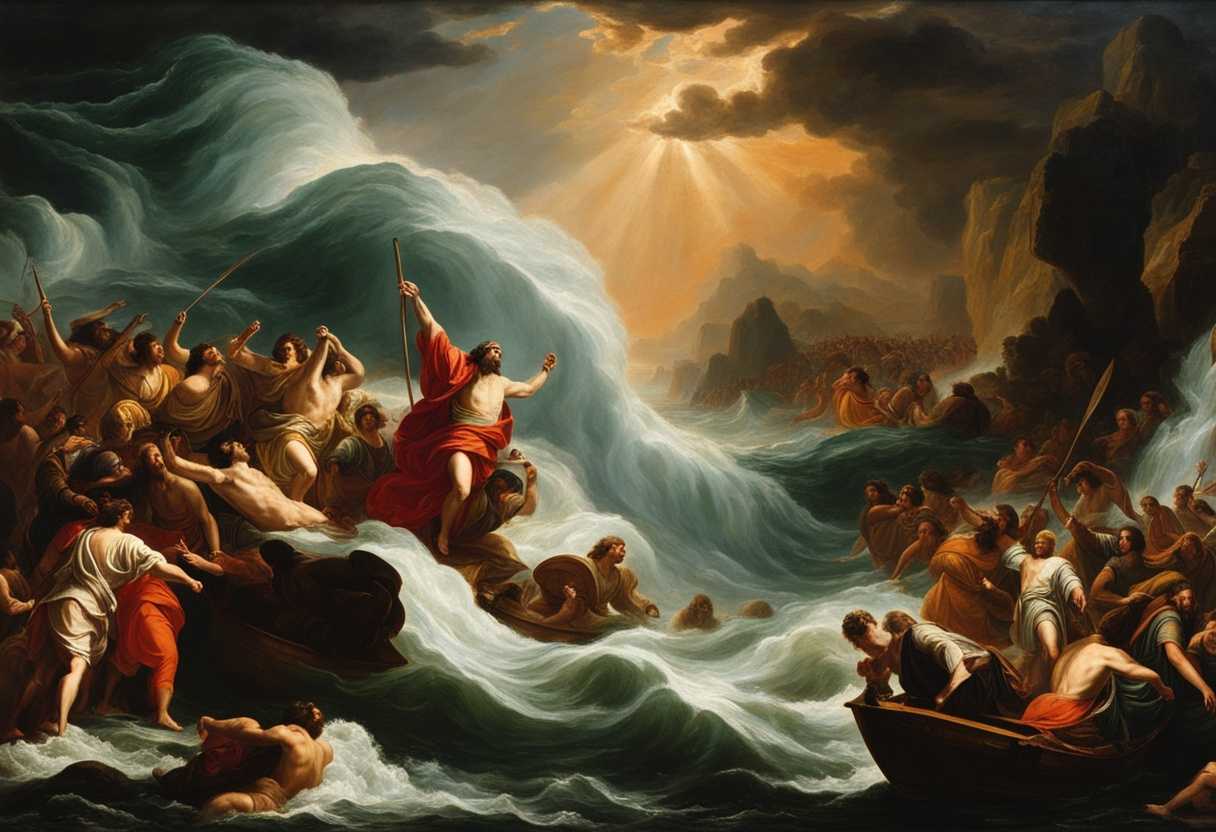
The parting of the waters refers primarily to the miraculous event during the Exodus when God, through Moses, divided the Red Sea, allowing the Israelites to escape from Egypt (Exodus 14:21-22). This act symbolizes God’s power to deliver His people and His faithfulness in fulfilling His promises.
Scripture
21 Then Moses stretched out his hand over the sea, and the Lord drove the sea back by a strong east wind all night and made the sea dry land, and the waters were divided.
22 And the people of Israel went into the midst of the sea on dry ground, the waters being a wall to them on their right hand and on their left.
23 The Egyptians pursued and went in after them into the midst of the sea, all Pharaoh’s horses, his chariots, and his horsemen.
24 And in the morning watch the Lord in the pillar of fire and of cloud looked down on the Egyptian forces and threw the Egyptian forces into a panic,
25 He clogged their chariot wheels so that they drove heavily. And the Egyptians said, “Let us flee from before Israel, for the Lord fights for them against the Egyptians.”
26 Then the Lord said to Moses, “Stretch out your hand over the sea, that the water may come back upon the Egyptians, upon their chariots, and upon their horsemen.”
27 So Moses stretched out his hand over the sea, and the sea returned to its normal course when the morning appeared.
28 The waters returned and covered the chariots and the horsemen; of all the host of Pharaoh that had followed them into the sea, not one of them remained.
29 But the people of Israel walked on dry ground through the sea, the waters being a wall to them on their right hand and on their left.
30 Thus the Lord saved Israel that day from the hand of the Egyptians, and Israel saw the Egyptians dead on the seashore.
31 Israel saw the great power that the Lord used against the Egyptians, so the people feared the Lord, and they believed in the Lord and in his servant Moses.
Parting of the Waters in the Bible
The parting of the waters, particularly in the context of Exodus 14:21-22, serves as a profound illustration of God’s sovereignty and His commitment to the liberation of His people. This miraculous event not only showcases divine intervention in the face of overwhelming odds but also emphasizes the theme of faith. The Israelites, trapped between the pursuing Egyptian army and the daunting waters, were called to trust in God’s promise of deliverance. By splitting the Red Sea, God not only provided a literal pathway to freedom but also reinforced the idea that faith often precedes salvation; as stated in Hebrews 11:29, “By faith the people crossed the Red Sea as on dry land; but when the Egyptians tried to do so, they were drowned.”
Moreover, the parting of the waters encapsulates a broader theological narrative in the Bible regarding God’s redemptive plan. Often interpreted as a foreshadowing of baptism, the crossing of the Red Sea symbolizes spiritual rebirth and freedom from sin, paralleling New Testament themes of salvation and renewal, as seen in Romans 6:3-4, where Paul speaks of being buried with Christ in baptism and raised to new life. This incident, therefore, serves as a pivotal moment not only in Israel’s history but also in the overarching story of salvation, where God continues to part the metaphorical waters of sin and despair, inviting believers to walk into the new life offered through Christ. Ultimately, the parting of the waters represents both a historical event and a lasting message of hope, deliverance, and the faithfulness of God throughout generations.
Beyond its immediate context in Exodus, the theme of God parting the waters resonates throughout Scripture, highlighting divine intervention in times of great need. In Joshua 3, the crossing of the Jordan River exemplifies this motif, marking a significant transition for the Israelites as they enter the promised land. Just as in the Red Sea account, the waters are miraculously halted, allowing the people to cross on dry ground. This event echoes the earlier miracle, reinforcing God’s presence and guidance in Israel’s journey and emphasizing the importance of obedience and consecration to the Lord. Here, the parting of the waters acts as a symbol of trust in God’s promises, reiterating that He is the ultimate deliverer and a source of hope.
Moreover, the imagery of parted waters appears in prophetic literature, such as in Isaiah 43:16-17, where God declares His powerful ability to open pathways in chaotic situations. This passage not only recalls the historical exodus from Egypt but also assures the people of God’s continuous support in their future struggles. In this context, the parting of waters transcends its historical narrative and becomes a metaphor for God’s ability to create safe passage amid life’s turbulent moments. The theme extends into the New Testament, as seen in instances of Jesus calming the stormy seas, symbolizing divine authority over nature and showcasing His role as the ultimate Savior who brings peace in the chaos of life. Thus, the motif of parted waters serves as a consistent reminder of God’s sovereignty, faithfulness, and the call for believers to trust in His guiding presence as they navigate life’s challenges.
Divine Intervention and Deliverance
The parting of the waters symbolizes God’s direct intervention in human affairs, showcasing His power to deliver His people from seemingly insurmountable obstacles. This act serves as a reminder that faith in divine providence can lead to miraculous outcomes, reinforcing the belief that God is actively involved in the lives of those who trust in Him. It illustrates the theme of liberation, where the faithful are guided through trials and tribulations toward freedom and safety.
Symbol of New Beginnings
The act of parting the waters also represents the concept of new beginnings and transformation. As the waters are divided, it creates a pathway for the people to move forward into a new life, free from the bondage of their past. This imagery resonates with the idea of baptism and spiritual rebirth, where individuals emerge from the waters renewed and cleansed, ready to embrace a new identity and purpose in their journey of faith.
Faith and Obedience
The parting of the waters underscores the importance of faith and obedience in the face of adversity. The act itself requires trust in God’s promises and the willingness to step into the unknown. This theme encourages believers to act on their faith, even when circumstances appear daunting. It serves as a powerful lesson that obedience to divine guidance can lead to extraordinary outcomes, reinforcing the belief that faith can move mountains and open paths where none seem to exist.
How to Seek Divine Guidance for Christian Growth
Seeking divine guidance is a deeply personal journey that can transform your Christian growth in profound ways. Start by cultivating a habit of prayer, where you not only speak to God but also listen for His voice; this two-way communication is essential. Immerse yourself in Scripture, allowing the Word to illuminate your path and provide wisdom for your daily decisions. Surround yourself with a community of believers who can offer support, encouragement, and accountability—remember, we are called to bear one another’s burdens. Additionally, consider fasting or setting aside time for reflection, as these practices can help clear your mind and open your heart to God’s leading. Trust that He is always present, guiding you through the Holy Spirit, and be open to the unexpected ways He may direct your steps. Embrace this journey with patience and faith, knowing that growth often comes through both the joys and challenges of life.
Bible References to Parting of Waters:
Joshua 3:14-17: 14 So when the people set out from their tents to pass over the Jordan with the priests bearing the ark of the covenant before the people,
15 and as soon as those bearing the ark had come as far as the Jordan, and the feet of the priests bearing the ark were dipped in the brink of the water (now the Jordan overflows all its banks throughout the time of harvest),
16 the waters coming down from above stood and rose up in a heap very far away, at Adam, the city that is beside Zarethan, and those flowing down toward the Sea of the Arabah, the Salt Sea, were completely cut off. And the people passed over opposite Jericho.
17 And the priests who bore the ark of the covenant of the Lord stood firmly on dry ground in the midst of the Jordan, and all Israel was passing over on dry ground until all the nation finished passing over the Jordan.
2 Kings 2:8-14: 8 Then Elijah took his cloak and rolled it up and struck the water, and the water was parted to the one side and to the other, till the two of them could go over on dry ground.
9 When they had crossed, Elijah said to Elisha, “Ask what I shall do for you, before I am taken from you.” And Elisha said, “Please let there be a double portion of your spirit on me.”
10 And he said, “You have asked a hard thing; yet, if you see me as I am being taken from you, it shall be so for you, but if you do not see me, it shall not be so.”
11 And as they still went on and talked, behold, chariots of fire and horses of fire separated the two of them. And Elijah went up by a whirlwind into heaven.
12 And Elisha saw it and he cried, “My father, my father! The chariots of Israel and its horsemen!” And he saw him no more. Then he took hold of his own clothes and tore them in two pieces.
13 He picked up the cloak of Elijah that had fallen from him and went back and stood on the bank of the Jordan.
14 Then he took the cloak of Elijah that had fallen from him and struck the water, saying, “Where is the Lord, the God of Elijah?” And when he had struck the water, the water was parted to the one side and to the other, and Elisha went over.
Psalm 114:3-5: 3 The sea looked and fled; Jordan turned back.
4 The mountains skipped like rams, the hills like lambs.
5 What ails you, O sea, that you flee? O Jordan, that you turn back?
Isaiah 43:16-17: 16 Thus says the Lord, who makes a way in the sea, a path in the mighty waters,
17 who brings out chariot and horse,
army and warrior;
they lie down, they cannot rise,
they are extinguished, quenched like a wick.
Nehemiah 9:11-12: 11 And you divided the sea before them, so that they went through the midst of the sea on dry land, and you cast their pursuers into the depths, as a stone into mighty waters.
12 By a pillar of cloud you led them in the day, and by a pillar of fire in the night to light for them the way in which they should go.
Psalm 66:6-7: 6 He turned the sea into dry land; they passed through the river on foot. There did we rejoice in him.
7 He rules by his might forever; his eyes keep watch on the nations; let not the rebellious exalt themselves. Selah
Psalm 77:16-20: 16 When the waters saw you, O God, when the waters saw you, they were afraid; indeed, the deep trembled.
17 The clouds poured out water; the skies gave forth thunder; your arrows flashed on every side.
18 The crash of your thunder was in the whirlwind; the flashes of your lightning lighted up the world; the earth trembled and shook.
19 Your way was through the sea, your path through the great waters; yet your footprints were unseen.
20 You led your people like a flock by the hand of Moses and Aaron.
Isaiah 51:10-11: 10 Was it not you who dried up the sea,
the waters of the great deep,
who made the depths of the sea a way
for the redeemed to pass over?
11 And the ransomed of the Lord shall return and come to Zion with singing; everlasting joy shall be upon their heads; they shall obtain gladness and joy, and sorrow and sighing shall flee away.
Hebrews 11:29: 29 By faith the people crossed the Red Sea as on dry land, but the Egyptians, when they attempted to do the same, were drowned.

Rev. François Dupont is a dedicated church minister with a wealth of experience in serving spiritual communities. With a calm and serene demeanor, he has been devoted to sharing the message of love, compassion, and tolerance for over two decades. Through his thoughtful sermons, compassionate counseling, and unwavering support, Rev. Dupont has touched the lives of countless individuals, allowing them to find solace and strength during difficult times. His serene presence and deep understanding of the human condition make him a trusted guide for those seeking spiritual nourishment and guidance.