
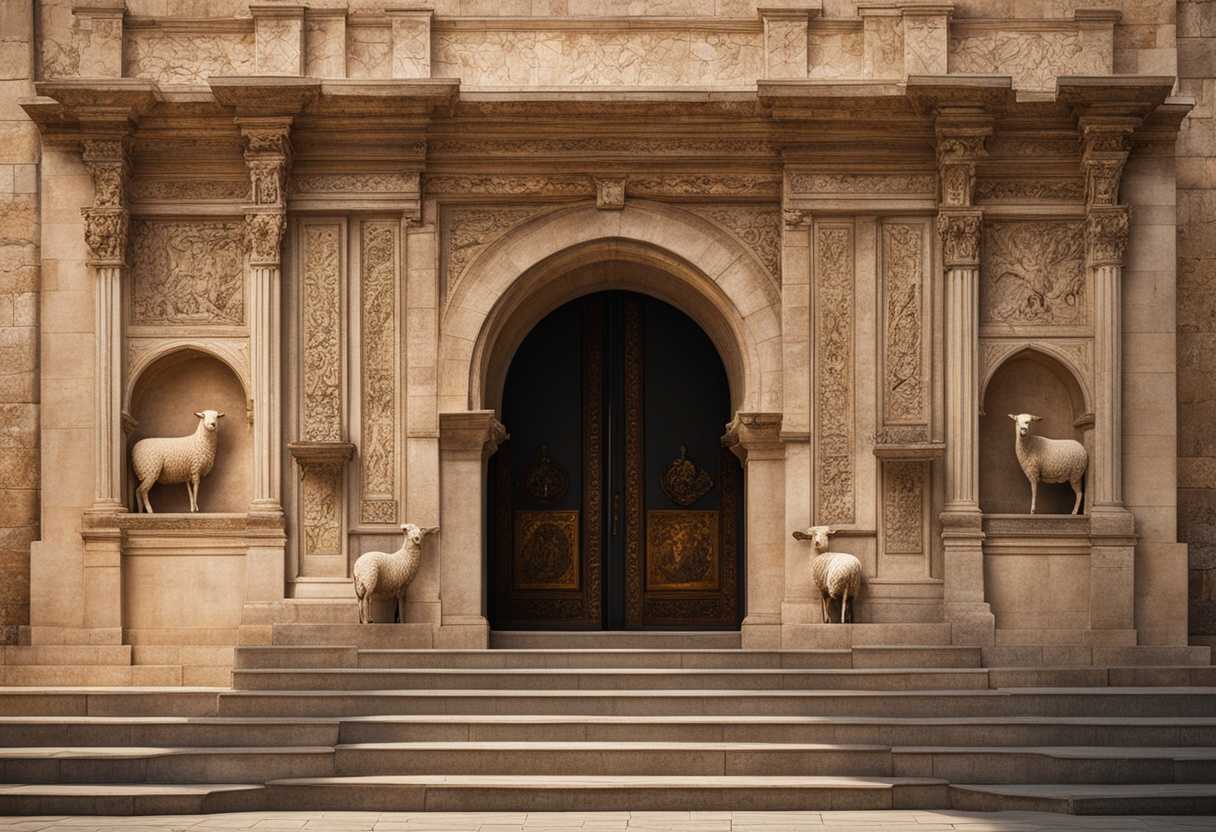
The Sheep Gate, mentioned in Nehemiah 3:1 and John 5:2, is primarily associated with the entrance to Jerusalem where sheep were brought for sacrifice. Symbolically, it represents Christ as the Lamb of God, emphasizing themes of sacrifice, redemption, and access to God.
Scripture
1 Then Eliashib the high priest rose up with his brothers the priests, and they built the Sheep Gate. They consecrated it and set its doors. They consecrated it as far as the Tower of the Hundred, as far as the Tower of Hananel.
2 And next to him the men of Jericho built. And next to them Zaccur the son of Imri built.
3 The sons of Hassenaah built the Fish Gate. They laid its beams and set its doors, its bolts, and its bars.
4 And next to them Meremoth the son of Uriah, son of Hakkoz repaired. Next to them Meshullam the son of Berechiah, son of Meshezabel repaired. Next to them Zadok the son of Baana repaired.
5 And next to them the Tekoites repaired, but their nobles would not stoop to serve their Lord.
6 Joiada the son of Paseah and Meshullam the son of Besodeiah repaired the Gate of Yeshanah. They laid its beams and set its doors, its bolts, and its bars.
7 And next to them repaired Melatiah the Gibeonite and Jadon the Meronothite, the men of Gibeon and of Mizpah, the seat of the governor of the province Beyond the River.
8 Next to him Uzziel the son of Harhaiah, goldsmiths, repaired. Next to him Hananiah, one of the perfumers, repaired, and they restored Jerusalem as far as the Broad Wall.
9 Next to them Rephaiah the son of Hur, ruler of half the district of Jerusalem, repaired.
10 Next to them Jedaiah the son of Harumaph repaired opposite his house. And next to him Hattush the son of Hashabneiah repaired.
11 Malchijah the son of Harim and Hasshub the son of Pahath-moab repaired another section and the Tower of the Ovens.
12 And next to him Shallum the son of Hallohesh, ruler of half the district of Jerusalem, repaired, he and his daughters.
13 Hanun and the inhabitants of Zanoah repaired the Valley Gate. They rebuilt it and set its doors, its bolts, and its bars, and repaired a thousand cubits of the wall, as far as the Dung Gate.
14 And the Dung Gate repaired Malchijah the son of Rechab, ruler of the district of Beth-haccherem. He rebuilt it and set its doors, its bolts, and its bars.
15 And Shallum the son of Col-hozeh, ruler of the district of Mizpah, repaired the Fountain Gate. He rebuilt it and covered it and set its doors, its bolts, and its bars. And he built the wall of the Pool of Shelah of the king’s garden, as far as the stairs that go down from the city of David.
16 After him Nehemiah the son of Azbuk, ruler of half the district of Beth-zur, repaired to a point opposite the tombs of David, as far as the artificial pool, and as far as the house of the mighty men.
17 After him the Levites repaired, Rehum the son of Bani. Next to him Hashabiah, ruler of half the district of Keilah, repaired for his district.
18 After him their brothers repaired Bavvai the son of Henadad, ruler of half the district of Keilah.
19 Next to him Ezer the son of Jeshua, ruler of Mizpah, repaired another section opposite the ascent to the armory at the buttress.
20 After him Baruch the son of Zabbai repaired another section, from the buttress to the door of the house of Eliashib the high priest.
21 After him Meremoth the son of Uriah, son of Hakkoz repaired another section, from the door of the house of Eliashib to the end of the house of Eliashib.
22 And after him the priests, the men of the surrounding area,
23 After them Benjamin and Hasshub repaired opposite their house. After them Azariah the son of Maaseiah, son of Ananiah, repaired beside his own house.
24 After him Binnui the son of Henadad repaired another section, from the house of Azariah to the buttress.
25 Palal the son of Uzai repaired opposite the buttress and the tower projecting from the upper house of the king at the court of the guard.
26 and the temple servants living on Ophel repaired to a point opposite the Water Gate on the east and the projecting tower.
27 After them the Tekoites repaired another section opposite the great projecting tower as far as the wall of Ophel.
28 Above the Horse Gate the priests repaired, each one opposite his own house.
29 After them Zadok the son of Immer repaired opposite his own house. And after him Shemaiah the son of Shecaniah, the keeper of the East Gate, repaired.
30 After him Hananiah the son of Shelemiah and Hanun the sixth son of Zalaph repaired another section. After him Meshullam the son of Berechiah repaired opposite his chamber.
31 After him Malchijah, one of the goldsmiths, repaired as far as the house of the temple servants and of the merchants, opposite the Muster Gate, and to the upper chamber of the corner.
32 And between the upper chamber of the corner and the Sheep Gate the goldsmiths and the merchants repaired.
Meaning of the Sheep Gate in Scripture
The Sheep Gate, as referenced in Nehemiah 3:1 and John 5:2, holds profound significance within biblical theology. In Nehemiah, it signifies the restoration of the walls of Jerusalem, highlighting Israel’s renewal after exile and their commitment to covenant faithfulness. The Sheep Gate, being the entry point for sacrificial lambs, inherently points to the sacrificial system established in the Mosaic Law, where lambs without blemish were offered for atonement. This foreshadows Christ’s ultimate sacrifice; as articulated in John 1:29, John the Baptist recognizes Jesus as “the Lamb of God, who takes away the sin of the world,” confirming that Jesus fulfills the role symbolized by the Sheep Gate.
Moreover, in John 5:2, the Sheep Gate is also linked to healing, as it leads to the Pool of Bethesda, where those suffering from ailments gathered in hope of miraculous cures. This connection underscores Jesus’ mission of healing and restoration, both physically and spiritually. By performing miracles in this context, Jesus demonstrates that he is the gateway to wholeness and divine interaction, echoing his declaration in John 10:9, “I am the door; if anyone enters by me, he will be saved and will go in and out and find pasture.” Thus, the Sheep Gate not only signifies Christ’s sacrificial role but also symbolizes the access and abundant life he provides to believers, illustrating the broader themes of redemption, healing, and divine invitation found throughout Scripture.
The Sheep Gate also represents a pivotal aspect of communal identity and spiritual connection within the Old Testament framework. As a designated entry point for the sacrificial lambs, it embodies the idea of purity and the communal engagement of the people with the sacrificial system. This emphasizes the relational nature of worship, where individual and community are intricately tied in the act of seeking forgiveness and restoration through the blood of the innocent lambs. Such a setting reflects the significance of collective faithfulness and the narrative of redemption that weaves through Israel’s history, highlighting how communal practices can lead to national revival and spiritual awakening.
Furthermore, the imagery of the Sheep Gate extends into prophetic literature, where it serves as a metaphor for God’s protection and guidance over His people. The designations of the gate throughout various texts often herald discussions of God’s shepherding role, effectively foreshadowing the ministry of Jesus, who recalls this intimate relationship in His parables. The Sheep Gate can, thus, be viewed as a testament to God’s consistent desire to lead His flock, not only toward physical destinations but also into deeper spiritual understanding and communion. Therefore, the rich symbolism surrounding the Sheep Gate reinforces the themes of protection, belonging, and the ongoing narrative of redemption as God’s people navigate their faith journey.
Symbol of Access and Entry
The Sheep Gate represents a point of access, particularly in the context of spiritual entry into the community of faith. It signifies the way in which believers can enter into a relationship with God, much like sheep entering a fold for protection and care. This gate serves as a reminder that there is a designated path for those seeking spiritual nourishment and safety, emphasizing the importance of entering through the right means to find refuge and guidance.
Representation of Sacrifice and Redemption
The Sheep Gate also symbolizes the themes of sacrifice and redemption. Historically, this gate was associated with the sacrificial system in ancient Israel, where sheep were brought for offerings. This connection highlights the idea that through sacrifice, there is a pathway to atonement and forgiveness. In a broader theological sense, it points to the ultimate sacrifice made for humanity, illustrating the concept of redemption that is central to the Christian faith.
Community and Belonging
Furthermore, the Sheep Gate signifies the importance of community and belonging within the faith. It serves as a metaphor for the gathering of believers who come together for support, fellowship, and worship. The gate not only allows entry but also fosters a sense of identity and belonging among those who pass through it, reinforcing the idea that faith is not just an individual journey but a collective experience within the body of believers.
How to Embrace Faith for a Deeper Christian Life
Embracing faith for a deeper Christian life is a journey that invites us to cultivate a personal relationship with God, grounded in trust and love. Start by immersing yourself in Scripture, allowing the Word to speak to your heart and guide your actions; consider setting aside time each day for prayer and reflection, where you can pour out your thoughts and listen for His voice. Surround yourself with a community of believers who can encourage and challenge you, as fellowship is vital in nurturing our faith. Remember, faith is not just a feeling but a commitment to live out the teachings of Christ in our daily lives—showing kindness, practicing forgiveness, and serving others. As you take these steps, you’ll find that your faith deepens, transforming not only your relationship with God but also how you engage with the world around you. Embrace this journey with an open heart, and watch how God works in your life in ways you never imagined.
Bible References to the Sheep Gate:
Nehemiah 12:39: 39 and above the Gate of Ephraim, and by the Gate of Yeshanah, and by the Fish Gate and the Tower of Hananel and the Tower of the Hundred, to the Sheep Gate; and they came to a halt at the Gate of the Guard.
John 5:1-9: 1 After this there was a feast of the Jews, and Jesus went up to Jerusalem.
2 Now there is in Jerusalem by the Sheep Gate a pool, in Aramaic called Bethesda, which has five roofed colonnades.
3 In these lay a multitude of invalids—blind, lame, and paralyzed.
4 for an angel of the Lord went down at certain seasons into the pool and stirred up the water; whoever stepped in first after the stirring of the water was healed of whatever disease he had.
5 One man was there who had been an invalid for thirty-eight years.
6 When Jesus saw him lying there and knew that he had already been there a long time, he said to him, “Do you want to be healed?”
7 The sick man answered him, “Sir, I have no one to put me into the pool when the water is stirred up, and while I am going another steps down before me.”
8 Jesus said to him, “Get up, take up your bed, and walk.”
9 And at once the man was healed, and he took up his bed and walked.

Reverend Ogunlade is a seasoned Church Minister with over three decades of experience in guiding and nurturing congregations. With profound wisdom and a serene approach, Reverend Ogunlade has carried out various pastoral duties, including delivering uplifting sermons, conducting religious ceremonies, and offering sage counsel to individuals seeking spiritual guidance. Their commitment to fostering harmony and righteousness within their community is exemplified through their compassionate nature, making them a beloved and trusted figure among the congregation.