
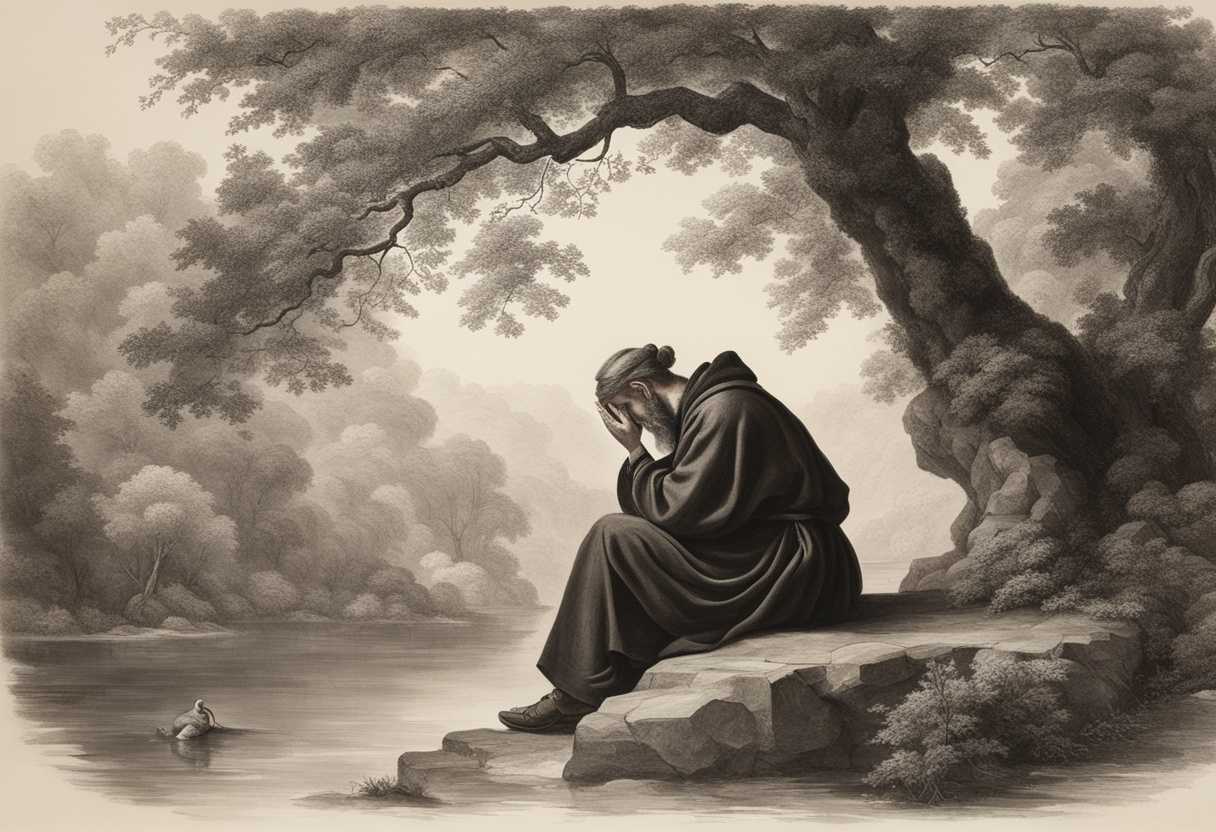
A Bible hermit is typically understood as a person who withdraws from society to live a life of solitude, prayer, and contemplation, often inspired by scriptures that emphasize solitude and communion with God, such as Luke 5:16. Hermits seek spiritual growth and deeper connection with God, reflecting the practices of early Christian ascetics.
Scripture
2 And the word of the Lord came to him:
3 “Depart from here and turn eastward and hide yourself by the brook Cherith, which is east of the Jordan.”
4 You shall drink from the brook, and I have commanded the ravens to feed you there.
5 So he went and did according to the word of the Lord. He went and lived by the brook Cherith that is east of the Jordan.
6 And the ravens brought him bread and meat in the morning, and bread and meat in the evening, and he drank from the brook.
Definition of a Bible Hermit
The concept of a Bible hermit encapsulates a profound spiritual journey characterized by the pursuit of solitude for the sake of deepening one’s relationship with God. The practice of withdrawing from society to engage in prayer and contemplation can be traced back to both the Old and New Testaments. For instance, Luke 5:16 states, “But Jesus often withdrew to lonely places and prayed,” illustrating that even Christ himself sought the quietude necessary for spiritual reflection and communion with the Father. This aligns with the broader biblical theme that values solitude as a means to clarity in one’s faith and a mode of preparing for ministry, as evidenced in the lives of prophets and early Christian ascetics who frequently retreated to the desert or secluded places to seek divine counsel (Matthew 4:1-11, where Jesus fasts in the wilderness).
The life of a hermit reveals the tension between the need for community and the call for personal spiritual growth. Scriptures such as Isaiah 30:15, “In repentance and rest is your salvation, in quietness and trust is your strength,” speak to the inherent strength found in stillness and reflection. While community plays a crucial role in Christian life—illustrated in Hebrews 10:24-25, which encourages believers to gather and encourage one another—hermits embody the notion that solitude can cultivate a deeper spiritual resilience and understanding of one’s purpose in Christ. Ultimately, the hermitic life is not merely about physical isolation but about creating space where one can encounter God intimately and profoundly, nurturing an authentic faith that can, in turn, be shared with the broader community when the hermit re-engages with the world.
The life of a Bible hermit does not merely revolve around physical separation from society; it embodies a commitment to spiritual asceticism. Ancient traditions recognize that renouncing worldly distractions allows for an intense focus on prayer, meditation, and scriptural study. For example, in the context of both the Old and New Testaments, hermits often adopted a lifestyle that emphasized discipline and simplicity, aligning their personal practices with teachings that underscored the necessity of purity and devotion. The example of John the Baptist, who lived in the wilderness and preached repentance, showcases an early model of hermitic life where isolation served as a backdrop for profound spiritual insights and preparation for a larger mission.
Moreover, the writings of the early Church Fathers and monastic traditions further illuminate the life of a hermit. They often emphasized that withdrawal from society was not an escape but a purposeful journey aimed at encountering God’s presence more intimately. Saints such as Anthony of the Desert exemplified this notion, establishing the foundation for monastic communities while also advocating for individual solitude as a path to holiness. In this sense, the hermitic vocation enriches the collective faith experience, providing a wellspring of spiritual wisdom that nourishes both the individual and the community. Thus, the role of a hermit is integrally linked to the broader body of Christ, serving as a reminder that individual retreats into solitude can lead to transformative experiences essential for personal growth and ultimate contributions to the faith community.
The Pursuit of Solitude for Spiritual Growth
A Bible hermit is often understood as an individual who seeks solitude to deepen their relationship with God. This pursuit of isolation allows for focused prayer, meditation, and reflection, fostering a more profound spiritual connection. The act of withdrawing from society is seen as a way to escape distractions and worldly concerns, enabling the hermit to cultivate a life centered on divine communion.
A Model of Self-Denial and Sacrifice
In the biblical context, hermits exemplify self-denial and sacrifice, embodying the call to forsake earthly pleasures for spiritual fulfillment. This lifestyle reflects a commitment to living simply and intentionally, prioritizing spiritual over material wealth. The hermit’s choice to live apart from the community serves as a powerful testament to the belief that true richness comes from a life devoted to God rather than the accumulation of worldly possessions.
Witness to the Community
Despite their physical separation from society, Bible hermits often serve as a spiritual witness to the broader community. Their lives can inspire others to reflect on their own spiritual journeys and the importance of solitude in seeking God. By embodying a life of prayer and contemplation, hermits remind the faithful of the value of inner peace and the transformative power of a dedicated spiritual life, encouraging communal members to pursue their own paths of faith.
How to Embrace Solitude for Spiritual Growth
Embracing solitude can be a transformative journey for your spiritual growth, allowing you to deepen your relationship with God and yourself. In our fast-paced world, it’s easy to get caught up in the noise and distractions that pull us away from meaningful reflection. I encourage you to carve out intentional time for solitude—whether it’s a quiet morning with your Bible, a walk in nature, or simply sitting in silence. Use this time to pray, meditate on Scripture, and listen for God’s voice. Remember, Jesus often withdrew to lonely places to pray (Luke 5:16), showing us the importance of solitude in nurturing our faith. As you embrace these moments of stillness, you may find clarity, peace, and a renewed sense of purpose, helping you to grow closer to God and better understand His will for your life.
Bible References to Hermits in Scriptures:
Matthew 3:1-4: 1 In those days John the Baptist came preaching in the wilderness of Judea,
2 “Repent, for the kingdom of heaven is at hand.”
3 For this is he who was spoken of by the prophet Isaiah when he said, “The voice of one crying in the wilderness: ‘Prepare the way of the Lord; make his paths straight.’”
4 Now John wore a garment of camel’s hair and a leather belt around his waist, and his food was locusts and wild honey.
Luke 1:80: 80 And the child grew and became strong in spirit, and he was in the wilderness until the day of his public appearance to Israel.
Mark 1:12-13: 12 The Spirit immediately drove him out into the wilderness.
13 And he was in the wilderness forty days, being tempted by Satan. And he was with the wild animals, and the angels were ministering to him.
1 Samuel 22:1-2: 1 David departed from there and escaped to the cave of Adullam.
2 And everyone who was in distress, and everyone who was in debt, and everyone who was bitter in soul, gathered to him. And he became commander over them. And there were with him about four hundred men.
1 Kings 19:3-9: 3 Then he was afraid, and he arose and ran for his life and came to Beersheba, which belongs to Judah, and left his servant there.
4 But he himself went a day’s journey into the wilderness and came and sat down under a broom tree. And he asked that he might die, saying, “It is enough; now, O Lord, take away my life, for I am no better than my fathers.”
5 Then he lay down under the broom tree and fell asleep.
6 And he looked, and behold, there at his head was a cake baked on hot stones and a jar of water. And he ate and drank and lay down again.
7 And the angel of the Lord came again a second time and touched him and said, “Arise and eat, for the journey is too great for you.”
8 And he arose and ate and drank, and went in the strength of that food forty days and forty nights to Horeb, the mount of God.
9 There he came to a cave and lodged in it. And behold, the word of the Lord came to him, and he said to him, “What are you doing here, Elijah?”
Genesis 28:10-22: 10 Jacob left Beersheba and went toward Haran.
11 And he came to a certain place and stayed there that night, because the sun had set. Taking one of the stones of the place, he put it under his head and lay down in that place to sleep.
12 And he dreamed, and behold, there was a ladder set up on the earth, and the top of it reached to heaven. And behold, the angels of God were ascending and descending on it!
28 And behold, the Lord stood above it and said, “I am the Lord, the God of Abraham your father and the God of Isaac.
14 Your offspring shall be like the dust of the earth, and you shall spread abroad to the west and to the east and to the north and to the south, and in you and your offspring shall all the families of the earth be blessed.
15 Behold, I am with you and will keep you wherever you go, and will bring you back to this land. For I will not leave you until I have done what I have promised you.”
16 Then Jacob awoke from his sleep and said, “Surely the Lord is in this place, and I did not know it.”
17 And he was afraid and said, “How awesome is this place! This is none other than the house of God, and this is the gate of heaven.”
18 So early in the morning Jacob took the stone that he had put under his head and set it up for a pillar and poured oil on the top of it.
19 He called the name of that place Bethel, but the name of the city was Luz at the first.
20 Then Jacob made a vow, saying, “If God will be with me and will keep me in this way that I go, and will give me bread to eat and clothing to wear,
21 so that I come again to my father’s house in peace, then the Lord shall be my God,
22 And this stone, which I have set up for a pillar, shall be God’s house. And of all that you give me I will give a full tenth to you.”
Exodus 3:1-6: 1 Now Moses was keeping the flock of his father-in-law, Jethro, the priest of Midian, and he led his flock to the west side of the wilderness and came to Horeb, the mountain of God.
2 And the angel of the Lord appeared to him in a flame of fire out of the midst of a bush. He looked, and behold, the bush was burning, yet it was not consumed.
3 And Moses said, “I will turn aside to see this great sight, why the bush is not burned.”
4 When the Lord saw that he turned aside to see, God called to him out of the bush, “Moses, Moses!” And he said, “Here I am.”
5 Then he said, “Do not come near; take your sandals off your feet, for the place on which you are standing is holy ground.”
6 And he said, “I am the God of your father, the God of Abraham, the God of Isaac, and the God of Jacob.” And Moses hid his face, for he was afraid to look at God.
Judges 6:11-24: 11 Now the angel of the Lord came and sat under the terebinth at Ophrah, which belonged to Joash the Abiezrite, while his son Gideon was beating out wheat in the winepress to hide it from the Midianites.
12 And the angel of the Lord appeared to him and said to him, “The Lord is with you, O mighty man of valor.”
13 And Gideon said to him, “Please, sir, if the Lord is with us, why then has all this happened to us? And where are all his wonderful deeds that our fathers recounted to us, saying, ‘Did not the Lord bring us up from Egypt?’ But now the Lord has forsaken us and given us into the hand of Midian.”
14 And the Lord turned to him and said, “Go in this might of yours and save Israel from the hand of Midian; do not I send you?”
15 And he said to him, “Please, Lord, how can I save Israel? Behold, my clan is the weakest in Manasseh, and I am the least in my father’s house.”
16 And the Lord said to him, “But I will be with you, and you shall strike the Midianites as one man.”
17 And he said to him, “If now I have found favor in your eyes, then show me a sign that it is you who speak with me.
18 Please do not depart from here until I come to you and bring out my present and set it before you.” And he said, “I will stay till you return.”
19 So Gideon went into his house and prepared a young goat and unleavened cakes from an ephah of flour. The meat he put in a basket, and the broth he put in a pot, and brought them to him under the terebinth and presented them.
20 And the angel of God said to him, “Take the meat and the unleavened cakes, and put them on this rock, and pour the broth over them.” And he did so.
21 Then the angel of the Lord reached out the tip of the staff that was in his hand and touched the meat and the unleavened cakes. And fire sprang up from the rock and consumed the meat and the unleavened cakes. And the angel of the Lord vanished from his sight.
22 Then Gideon perceived that he was the angel of the Lord. And Gideon said, “Alas, O Lord God! For now I have seen the angel of the Lord face to face.”
23 But the Lord said to him, “Peace be to you. Do not fear; you shall not die.”
24 Then Gideon built an altar there to the Lord and called it, The Lord Is Peace.
Jeremiah 16:1-4: 1 The word of the Lord came to me:
2 “You shall not take a wife, nor shall you have sons or daughters in this place.
3 For thus says the Lord concerning the sons and daughters who are born in this place, and concerning the mothers who bore them and the fathers who fathered them in this land:
4 They shall die of deadly diseases. They shall not be lamented, nor shall they be buried. They shall be as dung on the surface of the ground. They shall perish by the sword and by famine, and their dead bodies shall be food for the birds of the air and for the beasts of the earth.
Ezekiel 4:1-8: 1 “And you, son of man, take a brick and lay it before you, and engrave on it a city, even Jerusalem.”
2 And put siegeworks against it, and build a siege wall against it, and cast up a mound against it. Set camps also against it, and plant battering rams against it all around.
3 And you, take an iron griddle, and place it as an iron wall between you and the city; and set your face toward it, and let it be in a state of siege, and press the siege against it. This is a sign for the house of Israel.
4 Then lie on your left side, and place the punishment of the house of Israel upon it. For the number of the days that you lie on it, you shall bear their punishment.
5 For I assign to you a number of days, 390 days, equal to the number of the years of their punishment. So long shall you bear the punishment of the house of Israel.
6 And when you have completed these, you shall lie down a second time, but on your right side, and bear the punishment of the house of Judah. Forty days I assign you, a day for each year.
7 And you shall set your face toward the siege of Jerusalem, with your arm bared, and you shall prophesy against the city.
8 And behold, I will put cords upon you, so that you cannot turn from one side to the other, till you have completed the days of your siege.
Hosea 3:1-5: 1 And the Lord said to me, “Go again, love a woman who is loved by another man and is an adulteress, even as the Lord loves the children of Israel, though they turn to other gods and love cakes of raisins.”
2 So I bought her for fifteen shekels of silver and a homer and a lethech of barley.
3 And I said to her, “You must dwell as mine for many days. You shall not play the whore, or belong to another man; so will I also be to you.”
4 For the people of Israel shall dwell many days without king or prince, without sacrifice or pillar, without ephod or household gods.
5 Afterward the children of Israel shall return and seek the Lord their God, and David their king, and they shall come in fear to the Lord and to his goodness in the latter days.
Isaiah 20:1-6: 1 In the year that the commander in chief, who was sent by Sargon the king of Assyria, came to Ashdod and fought against it and captured it—
2 at that time the Lord spoke by Isaiah the son of Amoz, saying, “Go, and loose the sackcloth from your waist and take off your sandals from your feet,” and he did so, walking naked and barefoot.
3 Then the Lord said, “As my servant Isaiah has walked naked and barefoot for three years as a sign and a portent against Egypt and Cush,
4 so shall the king of Assyria lead away the Egyptian captives and the Cushite exiles, both the young and the old, naked and barefoot, with buttocks uncovered, the nakedness of Egypt.
5 Then they shall be dismayed and ashamed because of Cush their hope and of Egypt their boast.
6 And the inhabitants of this coastland will say in that day, ‘Behold, this is what has happened to those in whom we hoped and to whom we fled for help to be delivered from the king of Assyria! And we, how shall we escape?’”
Daniel 10:2-3: 2 In those days I, Daniel, was mourning for three weeks.
3 I ate no delicacies, no meat or wine entered my mouth, nor did I anoint myself at all, for the full three weeks.
Acts 9:1-9: 1 But Saul, still breathing threats and murder against the disciples of the Lord, went to the high priest
2 and asked him for letters to the synagogues at Damascus, so that if he found any belonging to the Way, men or women, he might bring them bound to Jerusalem.
3 Now as he went on his way, he approached Damascus, and suddenly a light from heaven shone around him.
4 And falling to the ground, he heard a voice saying to him, “Saul, Saul, why are you persecuting me?”
5 And he said, “Who are you, Lord?” And he said, “I am Jesus, whom you are persecuting.
6 But rise and enter the city, and you will be told what you are to do.”
7 The men who were traveling with him stood speechless, hearing the voice but seeing no one.
8 Saul rose from the ground, and although his eyes were opened, he saw nothing. So they led him by the hand and brought him into Damascus.
9 And for three days he was without sight, and neither ate nor drank.

Reverend Ogunlade is a seasoned Church Minister with over three decades of experience in guiding and nurturing congregations. With profound wisdom and a serene approach, Reverend Ogunlade has carried out various pastoral duties, including delivering uplifting sermons, conducting religious ceremonies, and offering sage counsel to individuals seeking spiritual guidance. Their commitment to fostering harmony and righteousness within their community is exemplified through their compassionate nature, making them a beloved and trusted figure among the congregation.