
In the Bible, a proclaimer typically refers to someone who publicly announces or preaches God’s messages and teachings, often represented by prophets or evangelists. Their role is to spread the word of God and share the gospel with others, as seen in passages such as Isaiah 61:1 and Acts 10:42.
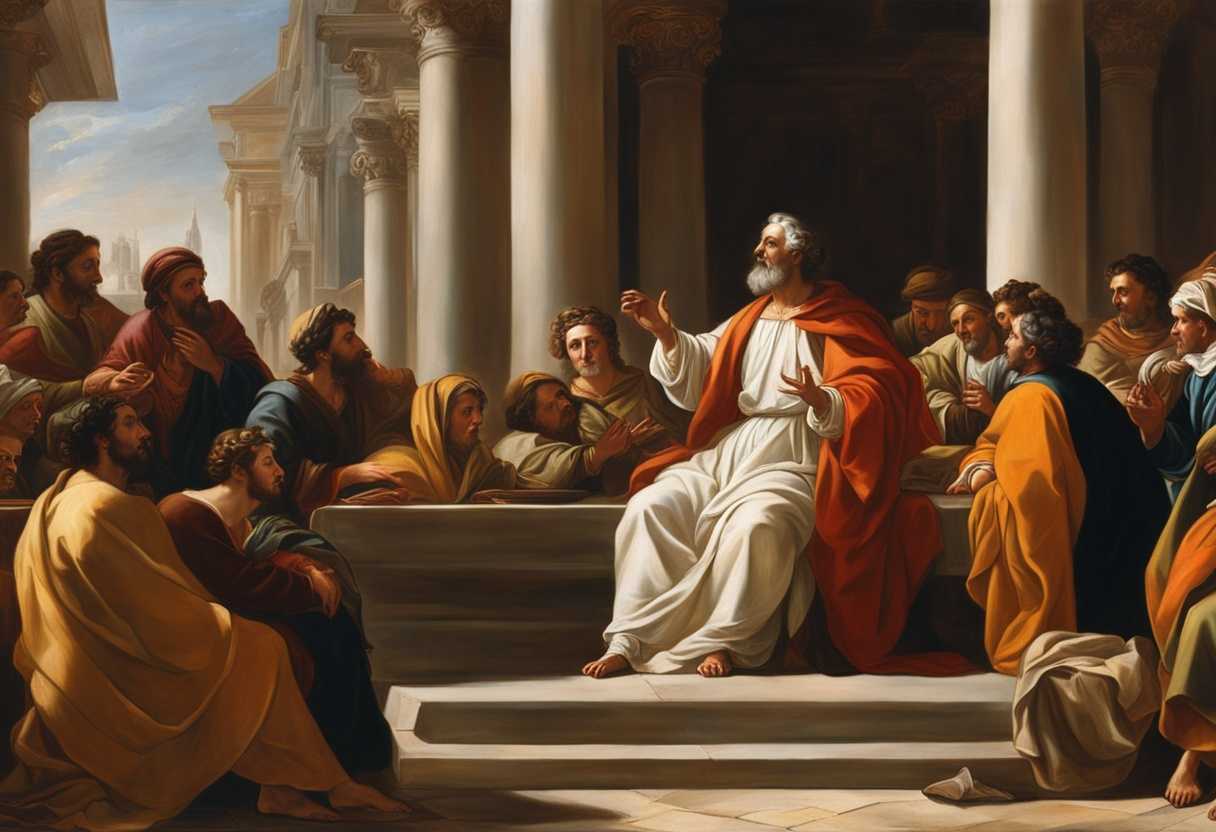
Scripture
1 The Spirit of the Lord God is upon me,
because the Lord has anointed me
to bring good news to the poor;
he has sent me to bind up the brokenhearted,
to proclaim liberty to the captives,
and the opening of the prison to those who are bound;
2 to proclaim the year of the Lord’s favor, and the day of vengeance of our God; to comfort all who mourn;
3 to grant to those who mourn in Zion—
to give them a beautiful headdress instead of ashes,
the oil of gladness instead of mourning,
the garment of praise instead of a faint spirit;
that they may be called oaks of righteousness,
the planting of the Lord, that he may be glorified.
Biblical Definition of a Proclaimer
In the Bible, the concept of a proclaimer extends beyond simple announcement; it embodies the responsibility of sharing God’s truth and fostering a relationship between God and humanity. Proclaimers or messengers, such as prophets and apostles, were chosen to convey divine revelations and truths to God’s people, encouraging repentance, faith, and obedience. For instance, Isaiah 61:1 states, “The Spirit of the Sovereign Lord is on me, because the Lord has anointed me to proclaim good news to the poor,” illustrating how proclaimers are often called and empowered by the Holy Spirit to address societal needs and spiritual conditions. This verse not only highlights their role in delivering hope but also emphasizes the transformative power of the message they bring.
Furthermore, in the New Testament, this proclaimer role is encapsulated in the Great Commission, where Jesus commands His disciples to “go and make disciples of all nations” (Matthew 28:19). The directive emphasizes the evangelical task of spreading the good news of Jesus Christ to diverse peoples. Similarly, in Acts 10:42, it is stated, “He commanded us to preach to the people and to testify that he is the one whom God appointed as judge of the living and the dead,” reinforcing the urgent call to evangelize and the profound significance of this message in the context of salvation. Overall, the notion of a proclaimer in the Bible signifies both the urgency and the sacred duty to communicate God’s love, redemption, and truth to the world, serving as a conduit for divine grace and wisdom.
The role of proclaimers in scripture also encompasses a profound commitment to discipleship and teaching. In the early Church, figures like Peter and Paul exemplified the proclaimer’s duty, taking on the challenge of spreading the Gospel not only through preaching but also through personal example and mentorship. Paul’s letters frequently encapsulate the essence of proclamation by instructing believers on living out their faith in tangible ways, illustrating that proclamations are formed as much by words as by actions. For example, in his epistles, Paul emphasizes the importance of living a life worthy of the Gospel, thus linking proclamation with ethical behavior and community building. This holistic approach underlines that proclaimers are not merely heralds delivering a message but are integrally involved in the lives of those they serve, modeling the teachings of Christ.
Moreover, proclaimers are depicted as integral to the worship life of the community. The Psalms, for instance, abound with calls to proclaim God’s works among the nations and to declare His glory, showcasing the significance of collective worship as a platform for proclamation. This aspect reveals how proclaimer roles are interconnected with the broader community of faith—they are not isolated figures but are part of a larger narrative where worship, testimony, and mission converge. By participating in worship, believers not only affirm their commitment to God’s truths but also prepare themselves to venture out as proclaimers in a world in need of hope and illumination. Therefore, in both Old and New Testament contexts, the definition of a proclaimer extends beyond mere speech; it embodies a lifestyle marked by integrity, community, and a relentless drive to reflect God’s truth in every sphere of influence.
The Role of a Proclaimer in Spreading the Gospel
A proclaimer in the biblical context serves as a messenger of God’s word, tasked with sharing the good news of salvation and the teachings of Jesus Christ. This role emphasizes the importance of evangelism and the call for believers to actively participate in spreading the message of hope and redemption. Proclaimers are seen as vital instruments in the mission of the church, encouraging others to embrace faith and live according to God’s will.
The Authority of a Proclaimer
Proclaimers in the Bible often operate under divine authority, which grants them the responsibility to speak on behalf of God. This authority is not self-appointed but is bestowed through a calling or commissioning by God. As such, proclaimers are expected to deliver messages with integrity and faithfulness, ensuring that their teachings align with biblical truths. This aspect highlights the seriousness of the role and the accountability that comes with proclaiming God’s word to others.
The Transformative Power of Proclamation
The act of proclamation is not merely about conveying information; it is about transformation. Proclaimers are called to inspire change in the hearts and lives of their listeners. Through their messages, they aim to bring about spiritual awakening, encourage repentance, and foster a deeper relationship with God. This transformative power underscores the belief that the word of God, when proclaimed faithfully, has the ability to change lives and communities, leading to a greater understanding of God’s love and purpose.
How to Proclaim God’s Message Effectively as a Christian
Proclaiming God’s message effectively as a Christian is about more than just sharing words; it’s about embodying the love and grace of Christ in every interaction. Start by immersing yourself in Scripture, allowing it to transform your heart and mind, so that your message is rooted in truth and authenticity. Remember, it’s not just what you say, but how you live that speaks volumes—let your actions reflect the compassion and kindness of Jesus. Engage in genuine conversations, listen actively, and be sensitive to the needs of those around you; this builds trust and opens doors for meaningful dialogue. Lastly, pray for guidance and the right words, trusting that the Holy Spirit will empower you to share your faith in a way that resonates with others. By being a living testament to God’s love, you’ll find that your proclamation becomes a natural extension of who you are.
Bible References to Proclaimers in Scripture:
Matthew 28:18-20: 18 And Jesus came and said to them, “All authority in heaven and on earth has been given to me.
19 Go therefore and make disciples of all nations, baptizing them in the name of the Father and of the Son and of the Holy Spirit,
20 teaching them to observe all that I have commanded you. And behold, I am with you always, to the end of the age.
Luke 4:18-19: 18 “The Spirit of the Lord is upon me,
because he has anointed me
to proclaim good news to the poor.
He has sent me to proclaim liberty to the captives
and recovering of sight to the blind,
to set at liberty those who are oppressed,
19 to proclaim the year of the Lord’s favor.
Acts 1:8: 8 But you will receive power when the Holy Spirit has come upon you, and you will be my witnesses in Jerusalem and in all Judea and Samaria, and to the end of the earth.”
Romans 10:14-15: 14 How then will they call on him in whom they have not believed? And how are they to believe in him of whom they have never heard? And how are they to hear without someone preaching?
15 And how are they to preach unless they are sent? As it is written, “How beautiful are the feet of those who preach the good news!”
2 Timothy 4:1-2: 1 I charge you in the presence of God and of Christ Jesus, who is to judge the living and the dead, and by his appearing and his kingdom:
2 preach the word; be ready in season and out of season; reprove, rebuke, and exhort, with complete patience and teaching.
1 Peter 2:9-10: 9 But you are a chosen race, a royal priesthood, a holy nation, a people for his own possession, that you may proclaim the excellencies of him who called you out of darkness into his marvelous light.
10 Once you were not a people, but now you are God’s people; once you had not received mercy, but now you have received mercy.
Mark 16:15-16: 15 And he said to them, “Go into all the world and proclaim the gospel to the whole creation.
16 Whoever believes and is baptized will be saved, but whoever does not believe will be condemned.
Isaiah 52:7-8: 7 How beautiful upon the mountains are the feet of him who brings good news, who publishes peace, who brings good news of happiness, who publishes salvation, who says to Zion, “Your God reigns.”
8 The voice of your watchmen—they lift up their voice;
together they sing for joy;
for eye to eye they see
the return of the Lord to Zion.
Jeremiah 1:4-10: 4 Now the word of the Lord came to me, saying,
5 “Before I formed you in the womb I knew you, and before you were born I consecrated you; I appointed you a prophet to the nations.”
6 Then I said, “Ah, Lord God! Behold, I do not know how to speak, for I am only a youth.”
7 But the Lord said to me, “Do not say, ‘I am only a youth’; for to all to whom I send you, you shall go, and whatever I command you, you shall speak.
8 Be not afraid of them, for I am with you to deliver you, declares the Lord.
9 Then the Lord put out his hand and touched my mouth. And the Lord said to me, “Behold, I have put my words in your mouth.
10 See, I have set you this day over nations and over kingdoms, to pluck up and to break down, to destroy and to overthrow, to build and to plant.”
Ezekiel 3:17-21: 17 “Son of man, I have made you a watchman for the house of Israel. Whenever you hear a word from my mouth, you shall give them warning from me.”
18 If I say to the wicked, ‘You shall surely die,’ and you give him no warning, nor speak to warn the wicked from his wicked way, in order to save his life, that wicked person shall die for his iniquity, but his blood I will require at your hand.
19 But if you warn the wicked, and he does not turn from his wickedness, or from his wicked way, he shall die for his iniquity, but you will have delivered your soul.
20 Again, if a righteous person turns from his righteousness and commits injustice, and I lay a stumbling block before him, he shall die. Because you have not warned him, he shall die for his sin, and his righteous deeds that he has done shall not be remembered, but his blood I will require at your hand.
21 But if you warn the righteous person not to sin, and he does not sin, he shall surely live, because he took warning, and you will have delivered your soul.”
John 20:21-23: 21 Jesus said to them again, “Peace be with you. As the Father has sent me, even so I am sending you.”
22 And when he had said this, he breathed on them and said to them, “Receive the Holy Spirit.
23 If you forgive the sins of any, they are forgiven them; if you withhold forgiveness from any, it is withheld.”
Acts 13:47-49: 47 For so the Lord has commanded us, saying, “I have made you a light for the Gentiles, that you may bring salvation to the ends of the earth.”
48 And when the Gentiles heard this, they began rejoicing and glorifying the word of the Lord, and as many as were appointed to eternal life believed.
49 And the word of the Lord was spreading throughout the whole region.
1 Corinthians 9:16-18: 16 For if I preach the gospel, that gives me no ground for boasting. For necessity is laid upon me. Woe to me if I do not preach the gospel!
17 For if I do this of my own will, I have a reward, but if not of my own will, I am still entrusted with a stewardship.
18 What then is my reward? That in my preaching I may present the gospel free of charge, so as not to make full use of my right in the gospel.
2 Corinthians 5:18-20: 18 All this is from God, who through Christ reconciled us to himself and gave us the ministry of reconciliation;
19 that is, in Christ God was reconciling the world to himself, not counting their trespasses against them, and entrusting to us the message of reconciliation.
20 Therefore, we are ambassadors for Christ, God making his appeal through us. We implore you on behalf of Christ, be reconciled to God.

Reverend Ogunlade is a seasoned Church Minister with over three decades of experience in guiding and nurturing congregations. With profound wisdom and a serene approach, Reverend Ogunlade has carried out various pastoral duties, including delivering uplifting sermons, conducting religious ceremonies, and offering sage counsel to individuals seeking spiritual guidance. Their commitment to fostering harmony and righteousness within their community is exemplified through their compassionate nature, making them a beloved and trusted figure among the congregation.