
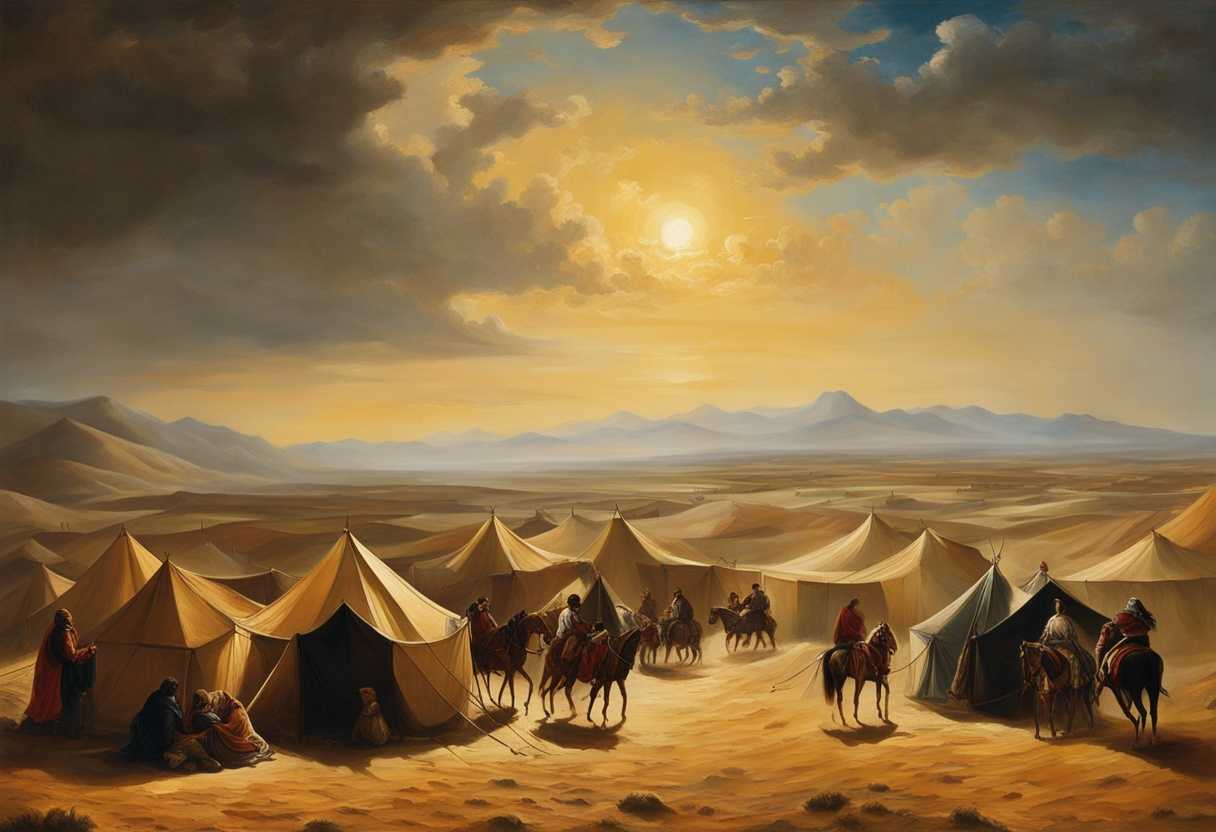
Ishmaelites are the descendants of Ishmael, the son of Abraham and Hagar, as mentioned in the Book of Genesis. They are often associated with nomadic tribes and are considered the ancestors of various Arab peoples.
Scripture
1 Now Sarai, Abram’s wife, had borne him no children.
2 And Sarai said to Abram, “Behold now, the Lord has prevented me from bearing children. Go in to my servant; it may be that I shall obtain children by her.” And Abram listened to the voice of Sarai.
3 And Sarai, Abram’s wife, took Hagar the Egyptian, her servant, after Abram had lived ten years in the land of Canaan, and gave her to Abram her husband to be his wife.
4 And he went in to Hagar, and she conceived. And when she saw that she had conceived, she looked with contempt on her mistress.
5 And Sarai said to Abram, “May the wrong done to me be on you! I gave my servant to your embrace, and when she saw that she had conceived, she looked on me with contempt. May the Lord judge between you and me!”
6 But Abram said to Sarai, “Behold, your servant is in your power; do to her as you please.” Then Sarai dealt harshly with her, and she fled from her.
7 The angel of the Lord found her by a spring of water in the wilderness, the spring on the way to Shur.
8 And he said, “Hagar, servant of Sarai, where have you come from and where are you going?” She said, “I am fleeing from my mistress Sarai.”
9 The angel of the Lord said to her, “Return to your mistress and submit to her.”
10 The angel of the Lord also said to her, “I will surely multiply your offspring so that they cannot be numbered for multitude.”
11 And the angel of the Lord said to her, “Behold, you are pregnant and shall bear a son. You shall call his name Ishmael, because the Lord has listened to your affliction.
12 He shall be a wild donkey of a man, his hand against everyone and everyone’s hand against him, and he shall dwell over against all his kinsmen.”
13 So she called the name of the Lord who spoke to her, “You are a God of seeing,” for she said, “Truly here I have seen him who looks after me.”
14 Therefore the well was called Beer-lahai-roi; it lies between Kadesh and Bered.
15 And Hagar bore Abram a son, and Abram called the name of his son, whom Hagar bore, Ishmael.
16 Abram was eighty-six years old when Hagar bore Ishmael to Abram.
Ishmaelites in the Bible: Definition and Significance
In the Bible, the term “Ishmaelites” refers specifically to the descendants of Ishmael, who is introduced in Genesis 16 as the son of Abraham and Hagar, Sarah’s Egyptian maidservant. The significance of the Ishmaelites extends beyond mere genealogy; it touches on themes of covenant, promise, and the divergent paths of Abraham’s lineage. In Genesis 17:20, God promises Abraham that Ishmael would be blessed and made into a great nation, indicating that he would have a significant role in the unfolding narrative of God’s plan. This blessing positions the Ishmaelites as an important, albeit complex, part of the biblical story—highlighting the tension between Isaac’s, the child of promise, lineage and Ishmael’s descendants, who are often portrayed as outsiders.
Moreover, the Ishmaelites symbolize the intertwined destinies of different peoples and nations. In Genesis 37:25-28, Ishmaelites are mentioned in the context of Joseph’s story, where they buy Joseph from his brothers. This event emphasizes how Ishmaelites, often linked to trade and nomadism, play a crucial role in the broader narrative of providence. Their representation in the Bible invites readers to reflect on themes of rejection, identity, and the complexity of divine plans. Over time, the term “Ishmaelites” has also evolved in its interpretation, often closely identified with various Arab nations and communities, further enriching the tapestry of biblical history and its continuing relevance in modern discourse on ethnicity and identity.
The Ishmaelites appear in various contexts throughout the biblical narrative, further underscoring their role as more than just a genealogical reference. In Judges 8:24-26, we find a mention of the Ishmaelites in relation to the spoils of conflict, indicating their prosperity and wealth—especially in the context of trade. Gideon, capturing the Midianite kings, collects earrings made of gold from the Ishmaelites, which highlights their prominence and the economic interactions between these groups. This passage serves to illustrate the cultural and commercial exchanges occurring among different tribes and nations within the ancient Near East, revealing how the Ishmaelites were integrally involved in these dynamics.
Moreover, the Ishmaelites’ identity and legacy are also explored through the lens of prophecy. In Jeremiah 49:28-30, a prophecy concerning Kedar, a prominent tribe descended from Ishmael, illustrates the enduring impact of his lineage on the geopolitical landscape. The text uses the Ishmaelites to represent the broader themes of judgment and survival in the face of calamity, showcasing how the descendants of Ishmael had their own place within the unfolding events surrounding Israel and their neighboring nations. These references remind readers that the Ishmaelites are not only pivotal characters in their own right but also serve as a mirror to the complexities of human relationships and God’s overarching narrative involving nations and peoples connected through shared ancestry and conflicts. Hence, their mention throughout scripture continues to provide a rich tapestry for understanding the multifaceted nature of biblical history and prophetic literature.
The Lineage and Identity of the Ishmaelites
The Ishmaelites are traditionally understood as the descendants of Ishmael, the son of Abraham and Hagar. This lineage signifies a connection to Abraham’s broader family, illustrating the complex relationships and dynamics within his household. The identity of the Ishmaelites reflects themes of inclusion and exclusion, as they are often seen as outsiders to the covenant community established through Isaac, Abraham’s other son. This distinction highlights the multifaceted nature of God’s promises and the diverse paths of Abraham’s descendants.
Cultural and Economic Significance
In the biblical narrative, the Ishmaelites are often associated with trade and commerce, particularly as merchants and nomads. Their role in the economy of the ancient Near East underscores the importance of trade routes and intercultural exchanges. This aspect of their identity emphasizes the interconnectedness of different peoples and cultures, suggesting that God’s plan encompasses a wider scope than just the chosen lineage of Israel. The Ishmaelites serve as a reminder of the broader human experience and the ways in which different groups contribute to the unfolding of divine purpose.
Symbolism of Conflict and Reconciliation
The relationship between the Ishmaelites and the Israelites is marked by tension and conflict, stemming from the rivalry between Ishmael and Isaac. This dynamic serves as a metaphor for broader themes of conflict within families and nations. However, the narrative also opens the door to reconciliation and understanding, as the descendants of Ishmael are part of the larger story of God’s redemptive work. This duality invites reflection on the complexities of human relationships and the potential for unity amidst division, suggesting that God’s grace extends beyond traditional boundaries.
How to Embrace Compassion and Unity as Christians
Embracing compassion and unity as Christians is a beautiful journey that begins in our hearts and extends to our actions. It’s essential to remember that Jesus taught us to love our neighbors as ourselves, which means seeing the world through the eyes of others and responding with kindness and understanding. Start by actively listening to those around you, especially those who are different from you, and seek to understand their struggles and joys. Engage in acts of service, whether big or small, as these moments can bridge divides and foster a sense of community. Remember, unity doesn’t mean uniformity; it’s about celebrating our diverse backgrounds while coming together in our shared faith. Pray for a heart that reflects Christ’s love, and let that love guide your interactions, creating a ripple effect of compassion that can transform not just your life, but the lives of those around you.
Bible References to the Ishmaelites:
Genesis 21:8-21: 8 And the child grew and was weaned. And Abraham made a great feast on the day that Isaac was weaned.
9 But Sarah saw the son of Hagar the Egyptian, whom she had borne to Abraham, laughing.
10 So she said to Abraham, “Cast out this slave woman with her son, for the son of this slave woman shall not be heir with my son Isaac.”
11 And the thing was very displeasing to Abraham on account of his son.
12 But God said to Abraham, “Be not displeased because of the boy and because of your slave woman. Whatever Sarah says to you, do as she tells you, for through Isaac shall your offspring be named.”
13 And I will make a nation of the son of the slave woman also, because he is your offspring.
14 So Abraham rose early in the morning and took bread and a skin of water and gave it to Hagar, putting it on her shoulder, along with the child, and sent her away. And she departed and wandered in the wilderness of Beersheba.
15 When the water in the skin was gone, she put the child under one of the bushes.
16 Then she went and sat down opposite him a good way off, about the distance of a bowshot, for she said, “Let me not look on the death of the child.” And as she sat opposite him, she lifted up her voice and wept.
17 And God heard the voice of the boy, and the angel of God called to Hagar from heaven and said to her, “What troubles you, Hagar? Fear not, for God has heard the voice of the boy where he is.
18 Up! Lift up the boy, and hold him fast with your hand, for I will make him into a great nation.”
19 Then God opened her eyes, and she saw a well of water. And she went and filled the skin with water and gave the boy a drink.
20 And God was with the boy, and he grew up. He lived in the wilderness and became an expert with the bow.
21 He lived in the wilderness of Paran, and his mother took a wife for him from the land of Egypt.
Genesis 25:12-18: 12 These are the generations of Ishmael, Abraham’s son, whom Hagar the Egyptian, Sarah’s servant, bore to Abraham.
13 These are the names of the sons of Ishmael, named in the order of their birth: Nebaioth, the firstborn of Ishmael, and Kedar, Adbeel, Mibsam,
14 Mishma, Dumah, Massa,
15 Hadad died, and Samlah of Masrekah reigned in his place.
16 These are the sons of Ishmael and these are their names, by their villages and by their encampments, twelve princes according to their tribes.
17 (These are the years of the life of Ishmael: 137 years. He breathed his last and died, and was gathered to his people.)
18 They settled from Havilah to Shur, which is opposite Egypt in the direction of Assyria. He settled over against all his kinsmen.
Genesis 37:25-28: 25 Then they sat down to eat. And looking up they saw a caravan of Ishmaelites coming from Gilead, with their camels bearing gum, balm, and myrrh, on their way to carry it down to Egypt.
26 Then Judah said to his brothers, “What profit is it if we kill our brother and conceal his blood?
27 Come, let us sell him to the Ishmaelites, and let not our hand be upon him, for he is our brother, our own flesh. And his brothers listened to him.
28 Then Midianite traders passed by. And they drew Joseph up and lifted him out of the pit, and sold him to the Ishmaelites for twenty shekels of silver. They took Joseph to Egypt.
Judges 8:22-24: 22 Then the men of Israel said to Gideon, “Rule over us, you and your son and your grandson also, for you have saved us from the hand of Midian.”
23 Gideon said to them, “I will not rule over you, and my son will not rule over you; the Lord will rule over you.”
24 And Gideon said to them, “Let me make a request of you: every one of you give me the earrings from his spoil.” For they had golden earrings, because they were Ishmaelites.
1 Chronicles 1:28-31: 28 The sons of Abraham: Isaac and Ishmael.
29 These are their genealogies: the firstborn of Ishmael, Nebaioth, and Kedar, Adbeel, Mibsam,
30 Mishma, Dumah, Massa, Hadad, Tema,
31 Jetur, Naphish, and Kedemah. These are the sons of Ishmael.
1 Chronicles 2:17: 17 Abigail bore Amasa, and the father of Amasa was Jether the Ishmaelite.

Rev. François Dupont is a dedicated church minister with a wealth of experience in serving spiritual communities. With a calm and serene demeanor, he has been devoted to sharing the message of love, compassion, and tolerance for over two decades. Through his thoughtful sermons, compassionate counseling, and unwavering support, Rev. Dupont has touched the lives of countless individuals, allowing them to find solace and strength during difficult times. His serene presence and deep understanding of the human condition make him a trusted guide for those seeking spiritual nourishment and guidance.