
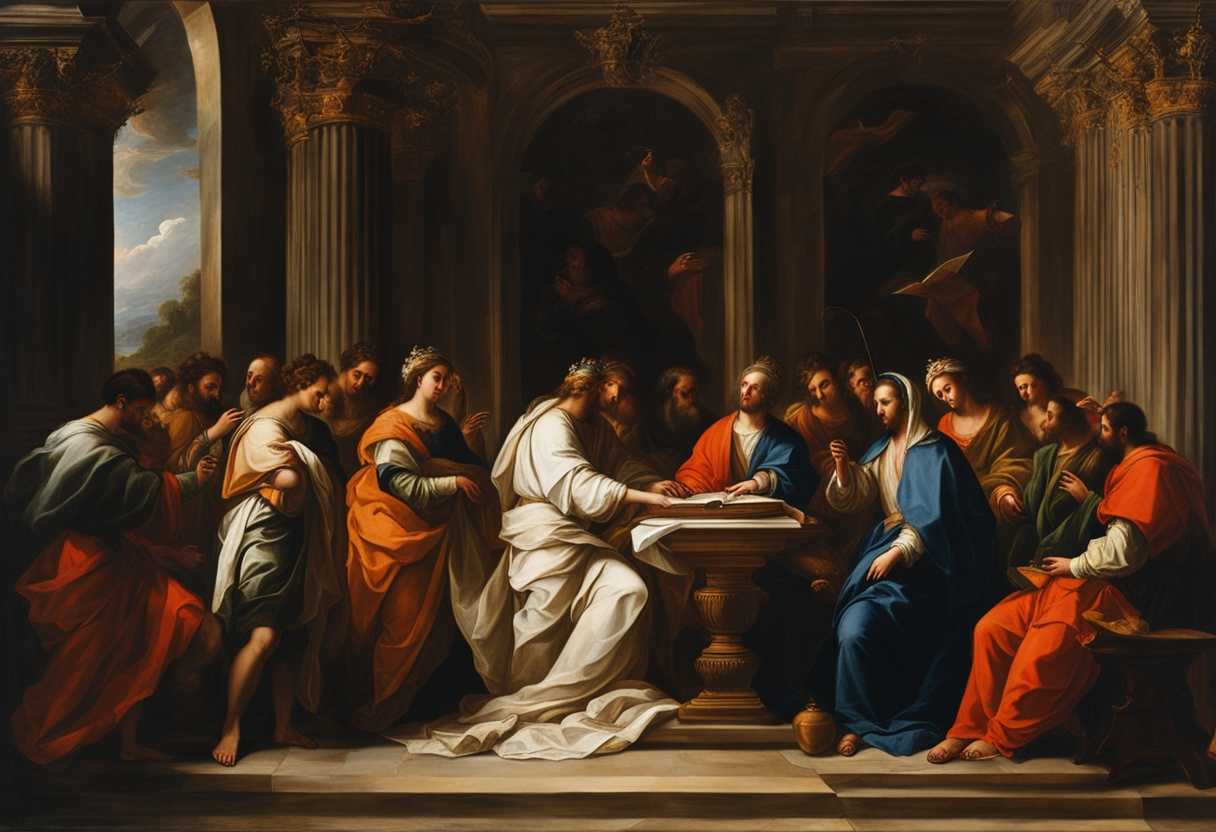
Ritual significance in the Bible refers to the importance and meaning associated with specific religious practices and ceremonies, often symbolizing a covenant relationship with God or the community’s identity and devotion. These rituals serve as expressions of faith and obedience, illustrating spiritual truths and the divine order intended for worship and moral living.
Scripture
1 The Lord said to Moses and Aaron in the land of Egypt,
2 “This month shall be for you the beginning of months. It shall be the first month of the year for you.
3 Tell all the congregation of Israel that on the tenth day of this month every man shall take a lamb according to their fathers’ houses, a lamb for a household.
4 And if the household is too small for a lamb, then he and his nearest neighbor shall take according to the number of persons; according to what each can eat you shall make your count for the lamb.
5 Your lamb shall be without blemish, a male a year old.
6 and you shall keep it until the fourteenth day of this month, when the whole assembly of the congregation of Israel shall kill their lambs at twilight.
7 Then they shall take some of the blood and put it on the two doorposts and the lintel of the houses in which they eat it.
8 They shall eat the flesh that night, roasted on the fire; with unleavened bread and bitter herbs they shall eat it.
9 Do not eat any of it raw or boiled in water, but roasted, its head with its legs and its inner parts.
10 And you shall let none of it remain until the morning; anything that remains until the morning you shall burn.
11 In this manner you shall eat it: with your belt fastened, your sandals on your feet, and your staff in your hand. And you shall eat it in haste. It is the Lord’s Passover.
12 For I will pass through the land of Egypt that night, and I will strike all the firstborn in the land of Egypt, both man and beast; and on all the gods of Egypt I will execute judgments: I am the Lord.
13 The blood shall be a sign for you, on the houses where you are. And when I see the blood, I will pass over you, and no plague will befall you to destroy you when I strike the land of Egypt.
14 “This day shall be for you a memorial day, and you shall keep it as a feast to the Lord; throughout your generations, as a statute forever, you shall keep it as a feast.”
15 Seven days you shall eat unleavened bread. On the first day you shall remove leaven out of your houses, for if anyone eats what is leavened, from the first day until the seventh day, that person shall be cut off from Israel.
16 On the first day you shall hold a holy assembly, and on the seventh day a holy assembly. No work shall be done on those days. But what everyone needs to eat, that alone may be prepared by you.
17 And you shall observe the Feast of Unleavened Bread, for on this very day I brought your hosts out of the land of Egypt. Therefore you shall observe this day, throughout your generations, as a statute forever.
18 In the first month, from the fourteenth day of the month at evening, you shall eat unleavened bread until the twenty-first day of the month at evening.
19 For seven days no leaven is to be found in your houses. If anyone eats what is leavened, that person will be cut off from the congregation of Israel, whether he is a sojourner or a native of the land.
20 You shall eat nothing leavened; in all your dwelling places you shall eat unleavened bread.”
21 Then Moses called all the elders of Israel and said to them, “Go and select lambs for yourselves according to your clans, and kill the Passover lamb.
22 Take a bunch of hyssop and dip it in the blood that is in the basin, and touch the lintel and the two doorposts with the blood that is in the basin. None of you shall go out of the door of his house until the morning.
23 For the Lord will pass through to strike the Egyptians, and when he sees the blood on the lintel and on the two doorposts, the Lord will pass over the door and will not allow the destroyer to enter your houses to strike you.
24 You shall observe this rite as a statute for you and for your sons forever.
25 And when you come to the land that the Lord will give you, as he has promised, you shall keep this service.
26 And when your children say to you, ‘What do you mean by this service?’
27 Then you shall say, ‘It is the sacrifice of the Lord’s Passover, for he passed over the houses of the people of Israel in Egypt, when he struck the Egyptians but spared our houses.’” And the people bowed their heads and worshiped.
28 Then the people of Israel went and did so; as the Lord had commanded Moses and Aaron, so they did.
Biblical Significance of Rituals
Ritual significance in the Bible reflects the deep connection between the people of Israel and their covenant with God, serving as a tangible means to express their faith and identity. Numerous scriptures highlight how rituals embody both communal and individual relationships with the divine. For instance, in Exodus 12, the Passover ritual not only commemorates the Israelites’ deliverance from Egypt but also fosters a shared remembrance of God’s salvation, reinforcing their identity as His chosen people. The eating of unleavened bread and the annual reliving of this event remind them of their origins and God’s continued presence in their lives (Exodus 12:14). This emphasis on memory and symbolism underlines the significance of rituals in fostering community and identity, as rituals are intended not only for personal devotion but also to maintain communal bonds through shared practices.
Moreover, rituals often serve as a means of moral instruction and spiritual reflection, illustrating deeper truths about God’s nature and expectations. For example, the ritual of sacrifices established in Leviticus, such as the Day of Atonement (Leviticus 16), encapsulates the themes of sin, redemption, and reconciliation, offering insights into the seriousness of sin and the necessity of atonement to restore fellowship with God. Similarly, Jesus’ practice of foot washing in John 13:1-17 acts as both a ritual and a teaching moment, symbolizing humility, service, and love that He calls His disciples to emulate. Thus, rituals in the biblical text are not merely acts of worship but are imbued with profound theological and ethical significance, illustrating the relational dynamics between God and humanity and offering guiding principles for living in accordance with divine will.
The concept of ritual significance in the Bible further extends into various aspects of Israelite life, showcasing how customs and practices are intricately woven into the fabric of their spiritual and communal existence. A notable example is the Festival of Weeks, also known as Shavuot, detailed in Deuteronomy 16:9-12. This festival, celebrated fifty days after Passover, marks the end of the grain harvest and serves as a time of gratitude to God for His provision. The act of bringing first-fruits to the temple not only reinforces the community’s dependence on God but also serves to remind them of their responsibilities to one another. Receiving these gifts in community fosters a sense of solidarity and shared blessings, highlighting the social dimension embedded within their rituals.
In addition, the practice of ritual purity, as outlined in Leviticus, emphasizes the importance of holiness and separation in the life of Israel. These purification rituals, which include rites for cleansing after childbirth or addressing leprosy (Leviticus 11-15), symbolize the continual need for the people to be set apart for God’s service. Such practices underline a profound understanding that physical cleanliness can reflect spiritual states, thereby influencing moral behavior and societal health. The communal aspect of these rituals facilitates the teaching of spiritual values, promoting accountability and collective identity rooted in holiness. The biblical approach to rituals thus encompasses not only acts of devotion but also communal ethics, socio-political implications, and the holistic development of the community in fulfilling their covenantal relationship with God.
The Covenant Relationship with God
Rituals in the Bible often serve to reinforce the covenant relationship between God and His people. They act as tangible expressions of faith and commitment, reminding the community of their unique identity as chosen by God. Through rituals, believers acknowledge their dependence on divine grace and the promises made by God, fostering a sense of belonging and responsibility within the community.
Community and Identity Formation
Rituals also play a crucial role in shaping the identity of the community. They create shared experiences that bind individuals together, fostering unity and collective memory. By participating in communal rituals, members reinforce their shared beliefs, values, and history, which helps to cultivate a strong sense of identity and purpose within the faith community.
Spiritual Transformation and Renewal
Rituals in the Bible often signify moments of spiritual transformation and renewal. They provide opportunities for individuals to reflect on their lives, seek forgiveness, and recommit themselves to their faith. Through acts of worship, sacrifice, and observance, believers engage in a process of inner change, allowing them to grow closer to God and align their lives with His will.
How to Embrace Sacred Practices for Spiritual Growth
Embracing sacred practices is a beautiful way to deepen your spiritual journey and grow closer to God. Start by carving out intentional time for prayer and meditation, allowing yourself to be still and listen for His voice amidst the noise of daily life. Consider incorporating scripture reading into your routine, not just as a task, but as a way to encounter God’s heart and wisdom. Journaling can also be a powerful tool; write down your thoughts, prayers, and reflections to track your spiritual growth and recognize God’s faithfulness over time. Additionally, engage in communal worship and service, as these practices remind us that we are part of a larger body of believers, called to love and support one another. Remember, it’s not about perfection but about progress; each small step you take in these sacred practices can lead to profound transformation in your relationship with Christ.
Bible References to Ritual Significance:
Leviticus 16:1-34: 1 The Lord spoke to Moses after the death of the two sons of Aaron, when they drew near before the Lord and died,
2 and the Lord said to Moses, “Tell Aaron your brother not to come at any time into the Holy Place inside the veil, before the mercy seat that is on the ark, so that he may not die. For I will appear in the cloud over the mercy seat.
3 But in this way Aaron shall come into the Holy Place: with a bull from the herd for a sin offering and a ram for a burnt offering.
4 He shall put on the holy linen coat and shall have the linen undergarment on his body, and he shall tie the linen sash around his waist, and wear the linen turban; these are the holy garments. He shall bathe his body in water and then put them on.
5 And he shall take from the congregation of the people of Israel two male goats for a sin offering, and one ram for a burnt offering.
6 “Aaron shall offer the bull as a sin offering for himself and shall make atonement for himself and for his house.
7 Then he shall take the two goats and set them before the Lord at the entrance of the tent of meeting.
8 And Aaron shall cast lots over the two goats, one lot for the Lord and the other lot for Azazel.
9 And Aaron shall present the goat on which the lot fell for the Lord and use it as a sin offering,
10 But the goat on which the lot fell for Azazel shall be presented alive before the Lord to make atonement over it, that it may be sent away into the wilderness to Azazel.
11 “Aaron shall present the bull as a sin offering for himself, and shall make atonement for himself and for his house.
12 And he shall take a censer full of coals of fire from the altar before the Lord, and two handfuls of sweet incense beaten small, and he shall bring it inside the veil
13 and put the incense on the fire before the Lord, that the cloud of the incense may cover the mercy seat that is over the testimony, so that he does not die.
14 And he shall take some of the blood of the bull and sprinkle it with his finger on the front of the mercy seat on the east side, and in front of the mercy seat he shall sprinkle some of the blood with his finger seven times.
15 “Then he shall kill the goat of the sin offering that is for the people and bring its blood inside the veil and do with its blood as he did with the blood of the bull, sprinkling it over the mercy seat and in front of the mercy seat.”
16 Thus he shall make atonement for the Holy Place, because of the uncleannesses of the people of Israel and because of their transgressions, all their sins. And so he shall do for the tent of meeting, which dwells with them in the midst of their uncleannesses.
17 There shall be no man in the tent of meeting when he enters to make atonement in the Holy Place, until he comes out and has made atonement for himself and for his house and for all the assembly of Israel.
18 Then he shall go out to the altar that is before the Lord and make atonement for it, and shall take some of the blood of the bull and some of the blood of the goat, and put it on the horns of the altar all around.
19 He shall sprinkle some of the blood on it with his finger seven times and cleanse it and consecrate it from the uncleannesses of the people of Israel.
20 “And when he has made an end of atoning for the Holy Place and the tent of meeting and the altar, he shall present the live goat.”
21 And Aaron shall lay both his hands on the head of the live goat, and confess over it all the iniquities of the people of Israel, and all their transgressions, all their sins. And he shall put them on the head of the goat and send it away into the wilderness by the hand of a man who is in readiness.
22 And the goat shall bear all their iniquities on itself to a remote area, and he shall let the goat go free in the wilderness.
23 Then Aaron shall come into the tent of meeting and shall take off the linen garments that he put on when he went into the Holy Place and shall leave them there.
24 And he shall bathe his body in water in a holy place and put on his garments and come out and offer his burnt offering and the burnt offering of the people and make atonement for himself and for the people.
25 And the fat of the sin offering he shall burn on the altar.
26 And he who lets the goat go to Azazel shall wash his clothes and bathe his body in water, and afterward he may come into the camp.
27 And the bull for the sin offering and the goat for the sin offering, whose blood was brought in to make atonement in the Holy Place, shall be carried outside the camp.
28 And he who burns them shall wash his clothes and bathe his body in water, and afterward he may come into the camp.
29 “And it shall be a statute to you forever that in the seventh month, on the tenth day of the month, you shall afflict yourselves and shall do no work, either the native or the stranger who sojourns among you.
30 for on this day shall atonement be made for you to cleanse you. You shall be clean before the Lord from all your sins.
31 It is a Sabbath of solemn rest to you, and you shall afflict yourselves; it is a statute forever.
32 And the priest who is anointed and consecrated as priest in his father’s place shall make atonement, wearing the holy linen garments.
33 and make atonement for the holy sanctuary, and he shall make atonement for the tent of meeting and for the altar, and he shall make atonement for the priests and for all the people of the assembly.
34 And this shall be a statute forever for you, that atonement may be made for the people of Israel once in the year because of all their sins.” And Aaron did as the Lord commanded Moses.
Numbers 9:1-14: 1 And the Lord spoke to Moses in the wilderness of Sinai, in the first month of the second year after they had come out of the land of Egypt, saying:
2 “Let the people of Israel keep the Passover at its appointed time.
3 On the fourteenth day of this month, at twilight, you shall keep it at its appointed time; according to all its statutes and all its rules you shall keep it.
4 So Moses told the people of Israel that they should keep the Passover.
5 And they kept the Passover in the first month, on the fourteenth day of the month, at twilight, in the wilderness of Sinai; according to all that the Lord commanded Moses, so the people of Israel did.
6 And there were certain men who were unclean through touching a dead body, so that they could not keep the Passover on that day, and they came before Moses and Aaron on that day.
7 And those men said to him, “We are unclean through touching a dead body. Why are we kept from bringing the Lord’s offering at its appointed time among the people of Israel?”
8 And Moses said to them, “Wait, that I may hear what the Lord will command concerning you.”
9 And the Lord spoke to Moses, saying,
10 “Speak to the people of Israel, saying, If any one of you or of your descendants is unclean through touching a dead body, or is on a long journey, he shall still keep the Passover to the Lord.”
11 In the second month on the fourteenth day at twilight, they shall keep it.
12 They shall leave none of it until the morning, nor break any of its bones; according to all the statute for the Passover they shall keep it.
13 But the man who is clean and is not on a journey, and yet fails to keep the Passover, that person shall be cut off from his people because he did not bring the Lord’s offering at its appointed time; that man shall bear his sin.
14 And if a stranger sojourns among you and would keep the Passover to the Lord, according to the statute of the Passover and according to its rule, so shall he do. You shall have one statute, both for the sojourner and for the native.”
Deuteronomy 16:1-17: 1 “Observe the month of Abib and keep the Passover to the Lord your God, for in the month of Abib the Lord your God brought you out of Egypt by night.
2 You shall offer the Passover sacrifice to the Lord your God, from the flock or the herd, at the place that the Lord will choose, to make his name dwell there.
3 You shall eat no leavened bread with it. Seven days you shall eat it with unleavened bread, the bread of affliction—for you came out of the land of Egypt in haste—that all the days of your life you may remember the day when you came out of the land of Egypt.
4 And no leaven shall be seen with you in all your territory for seven days, and none of the flesh that you sacrifice on the evening of the first day shall remain all night until morning.
5 You may not offer the Passover sacrifice within any of your towns that the Lord your God is giving you,
6 but at the place that the Lord your God will choose, to make his name dwell in it, there you shall offer the Passover sacrifice, in the evening at sunset, at the time you came out of Egypt.
7 You shall cook it and eat it at the place that the Lord your God will choose. And in the morning you shall turn and go to your tents.
8 Six days you shall eat unleavened bread, and on the seventh day there shall be a solemn assembly to the Lord your God. You shall do no work on it.
9 You shall count seven weeks. Begin to count the seven weeks from the time the sickle is first put to the standing grain.
10 Then you shall keep the Feast of Weeks to the Lord your God with the tribute of a freewill offering from your hand, which you shall give as the Lord your God blesses you.
11 You shall rejoice before the Lord your God, you and your son and your daughter, your male servant and your female servant, the Levite who is within your towns, the sojourner, the fatherless, and the widow who are among you, at the place that the Lord your God will choose, to make his name dwell there.
12 You shall remember that you were a slave in Egypt; and you shall be careful to observe these statutes.
13 “You shall keep the Feast of Booths seven days, when you have gathered in the produce from your threshing floor and your winepress.”
14 You shall rejoice in your feast, you and your son and your daughter, your male servant and your female servant, the Levite, the sojourner, the fatherless, and the widow who are within your towns.
15 Seven days you shall keep a solemn feast to the Lord your God in the place that the Lord will choose, because the Lord your God will bless you in all your produce and in all the work of your hands, so that you will be altogether joyful.
16 “Three times a year all your males shall appear before the Lord your God at the place that he will choose: at the Feast of Unleavened Bread, at the Feast of Weeks, and at the Feast of Booths. They shall not appear before the Lord empty-handed.”
17 Every man shall give as he is able, according to the blessing of the Lord your God that he has given you.
1 Kings 8:1-66: 1 Then Solomon assembled the elders of Israel and all the heads of the tribes, the leaders of the fathers’ houses of the people of Israel, before King Solomon in Jerusalem, to bring up the ark of the covenant of the Lord out of the city of David, which is Zion.
2 And all the men of Israel assembled to King Solomon at the feast in the month Ethanim, which is the seventh month.
3 And all the elders of Israel came, and the priests took up the ark.
4 And they brought up the ark of the Lord, the tent of meeting, and all the holy vessels that were in the tent; the priests and the Levites brought them up.
5 And King Solomon and all the congregation of Israel, who had assembled before him, were with him before the ark, sacrificing so many sheep and oxen that they could not be counted or numbered.
6 Then the priests brought the ark of the covenant of the Lord to its place in the inner sanctuary of the house, in the Most Holy Place, underneath the wings of the cherubim.
7 For the cherubim spread out their wings over the place of the ark, so that the cherubim overshadowed the ark and its poles.
8 And the poles were so long that the ends of the poles were seen from the Holy Place before the inner sanctuary; but they could not be seen from outside. And they are there to this day.
9 There was nothing in the ark except the two tablets of stone that Moses put there at Horeb, where the Lord made a covenant with the people of Israel, when they came out of the land of Egypt.
10 And when the priests came out of the Holy Place, a cloud filled the house of the Lord,
11 so that the priests could not stand to minister because of the cloud, for the glory of the Lord filled the house of the Lord.
12 Then Solomon said, “The Lord has said that he would dwell in thick darkness.
13 I have indeed built you an exalted house, a place for you to dwell in forever.”
14 Then the king turned around and blessed all the assembly of Israel, while all the assembly of Israel stood.
15 And he said, “Blessed be the Lord, the God of Israel, who with his hand has fulfilled what he promised with his mouth to David my father, saying,
16 Since the day that I brought my people Israel out of Egypt, I chose no city out of all the tribes of Israel in which to build a house, that my name might be there. But I chose David to be over my people Israel.
17 Now it was in the heart of David my father to build a house for the name of the Lord, the God of Israel.
18 “But the Lord said to David my father, ‘Whereas it was in your heart to build a house for my name, you did well that it was in your heart.’”
19 Nevertheless, you shall not build the house, but your son who shall be born to you shall build the house for my name.’
20 Now the Lord has fulfilled his promise that he made. I have risen in the place of David my father, and sit on the throne of Israel, as the Lord promised, and I have built the house for the name of the Lord, the God of Israel.
21 And there I have provided a place for the ark, in which is the covenant of the Lord that he made with our fathers, when he brought them out of the land of Egypt.
22 Then Solomon stood before the altar of the Lord in the presence of all the assembly of Israel and spread out his hands toward heaven,
23 and said, “O Lord, God of Israel, there is no God like you, in heaven above or on earth beneath, keeping covenant and showing steadfast love to your servants who walk before you with all their heart,
24 who have kept with your servant David my father what you declared to him. You spoke with your mouth, and with your hand have fulfilled it this day.
25 Now therefore, O Lord, God of Israel, keep for your servant David my father what you promised him, saying, ‘You shall not lack a man to sit before me on the throne of Israel, if only your sons pay close attention to their way, to walk before me as you have walked before me.’
26 Now therefore, O God of Israel, let your word be confirmed, which you have spoken to your servant David my father.
27 “But will God indeed dwell on the earth? Behold, heaven and the highest heaven cannot contain you; how much less this house that I have built!”
28 Yet have regard to the prayer of your servant and to his plea, O Lord my God, listening to the cry and to the prayer that your servant prays before you this day,
29 that your eyes may be open night and day toward this house, the place of which you have said, ‘My name shall be there,’ that you may listen to the prayer that your servant offers toward this place.
30 And listen to the plea of your servant and of your people Israel, when they pray toward this place. And listen in heaven your dwelling place, and when you hear, forgive.
31 “If a man sins against his neighbor and is made to take an oath and comes and swears his oath before your altar in this house,”
32 then hear in heaven and act and judge your servants, condemning the guilty by bringing his conduct on his own head, and vindicating the righteous by rewarding him according to his righteousness.
33 “When your people Israel are defeated before the enemy because they have sinned against you, and if they turn again to you and acknowledge your name and pray and plead with you in this house,”
34 then hear in heaven and forgive the sin of your people Israel and bring them again to the land that you gave to their fathers.
35 “When heaven is shut up and there is no rain because they have sinned against you, if they pray toward this place and acknowledge your name and turn from their sin, when you afflict them,”
36 then hear in heaven and forgive the sin of your servants, your people Israel, when you teach them the good way in which they should walk, and grant rain upon your land, which you have given to your people as an inheritance.
37 “If there is famine in the land, if there is pestilence or blight or mildew or locust or caterpillar, if their enemy besieges them in the land at their gates, whatever plague, whatever sickness there is,”
38 whatever prayer, whatever plea is made by any man or by all your people Israel, each knowing the affliction of his own heart and stretching out his hands toward this house,
39 then hear in heaven your dwelling place and forgive and act and render to each whose heart you know, according to all his ways (for you, you only, know the hearts of all the children of mankind),
40 that they may fear you all the days that they live in the land that you gave to our fathers.
41 “Likewise, when a foreigner, who is not of your people Israel, comes from a far country for your name’s sake
42 (for they shall hear of your great name and your mighty hand, and of your outstretched arm), when he comes and prays toward this house,
43 “hear in heaven your dwelling place and do according to all for which the foreigner calls to you, in order that all the peoples of the earth may know your name and fear you, as do your people Israel, and that they may know that this house that I have built is called by your name.”
44 “If your people go out to battle against their enemy, by whatever way you shall send them, and they pray to the Lord toward the city that you have chosen and the house that I have built for your name,”
45 then hear in heaven their prayer and their plea, and maintain their cause.
46 “If they sin against you—for there is no one who does not sin—and you are angry with them and give them to an enemy, so that they are carried away captive to the land of the enemy, far off or near,”
47 yet if they turn their heart in the land to which they have been carried captive, and repent and plead with you in the land of their captors, saying, ‘We have sinned and have acted perversely and wickedly,’
48 if they repent with all their mind and with all their heart in the land of their enemies, who carried them captive, and pray to you toward their land, which you gave to their fathers, the city that you have chosen, and the house that I have built for your name,
49 then hear in heaven your dwelling place their prayer and their plea, and maintain their cause,
50 and forgive your people who have sinned against you, and all their transgressions that they have committed against you, and grant them compassion in the sight of those who carried them captive, that they may have compassion on them.
51 (for they are your people, and your heritage, which you brought out of Egypt, from the midst of the iron furnace).
52 Let your eyes be open to the plea of your servant and to the plea of your people Israel, giving ear to them whenever they call to you.
53 for you separated them from among all the peoples of the earth to be your heritage, as you declared through Moses your servant, when you brought our fathers out of Egypt, O Lord God.”
54 Now as Solomon finished offering all this prayer and plea to the Lord, he arose from before the altar of the Lord, where he had knelt with hands outstretched toward heaven.
55 And he stood and blessed all the assembly of Israel with a loud voice, saying:
56 “Blessed be the Lord who has given rest to his people Israel, according to all that he promised. Not one word has failed of all his good promise, which he spoke by Moses his servant.”
57 be with us, as he was with our fathers. May he not leave us or forsake us,
58 that he may incline our hearts to him, to walk in all his ways and to keep his commandments, his statutes, and his rules, which he commanded our fathers.
59 Let these words of mine, with which I have pleaded before the Lord, be near to the Lord our God day and night, and may he maintain the cause of his servant and the cause of his people Israel, as each day requires,
60 that all the peoples of the earth may know that the Lord is God; there is no other.
61 Let your heart therefore be wholly true to the Lord our God, walking in his statutes and keeping his commandments, as at this day.”
62 Then the king, and all Israel with him, offered sacrifice before the Lord.
63 Solomon offered as peace offerings to the Lord 22,000 oxen and 120,000 sheep. So the king and all the people of Israel dedicated the house of the Lord.
64 The same day the king consecrated the middle of the court that was before the house of the Lord, for there he offered the burnt offering and the grain offering and the fat pieces of the peace offerings, because the bronze altar that was before the Lord was too small to receive the burnt offering and the grain offering and the fat pieces of the peace offerings.
65 So Solomon held the feast at that time, and all Israel with him, a great assembly, from Lebo-hamath to the Brook of Egypt, before the Lord our God, seven days.
66 On the eighth day he sent the people away, and they blessed the king and went to their homes joyful and glad of heart for all the goodness that the Lord had shown to David his servant and to Israel his people.
2 Chronicles 30:1-27: 1 Hezekiah sent to all Israel and Judah, and wrote letters also to Ephraim and Manasseh, that they should come to the house of the Lord at Jerusalem to keep the Passover to the Lord, the God of Israel.
2 For the king and his princes and all the assembly in Jerusalem had taken counsel to keep the Passover in the second month.
3 for they could not keep it at that time, because the priests had not consecrated themselves in sufficient number, nor had the people assembled in Jerusalem.
4 The plan seemed right to the king and all the assembly.
5 So they decreed to make a proclamation throughout all Israel, from Beersheba to Dan, that the people should come and keep the Passover to the Lord, the God of Israel, at Jerusalem, for they had not kept it as often as prescribed.
6 So couriers went throughout all Israel and Judah with letters from the king and his princes, as the king had commanded, saying, “O people of Israel, return to the Lord, the God of Abraham, Isaac, and Israel, that he may turn again to the remnant of you who have escaped from the hand of the kings of Assyria.
7 Do not be like your fathers and your brothers, who were faithless to the Lord God of their fathers, so that he made them a desolation, as you see.
8 Do not be like your fathers and your brothers, who were faithless to the Lord God of their fathers, so that he made them a desolation, as you see.
9 For if you return to the Lord, your brothers and your children will find compassion with their captors and return to this land. For the Lord your God is gracious and merciful and will not turn away his face from you, if you return to him.”
10 So the couriers went from city to city through the country of Ephraim and Manasseh, and as far as Zebulun, but they laughed them to scorn and mocked them.
11 However, some men of Asher, of Manasseh, and of Zebulun humbled themselves and came to Jerusalem.
12 The hand of God was also on Judah to give them one heart to do what the king and the princes commanded by the word of the Lord.
13 And many people came together in Jerusalem to keep the Feast of Unleavened Bread in the second month, a very great assembly.
14 They set to work and removed the altars that were in Jerusalem, and all the altars for burning incense they took away and threw into the Kidron Valley.
15 They slaughtered the Passover lamb on the fourteenth day of the second month. And the priests and the Levites were ashamed, so they consecrated themselves and brought burnt offerings into the house of the Lord.
16 They took their accustomed posts according to the Law of Moses the man of God. The priests threw the blood that they received from the hand of the Levites.
17 For there were many in the assembly who had not consecrated themselves. So the Levites had to slaughter the Passover lamb for everyone who was not clean, to consecrate it to the Lord.
18 For a majority of the people, many of them from Ephraim, Manasseh, Issachar, and Zebulun, had not cleansed themselves, yet they ate the Passover otherwise than as prescribed. But Hezekiah prayed for them, saying, “May the good Lord pardon everyone
19 that has set his heart to seek God, the Lord, the God of his fathers, even though not according to the sanctuary’s rules of cleanness.”
20 And the Lord heard Hezekiah and healed the people.
21 And the people of Israel who were present at Jerusalem kept the Feast of Unleavened Bread seven days with great gladness, and the Levites and the priests praised the Lord day by day, singing with all their might to the Lord.
22 And Hezekiah spoke encouragingly to all the Levites who showed good skill in the service of the Lord. So they ate the food of the festival for seven days, sacrificing peace offerings and giving thanks to the Lord, the God of their fathers.
23 And the whole assembly agreed to keep the feast for another seven days, and they kept it for another seven days with gladness.
24 For Hezekiah king of Judah gave the assembly a thousand bulls and seven thousand sheep for offerings, and the princes gave the assembly a thousand bulls and ten thousand sheep. And the priests consecrated themselves in great numbers.
25 The whole assembly of Judah, and the priests and the Levites, and the whole assembly that came out of Israel, and the sojourners who came out of the land of Israel, and the sojourners who lived in Judah, rejoiced.
26 So there was great joy in Jerusalem, for since the time of Solomon the son of David king of Israel there had been nothing like this in Jerusalem.
27 Then the priests and the Levites arose and blessed the people, and their voice was heard, and their prayer came to his holy habitation in heaven.
Ezra 3:1-6: 3 When the seventh month came, and the children of Israel were in the towns, the people gathered as one man to Jerusalem.
2 Then Jeshua the son of Jozadak and his fellow priests arose and built the altar of the God of Israel, to offer burnt offerings on it, as it is written in the Law of Moses the man of God.
3 They set the altar in its place, for fear was on them because of the peoples of the lands, and they offered burnt offerings on it to the Lord, burnt offerings morning and evening.
4 And they kept the Feast of Booths, as it is written, and offered the daily burnt offerings by number according to the rule, as each day required,
5 and after that the regular burnt offerings, the offerings at the new moon and at all the appointed feasts of the Lord, and the offerings of everyone who made a freewill offering to the Lord.
6 From the first day of the seventh month they began to offer burnt offerings to the Lord. But the foundation of the temple of the Lord was not yet laid.
Nehemiah 8:13-18: 13 On the second day the heads of fathers’ houses of all the people, with the priests and the Levites, came together to Ezra the scribe in order to study the words of the Law.
14 And they found it written in the Law that the Lord had commanded by Moses that the people of Israel should dwell in booths during the feast of the seventh month,
15 and that they should proclaim it and publish it in all their towns and in Jerusalem, “Go out to the hills and bring branches of olive, wild olive, myrtle, palm, and other leafy trees to make booths, as it is written.”
16 So the people went out and brought them and made booths for themselves, each on his roof, and in their courts and in the courts of the house of God, and in the square at the Water Gate and in the square at the Gate of Ephraim.
17 And all the assembly of those who had returned from the captivity made booths and lived in the booths, for from the days of Jeshua the son of Nun to that day the people of Israel had not done so. And there was very great rejoicing.
18 And day by day, from the first day to the last day, he read from the Book of the Law of God. They kept the feast seven days, and on the eighth day there was a solemn assembly, according to the rule.
Psalm 50:7-15: 7 “Hear, O my people, and I will speak; O Israel, I will testify against you. I am God, your God.”
8 Not for your sacrifices do I rebuke you; your burnt offerings are continually before me.
9 I will not accept a bull from your house or goats from your folds.
10 For every beast of the forest is mine, the cattle on a thousand hills.
11 I know all the birds of the hills, and all that moves in the field is mine.
12 If I were hungry, I would not tell you, for the world and its fullness are mine.
13 Do I eat the flesh of bulls or drink the blood of goats?
14 Offer to God a sacrifice of thanksgiving, and perform your vows to the Most High.
15 and call upon me in the day of trouble; I will deliver you, and you shall glorify me.
Isaiah 1:10-17: 10 Hear the word of the Lord, you rulers of Sodom! Give ear to the teaching of our God, you people of Gomorrah!
11 “What to me is the multitude of your sacrifices? says the Lord; I have had enough of burnt offerings of rams and the fat of well-fed beasts; I do not delight in the blood of bulls, or of lambs, or of goats.”
12 “When you come to appear before me,
who has required of you
this trampling of my courts?
13 Bring no more vain offerings; incense is an abomination to me.
14 Your new moons and your appointed feasts my soul hates; they have become a burden to me; I am weary of bearing them.
15 When you spread out your hands,
I will hide my eyes from you;
even though you make many prayers,
I will not listen;
your hands are full of blood.
16 Wash yourselves; make yourselves clean; remove the evil of your deeds from before my eyes; cease to do evil,
17 learn to do good;
seek justice,
correct oppression;
bring justice to the fatherless,
plead the widow’s cause.
Jeremiah 7:21-26: 21 Thus says the Lord of hosts, the God of Israel: “Add your burnt offerings to your sacrifices, and eat the flesh.
22 For in the day that I brought them out of the land of Egypt, I did not speak to your fathers or command them concerning burnt offerings and sacrifices.
23 But this command I gave them: ‘Obey my voice, and I will be your God, and you shall be my people. And walk in all the way that I command you, that it may be well with you.’
24 But they did not obey or incline their ear, but walked in their own counsels and the stubbornness of their evil hearts, and went backward and not forward.
25 From the day that your fathers came out of the land of Egypt to this day, I have persistently sent all my servants the prophets to them, day after day.
26 Yet they did not listen to me or incline their ear, but stiffened their neck. They did worse than their fathers.
Ezekiel 45:18-25: 18 “Thus says the Lord God: In the first month, on the first day of the month, you shall take a bull from the herd without blemish, and purify the sanctuary.”
19 The priest shall take some of the blood of the sin offering and put it on the doorposts of the temple, the four corners of the ledge of the altar, and the posts of the gate of the inner court.
20 You shall do the same on the seventh day of the month for anyone who has sinned through error or ignorance; so you shall make atonement for the temple.
21 “In the first month, on the fourteenth day of the month, you shall celebrate the Feast of the Passover, and for seven days unleavened bread shall be eaten.
22 On that day the prince shall provide for himself and all the people of the land a young bull for a sin offering.
23 And during the seven days of the feast he shall provide as a burnt offering to the Lord seven young bulls and seven rams without blemish, on each of the seven days; and a male goat daily for a sin offering.
24 And he shall provide as a grain offering an ephah for each bull, an ephah for each ram, and a hin of oil for each ephah.
25 In the seventh month, on the fifteenth day of the month, at the feast, he shall make the same provision for the sin offering, burnt offering, and grain offering, and for the oil.
Matthew 26:17-30: 17 Now on the first day of Unleavened Bread the disciples came to Jesus, saying, “Where will you have us prepare for you to eat the Passover?”
18 He said, “Go into the city to a certain man and say to him, ‘The Teacher says, My time is at hand. I will keep the Passover at your house with my disciples.’”
19 So the disciples did as Jesus had directed them, and they prepared the Passover.
20 When it was evening, he reclined at table with the twelve.
21 And as they were eating, he said, “Truly, I say to you, one of you will betray me.”
22 And they were very sorrowful and began to say to him one after another, “Is it I, Lord?”
23 He answered, “He who has dipped his hand in the dish with me will betray me.
24 The Son of Man goes as it is written of him, but woe to that man by whom the Son of Man is betrayed! It would have been better for that man if he had not been born.
25 Judas, who would betray him, answered, “Is it I, Rabbi?” He said to him, “You have said so.”
26 Now as they were eating, Jesus took bread, and after blessing it broke it and gave it to the disciples, and said, “Take, eat; this is my body.”
27 And he took a cup, and when he had given thanks he gave it to them, saying, “Drink of it, all of you,
28 for this is my blood of the covenant, which is poured out for many for the forgiveness of sins.
29 I tell you I will not drink again of this fruit of the vine until that day when I drink it new with you in my Father’s kingdom.”
30 And when they had sung a hymn, they went out to the Mount of Olives.
Mark 14:12-26: 12 And on the first day of Unleavened Bread, when they sacrificed the Passover lamb, his disciples said to him, “Where will you have us go and prepare for you to eat the Passover?”
13 And he sent two of his disciples and said to them, “Go into the city, and a man carrying a jar of water will meet you. Follow him,
14 And wherever he enters, say to the master of the house, ‘The Teacher says, Where is my guest room, where I may eat the Passover with my disciples?’
15 And he will show you a large upper room furnished and ready; there prepare for us.”
16 And the disciples set out and went to the city and found it just as he had told them, and they prepared the Passover.
17 And when it was evening, he came with the twelve.
18 And as they were reclining at table and eating, Jesus said, “Truly, I say to you, one of you will betray me, one who is eating with me.”
19 They began to be sorrowful and to say to him one after another, “Is it I?”
20 He said to them, “It is one of the twelve, one who is dipping bread into the dish with me.
21 For the Son of Man goes as it is written of him, but woe to that man by whom the Son of Man is betrayed! It would have been better for that man if he had not been born.
22 And as they were eating, he took bread, and after blessing it broke it and gave it to them, and said, “Take; this is my body.”
23 And he took a cup, and when he had given thanks he gave it to them, and they all drank of it.
24 And he said to them, “This is my blood of the covenant, which is poured out for many.
25 Truly, I say to you, I will not drink again of the fruit of the vine until that day when I drink it new in the kingdom of God.”
26 And when they had sung a hymn, they went out to the Mount of Olives.
Luke 22:7-20: 7 Then came the day of Unleavened Bread, on which the Passover lamb had to be sacrificed.
8 Jesus sent Peter and John, saying, “Go and prepare the Passover for us, that we may eat it.”
9 And they said to him, “Where will you have us prepare it?”
10 And he said to them, “Behold, when you have entered the city, a man carrying a jar of water will meet you. Follow him into the house that he enters.
11 and tell the master of the house, ‘The Teacher says to you, Where is the guest room, where I may eat the Passover with my disciples?’
12 And he will show you a large upper room furnished; prepare it there.”
13 And they went and found it just as he had told them, and they prepared the Passover.
14 And when the hour came, he reclined at table, and the apostles with him.
15 And he said to them, “I have earnestly desired to eat this Passover with you before I suffer.
16 for I tell you I will not eat it until it is fulfilled in the kingdom of God.”
17 And he took a cup, and when he had given thanks he said, “Take this, and divide it among yourselves.
18 for I tell you that from now on I will not drink of the fruit of the vine until the kingdom of God comes.”
19 And he took bread, and when he had given thanks, he broke it and gave it to them, saying, “This is my body, which is given for you. Do this in remembrance of me.”
20 And likewise the cup after they had eaten, saying, “This cup that is poured out for you is the new covenant in my blood.
John 13:1-17: 1 Now before the Feast of the Passover, when Jesus knew that his hour had come to depart out of this world to the Father, having loved his own who were in the world, he loved them to the end.
2 During supper, when the devil had already put it into the heart of Judas Iscariot, Simon’s son, to betray him,
3 Jesus, knowing that the Father had given all things into his hands, and that he had come from God and was going back to God,
4 rose from supper. He laid aside his outer garments, and taking a towel, tied it around his waist.
5 Then he poured water into a basin and began to wash the disciples’ feet and to wipe them with the towel that was wrapped around him.
6 He came to Simon Peter, who said to him, “Lord, do you wash my feet?”
7 Jesus answered him, “What I am doing you do not understand now, but afterward you will understand.”
8 Peter said to him, “You shall never wash my feet.” Jesus answered him, “If I do not wash you, you have no share with me.”
9 Simon Peter said to him, “Lord, not my feet only but also my hands and my head!”
10 Jesus said to him, “The one who has bathed does not need to wash, except for his feet, but is completely clean. And you are clean, but not every one of you.”
11 For he knew who was to betray him; that was why he said, “Not all of you are clean.”
12 When he had washed their feet and put on his outer garments and resumed his place, he said to them, “Do you understand what I have done to you?
13 You call me Teacher and Lord, and you are right, for so I am.
14 If I then, your Lord and Teacher, have washed your feet, you also ought to wash one another’s feet.
15 For I have given you an example, that you also should do just as I have done to you.
16 Truly, truly, I say to you, a servant is not greater than his master, nor is a messenger greater than the one who sent him.
17 If you know these things, blessed are you if you do them.
Acts 2:1-4: 1 When the day of Pentecost arrived, they were all together in one place.
2 And suddenly there came from heaven a sound like a mighty rushing wind, and it filled the entire house where they were sitting.
3 And divided tongues as of fire appeared to them and rested on each one of them.
4 And they were all filled with the Holy Spirit and began to speak in other tongues as the Spirit gave them utterance.
1 Corinthians 11:23-26: 23 For I received from the Lord what I also delivered to you, that the Lord Jesus on the night when he was betrayed took bread,
24 and when he had given thanks, he broke it, and said, “This is my body, which is for you. Do this in remembrance of me.”
25 In the same way also he took the cup, after supper, saying, “This cup is the new covenant in my blood. Do this, as often as you drink it, in remembrance of me.”
26 For as often as you eat this bread and drink the cup, you proclaim the Lord’s death until he comes.
Hebrews 9:1-14: Now even the first covenant had regulations for worship and an earthly place of holiness.
2 For a tent was prepared, the first section, in which were the lampstand and the table and the bread of the Presence. It is called the Holy Place.
3 Behind the second curtain was a second section called the Most Holy Place,
4 having the golden altar of incense and the ark of the covenant covered on all sides with gold, in which was a golden urn holding the manna, and Aaron’s staff that budded, and the tablets of the covenant.
5 Above it were the cherubim of glory overshadowing the mercy seat.
6 These preparations having thus been made, the priests go regularly into the first section, performing their ritual duties.
7 but into the second only the high priest goes, and he but once a year, and not without taking blood, which he offers for himself and for the unintentional sins of the people.
8 By this the Holy Spirit indicates that the way into the holy places is not yet opened as long as the first section is still standing.
9 (which is symbolic for the present age). According to this arrangement, gifts and sacrifices are offered that cannot perfect the conscience of the worshiper,
10 but deal only with food and drink and various washings, regulations for the body imposed until the time of reformation.
11 But when Christ appeared as a high priest of the good things that have come, then through the greater and more perfect tent (not made with hands, that is, not of this creation)
12 he entered once for all into the holy places, not by means of the blood of goats and calves but by means of his own blood, thus securing an eternal redemption.
13 For if the blood of goats and bulls, and the sprinkling of defiled persons with the ashes of a heifer, sanctify for the purification of the flesh,
14 how much more will the blood of Christ, who through the eternal Spirit offered himself without blemish to God, purify our conscience from dead works to serve the living God.
Hebrews 10:1-18: 10 For since the law has but a shadow of the good things to come instead of the true form of these realities, it can never, by the same sacrifices that are continually offered every year, make perfect those who draw near.
2 Otherwise, would they not have ceased to be offered, since the worshipers, having once been cleansed, would no longer have any consciousness of sins?
3 But in these sacrifices there is a reminder of sins every year.
4 For it is impossible for the blood of bulls and goats to take away sins.
5 Consequently, when Christ came into the world, he said, “Sacrifices and offerings you have not desired, but a body have you prepared for me;
6 In burnt offerings and sin offerings you have taken no pleasure.
7 Then I said, ‘Behold, I have come to do your will, O God, as it is written of me in the scroll of the book.’
When he said above, “You have neither desired nor taken pleasure in sacrifices and offerings and burnt offerings and sin offerings” (these are offered according to the law),
9 then he added, “Behold, I have come to do your will.” He does away with the first in order to establish the second.
10 And by that will we have been sanctified through the offering of the body of Jesus Christ once for all.
11 And every priest stands daily at his service, offering repeatedly the same sacrifices, which can never take away sins.
12 But when Christ had offered for all time a single sacrifice for sins, he sat down at the right hand of God,
13 waiting from that time until his enemies should be made a footstool for his feet.
14 For by a single offering he has perfected for all time those who are being sanctified.
15 And the Holy Spirit also bears witness to us; for after saying,
16 “This is the covenant that I will make with them
after those days, declares the Lord:
I will put my laws on their hearts,
and write them on their minds,”
17 then he adds, “I will remember their sins and their lawless deeds no more.”
18 Where there is forgiveness of these, there is no longer any offering for sin.

Rev. François Dupont is a dedicated church minister with a wealth of experience in serving spiritual communities. With a calm and serene demeanor, he has been devoted to sharing the message of love, compassion, and tolerance for over two decades. Through his thoughtful sermons, compassionate counseling, and unwavering support, Rev. Dupont has touched the lives of countless individuals, allowing them to find solace and strength during difficult times. His serene presence and deep understanding of the human condition make him a trusted guide for those seeking spiritual nourishment and guidance.