
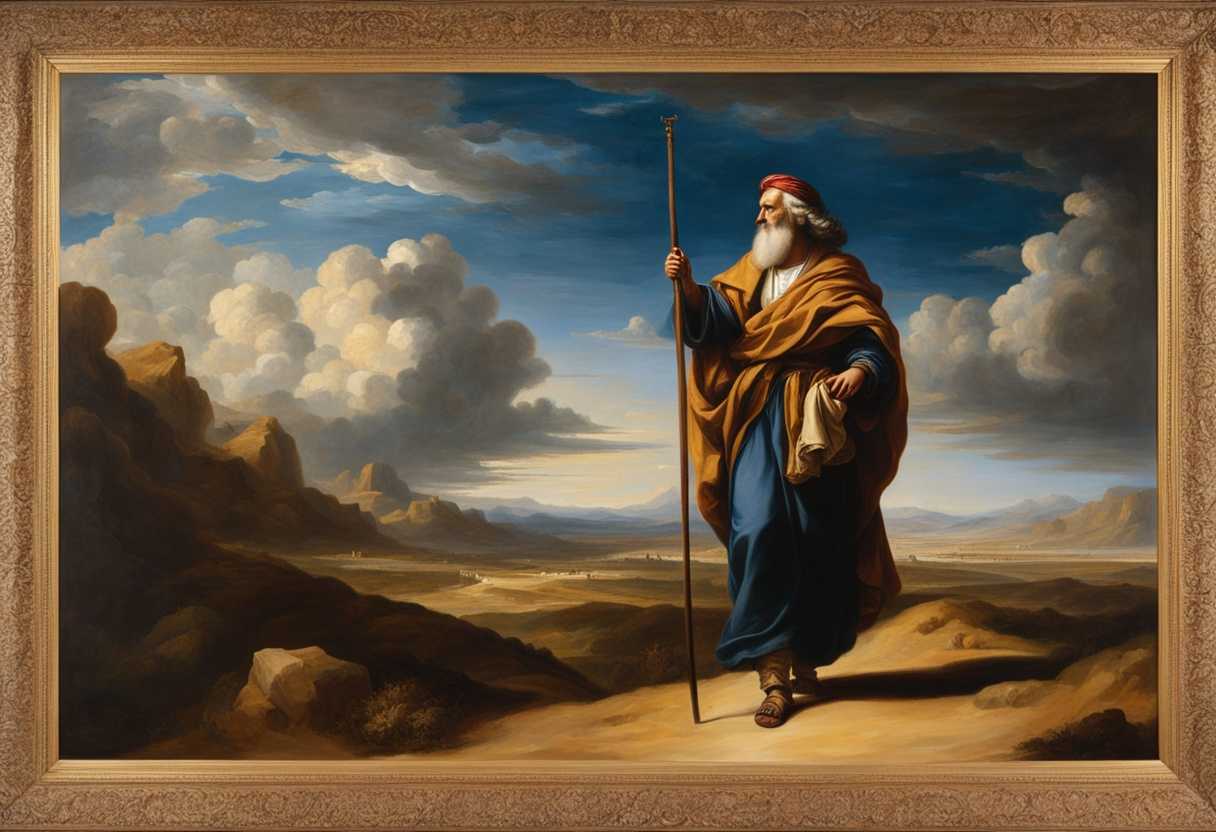
In the Bible, a nomad refers to a person who lives a wandering lifestyle, often without a permanent home, as seen in the lives of patriarchs like Abraham. This nomadic existence symbolizes faith, dependence on God for provision, and a journey toward spiritual promises.
Scripture
1 Now the Lord said to Abram, “Go from your country and your kindred and your father’s house to the land that I will show you.
2 And I will make of you a great nation, and I will bless you and make your name great, so that you will be a blessing.
3 I will bless those who bless you, and him who dishonors you I will curse, and in you all the families of the earth shall be blessed.”
4 So Abram went, as the Lord had told him, and Lot went with him. Abram was seventy-five years old when he departed from Haran.
5 Abram took Sarai his wife, and Lot his brother’s son, and all their possessions that they had gathered, and the people that they had acquired in Haran, and they set out to go to the land of Canaan.
6 Abram passed through the land to the place at Shechem, to the oak of Moreh. At that time the Canaanites were in the land.
7 Then the Lord appeared to Abram and said, “To your offspring I will give this land.” So he built there an altar to the Lord, who had appeared to him.
8 From there he moved to the hill country on the east of Bethel and pitched his tent, with Bethel on the west and Ai on the east. And there he built an altar to the Lord and called upon the name of the Lord.
9 And Abram journeyed on, still going toward the Negeb.
Biblical Significance of Nomads
In the Bible, the concept of the nomad is poignantly embodied in the life of Abraham, who is described in Hebrews 11:8-10 as someone who “obeyed when he was called to go out to a place that he was to receive as an inheritance, and he went out, not knowing where he was going.” This nomadic lifestyle signifies more than mere physical movement; it reflects a profound spiritual journey characterized by trust in God’s promises. Abraham’s relentless pilgrimage from Ur of the Chaldeans to the land of Canaan epitomizes a faith that prioritizes divine guidance over worldly security. In a broader sense, the nomadic existence challenges believers to embrace uncertainty and progression in their faith, reminding them that their ultimate home lies not in earthly possessions but in a promised divine inheritance (Hebrews 11:16).
The nomadic life also sets a powerful precedent for understanding our relationship with God as a journey rather than a destination. Psalm 119:105 describes God’s word as a “lamp to my feet and a light to my path,” indicating that the journey may often lack clear visibility but is consistently illuminated by faith and divine instruction. This aligns with the experiences of the Israelites during their exodus from Egypt, as they wandered the wilderness for forty years, relying solely on God for sustenance (Exodus 16:4). Their pilgrimage illustrates the larger narrative of redemption and reliance on God, positioning the nomadic life as an essential metaphor for spiritual maturation—where dependence and obedience to God’s guidance foster an authentic relationship characterized by continual growth and hope in the promises of God (1 Peter 2:11). Therefore, the biblical nomad embodies both the physical and spiritual transformations required to fully engage with faith and purpose.
The journey of the nomad in biblical texts highlights the tension between belonging and exile, illustrating how faith can guide individuals through both familiar and foreign lands. Consider the experiences of Jacob, who, despite being rooted in the ancestral home, became a nomad after fleeing Esau’s wrath. His sojourn not only marked a physical displacement but also initiated a significant transformation in his identity—a way of life that echoed the notion of being a sojourner in a world that is not his final home. This theme is also evident in the wanderings of the Israelites, who lived in tents and moved from place to place, representing a continued reliance on God’s provision. Each encampment was a reminder of their dependence on Him and the call to trust in promises yet to be fulfilled, exemplifying a faith that thrives in transience.
Moreover, the lifestyle of a nomad invites believers to consider their purpose and calling in a world that can often feel unpredictable. In various biblical accounts, nomadic figures like Moses and David experience moments of divine encounter and revelation during their wanderings, suggesting that it is often in the spaces between that we discover deeper truths about our purpose and the nature of God. These experiences emphasize that the journey itself—fraught with trials, learning, and growth—can cultivate character and faith. The nomadic way of life, steeped in the search for belonging while embracing the unknown, challenges believers to navigate their own paths with the understanding that their identity is rooted not in place but in relationship with the Creator, who continually beckons them onward in faith. Thus, being a biblical nomad serves as an enduring metaphor for the spiritual pilgrimage that all believers undertake, where the way forward is lit by faith, hope, and the promise of future fulfillment.
Spiritual Journey and Faith
In the Bible, the concept of a nomad often symbolizes the spiritual journey of faith. Just as nomads wander from place to place, believers are called to navigate through life with a sense of purpose and reliance on God. This journey reflects the transient nature of earthly existence, emphasizing that true fulfillment and belonging are found not in physical locations but in a relationship with the divine. The nomadic lifestyle serves as a metaphor for the believer’s quest for spiritual growth and understanding, highlighting the importance of faith in guiding one’s path.
Community and Identity
Nomadism in the biblical context also speaks to the themes of community and identity. Many biblical figures, such as Abraham, lived as nomads, forming communities that were bound not by land but by shared beliefs and values. This illustrates that identity is often rooted in faith and fellowship rather than geographical ties. The nomadic experience fosters a sense of belonging among those who share similar spiritual journeys, reinforcing the idea that community can thrive in diverse and transient circumstances.
Dependence on Divine Provision
Another broader meaning of nomadism in the Bible is the dependence on divine provision. Nomads often relied on God for sustenance and guidance as they traveled through unfamiliar territories. This reliance underscores the biblical principle that God provides for His people, even in times of uncertainty and wandering. The nomadic lifestyle serves as a reminder of the importance of trusting in God’s provision and direction, encouraging believers to seek His guidance in their own journeys through life.
How to Strengthen Your Faith on Life’s Journey
Strengthening your faith on life’s journey is a deeply personal and transformative process that requires intentionality and openness. Start by immersing yourself in Scripture; the Bible is not just a book, but a living guide that speaks to our hearts and circumstances. Make it a habit to read a passage daily, reflecting on its meaning and how it applies to your life. Prayer is another vital component—it’s your direct line to God, where you can express your fears, hopes, and gratitude. Don’t hesitate to share your journey with fellow believers; community can provide support, encouragement, and accountability. Lastly, embrace the challenges you face as opportunities for growth; remember that even in the toughest times, God is shaping you into the person He created you to be. Trust in His plan, and let your faith be a beacon of light guiding you through every twist and turn.
Bible References to the Meaning of Nomads:
Genesis 13:1-18: 1 So Abram went up from Egypt, he and his wife and all that he had, and Lot with him, into the Negeb.
2 Now Abram was very rich in livestock, in silver, and in gold.
3 And he journeyed on from the Negeb as far as Bethel to the place where his tent had been at the beginning, between Bethel and Ai,
4 to the place where he had made an altar at the first. And there Abram called upon the name of the Lord.
5 Now Lot, who went with Abram, also had flocks and herds and tents,
6 The land could not support both of them dwelling together; for their possessions were so great that they could not dwell together,
7 And there was strife between the herdsmen of Abram’s livestock and the herdsmen of Lot’s livestock. At that time the Canaanites and the Perizzites were dwelling in the land.
8 Then Abram said to Lot, “Let there be no strife between you and me, and between your herdsmen and my herdsmen, for we are kinsmen.
9 Is not the whole land before you? Separate yourself from me. If you take the left hand, then I will go to the right, or if you take the right hand, then I will go to the left.”
10 And Lot lifted up his eyes and saw that the Jordan Valley was well watered everywhere like the garden of the Lord, like the land of Egypt, in the direction of Zoar. (This was before the Lord destroyed Sodom and Gomorrah.)
11 So Lot chose for himself all the Jordan Valley, and Lot journeyed east. Thus they separated from each other.
12 Abram settled in the land of Canaan, while Lot settled among the cities of the valley and moved his tent as far as Sodom.
13 Now the men of Sodom were wicked, great sinners against the Lord.
14 The Lord said to Abram, after Lot had separated from him, “Lift up your eyes and look from the place where you are, northward and southward and eastward and westward,
15 for all the land that you see I will give to you and to your offspring forever.
16 I will make your offspring as the dust of the earth, so that if one can count the dust of the earth, your offspring also can be counted.
17 Arise, walk through the length and the breadth of the land, for I will give it to you.”
18 So Abram moved his tent and came and settled by the oaks of Mamre, which are at Hebron, and there he built an altar to the Lord.
Genesis 46:1-7: 1 So Israel took his journey with all that he had and came to Beersheba, and offered sacrifices to the God of his father Isaac.
2 And God spoke to Israel in visions of the night and said, “Jacob, Jacob.” And he said, “Here I am.”
3 Then he said, “I am God, the God of your father. Do not be afraid to go down to Egypt, for there I will make you into a great nation.
4 I myself will go down with you to Egypt, and I will also bring you up again, and Joseph’s hand shall close your eyes.”
5 Then Jacob set out from Beersheba. The sons of Israel carried Jacob their father, their little ones, and their wives, in the wagons that Pharaoh had sent to carry him.
6 They also took their livestock and their goods, which they had gained in the land of Canaan, and came into Egypt, Jacob and all his offspring with him,
7 his sons and his sons’ sons with him, his daughters, and his sons’ daughters. All his offspring he brought with him to Egypt.
Exodus 3:1-12: 1 Now Moses was keeping the flock of his father-in-law, Jethro, the priest of Midian, and he led his flock to the west side of the wilderness and came to Horeb, the mountain of God.
2 And the angel of the Lord appeared to him in a flame of fire out of the midst of a bush. He looked, and behold, the bush was burning, yet it was not consumed.
3 And Moses said, “I will turn aside to see this great sight, why the bush is not burned.”
4 When the Lord saw that he turned aside to see, God called to him out of the bush, “Moses, Moses!” And he said, “Here I am.”
5 Then he said, “Do not come near; take your sandals off your feet, for the place on which you are standing is holy ground.”
6 And he said, “I am the God of your father, the God of Abraham, the God of Isaac, and the God of Jacob.” And Moses hid his face, for he was afraid to look at God.
7 Then the Lord said, “I have surely seen the affliction of my people who are in Egypt and have heard their cry because of their taskmasters. I know their sufferings,
8 and I have come down to deliver them out of the hand of the Egyptians and to bring them up out of that land to a good and broad land, a land flowing with milk and honey, to the place of the Canaanites, the Hittites, the Amorites, the Perizzites, the Hivites, and the Jebusites.
9 And now, behold, the cry of the people of Israel has come to me, and I have also seen the oppression with which the Egyptians oppress them.
10 Come, I will send you to Pharaoh that you may bring my people, the children of Israel, out of Egypt.”
11 But Moses said to God, “Who am I that I should go to Pharaoh and bring the children of Israel out of Egypt?”
12 He said, “But I will be with you, and this shall be the sign for you, that I have sent you: when you have brought the people out of Egypt, you shall serve God on this mountain.”
Exodus 13:17-22: 17 When Pharaoh let the people go, God did not lead them by way of the land of the Philistines, although that was near. For God said, “Lest the people change their minds when they see war and return to Egypt.”
18 But God led the people around by the way of the wilderness toward the Red Sea. And the people of Israel went up out of the land of Egypt equipped for battle.
19 Moses took the bones of Joseph with him, for Joseph had made the sons of Israel solemnly swear, saying, “God will surely visit you, and you shall carry up my bones with you from here.”
20 And they moved on from Succoth and encamped at Etham, on the edge of the wilderness.
21 And the Lord went before them by day in a pillar of cloud to lead them along the way, and by night in a pillar of fire to give them light, that they might travel by day and by night.
22 The pillar of cloud by day and the pillar of fire by night did not depart from before the people.
Numbers 9:15-23: On the day that the tabernacle was set up, the cloud covered the tabernacle, the tent of the testimony. And at evening it was over the tabernacle like the appearance of fire until morning.
16 So it was always: the cloud covered it by day and the appearance of fire by night.
17 And whenever the cloud lifted from over the tent, after that the people of Israel set out, and in the place where the cloud settled, there the people of Israel camped.
18 At the command of the Lord the people of Israel set out, and at the command of the Lord they camped. As long as the cloud rested over the tabernacle, they remained in camp.
19 And when the cloud continued over the tabernacle many days, the people of Israel kept the charge of the Lord and did not set out.
20 Sometimes the cloud remained from evening until morning. And when the cloud lifted in the morning, they set out, or if it continued for a day and a night, when the cloud lifted, they set out.
21 And sometimes the cloud remained from evening until morning. And when the cloud lifted in the morning, they set out, or if it continued for a day and a night, when the cloud lifted, they set out.
22 Whether it was two days, or a month, or a longer time, that the cloud continued over the tabernacle, abiding there, the people of Israel remained in camp and did not set out, but when it lifted they set out.
23 At the command of the Lord they camped, and at the command of the Lord they set out. They kept the charge of the Lord, at the command of the Lord by Moses.
Deuteronomy 1:6-8: 6 “The Lord our God said to us in Horeb, ‘You have stayed long enough at this mountain.
7 Turn and take your journey, and go to the hill country of the Amorites and to all their neighbors in the Arabah, in the hill country and in the lowland and in the Negeb and by the seacoast, the land of the Canaanites, and Lebanon, as far as the great river, the river Euphrates.
8 See, I have set the land before you. Go in and take possession of the land that the Lord swore to your fathers, to Abraham, to Isaac, and to Jacob, to give to them and to their offspring after them.
Deuteronomy 2:1-7: 1 “Then we turned and journeyed into the wilderness in the direction of the Red Sea, as the Lord told me. And for many days we traveled around Mount Seir.
2 And the Lord spoke to me, saying,
3 You have been traveling around this mountain country long enough. Turn northward.
4 and command the people, “You are about to pass through the territory of your brothers, the people of Esau, who live in Seir; and they will be afraid of you. So be very careful.
5 Do not contend with them, for I will not give you any of their land, no, not so much as the sole of the foot to tread on, because I have given Mount Seir to Esau as a possession.
6 You shall purchase food from them with money, that you may eat, and you shall also buy water from them with money, that you may drink.
7 For the Lord your God has blessed you in all the work of your hands. He knows your going through this great wilderness. These forty years the Lord your God has been with you. You have lacked nothing.
Joshua 1:1-9: 1 After the death of Moses the servant of the Lord, the Lord said to Joshua the son of Nun, Moses’ assistant,
2 “Moses my servant is dead. Now therefore arise, go over this Jordan, you and all this people, into the land that I am giving to them, to the people of Israel.”
3 Every place that the sole of your foot will tread upon I have given to you, just as I promised to Moses.
4 From the wilderness and this Lebanon as far as the great river, the river Euphrates, all the land of the Hittites to the Great Sea toward the going down of the sun shall be your territory.
5 No man shall be able to stand before you all the days of your life. Just as I was with Moses, so I will be with you. I will not leave you or forsake you.
6 Be strong and courageous, for you shall cause this people to inherit the land that I swore to their fathers to give them.
7 Only be strong and very courageous, being careful to do according to all the law that Moses my servant commanded you. Do not turn from it to the right hand or to the left, that you may have good success wherever you go.
8 This Book of the Law shall not depart from your mouth, but you shall meditate on it day and night, so that you may be careful to do according to all that is written in it. For then you will make your way prosperous, and then you will have good success.
9 Have I not commanded you? Be strong and courageous. Do not be frightened, and do not be dismayed, for the Lord your God is with you wherever you go.
1 Samuel 23:13-29: 13 Then David and his men, who were about six hundred, arose and departed from Keilah, and they went wherever they could go. When Saul was told that David had escaped from Keilah, he gave up the expedition.
14 And David remained in the strongholds in the wilderness, in the hill country of the wilderness of Ziph. And Saul sought him every day, but God did not give him into his hand.
15 David saw that Saul had come out to seek his life. David was in the wilderness of Ziph at Horesh.
16 And Jonathan, Saul’s son, rose and went to David at Horesh, and strengthened his hand in God.
17 And he said to him, “Do not fear, for the hand of Saul my father shall not find you. You shall be king over Israel, and I shall be next to you. Saul my father also knows this.”
18 And the two of them made a covenant before the Lord. David remained at Horesh, and Jonathan went home.
Then the Ziphites went up to Saul at Gibeah, saying, “Is not David hiding among us in the strongholds at Horesh, on the hill of Hachilah, which is south of Jeshimon?”
20 Now come down, O king, according to all your heart’s desire to come down, and our part shall be to surrender him into the king’s hand.”
21 And Saul said, “May you be blessed by the Lord, for you have had compassion on me.
22 Please, go, make sure yet again. Know and see the place where his foot is, and who has seen him there, for it is told me that he is very cunning.
23 See therefore and take note of all the lurking places where he hides, and come back to me with sure information. Then I will go with you. And if he is in the land, I will search him out among all the thousands of Judah.”
24 And they arose and went to Ziph ahead of Saul. Now David and his men were in the wilderness of Maon, in the Arabah to the south of Jeshimon.
25 And Saul and his men went to seek him. And David was told, so he went down to the rock and lived in the wilderness of Maon. And when Saul heard that, he pursued after David in the wilderness of Maon.
26 And Saul went on one side of the mountain, and David and his men on the other side of the mountain. And David was hurrying to get away from Saul. As Saul and his men were closing in on David and his men to capture them,
27 But a messenger came to Saul, saying, “Hurry and come, for the Philistines have made a raid against the land.”
28 So Saul returned from pursuing after David and went against the Philistines. Therefore that place was called the Rock of Escape.
29 And David went up from there and lived in the strongholds of Engedi.
2 Samuel 15:13-23: 13 And a messenger came to David, saying, “The hearts of the men of Israel have gone after Absalom.”
14 Then David said to all his servants who were with him at Jerusalem, “Arise, and let us flee, or else there will be no escape for us from Absalom. Go quickly, lest he overtake us quickly and bring down ruin on us and strike the city with the edge of the sword.”
15 And the king’s servants said to the king, “Behold, your servants are ready to do whatever my lord the king decides.”
16 And the king went out, and all his household after him. And the king left ten concubines to keep the house.
17 And the king went out, and all the people after him, and they halted at the last house.
18 And all his servants passed by him, and all the Cherethites, and all the Pelethites, and all the six hundred Gittites who had followed him from Gath, passed on before the king.
19 Then the king said to Ittai the Gittite, “Why do you also go with us? Go back and stay with the king, for you are a foreigner and also an exile from your home.
20 You came only yesterday, and shall I today make you wander about with us, since I go I know not where? Go back and take your brothers with you, and may the Lord show steadfast love and faithfulness to you.”
21 But Ittai answered the king, “As the Lord lives, and as my lord the king lives, wherever my lord the king shall be, whether for death or for life, there also will your servant be.”
22 And David said to Ittai, “Go then, pass on.” So Ittai the Gittite passed on with all his men and all the little ones who were with him.
23 And all the land wept aloud as all the people passed by, and the king crossed the brook Kidron, and all the people passed on toward the wilderness.
Psalm 105:12-15: 12 When they were few in number, of little account, and sojourners in it,
13 When they went from one nation to another, from one kingdom to another people,
14 He allowed no one to oppress them; he rebuked kings on their account,
15 “Touch not my anointed ones, do my prophets no harm!”
Isaiah 35:1-10: 1 The wilderness and the dry land shall be glad;
the desert shall rejoice and blossom like the crocus;
2 It shall blossom abundantly and rejoice with joy and singing. The glory of Lebanon shall be given to it, the majesty of Carmel and Sharon. They shall see the glory of the Lord, the majesty of our God.
3 Strengthen the weak hands,
and make firm the feeble knees.
4 Say to those who have an anxious heart, “Be strong; fear not! Behold, your God will come with vengeance, with the recompense of God. He will come and save you.”
5 Then the eyes of the blind shall be opened, and the ears of the deaf unstopped;
6 Then shall the lame man leap like a deer, and the tongue of the mute sing for joy. For waters break forth in the wilderness, and streams in the desert.
7 And the burning sand shall become a pool, and the thirsty ground springs of water; in the haunt of jackals, where they lie down, the grass shall become reeds and rushes.
8 And a highway shall be there,
and it shall be called the Way of Holiness;
the unclean shall not pass over it.
It shall belong to those who walk on the way;
even if they are fools, they shall not go astray.
9 No lion shall be there, nor shall any ravenous beast come up on it; they shall not be found there, but the redeemed shall walk there.
10 And the ransomed of the Lord shall return and come to Zion with singing; everlasting joy shall be upon their heads; they shall obtain gladness and joy, and sorrow and sighing shall flee away.
Jeremiah 29:4-14: 4 “Thus says the Lord of hosts, the God of Israel, to all the exiles whom I have sent into exile from Jerusalem to Babylon:”
5 Build houses and live in them; plant gardens and eat their produce.
6 Take wives and have sons and daughters; take wives for your sons, and give your daughters in marriage, that they may bear sons and daughters; multiply there, and do not decrease.
7 But seek the welfare of the city where I have sent you into exile, and pray to the Lord on its behalf, for in its welfare you will find your welfare.
8 For thus says the Lord of hosts, the God of Israel: Do not let your prophets and your diviners who are among you deceive you, and do not listen to the dreams that they dream,
9 For they are prophesying falsely to you in my name; I have not sent them, declares the Lord.
10 “For thus says the Lord: When seventy years are completed for Babylon, I will visit you, and I will fulfill to you my promise and bring you back to this place.”
11 For I know the plans I have for you, declares the Lord, plans for welfare and not for evil, to give you a future and a hope.
12 Then you will call upon me and come and pray to me, and I will hear you.
13 You will seek me and find me, when you seek me with all your heart.
14 I will be found by you, declares the Lord, and I will restore your fortunes and gather you from all the nations and all the places where I have driven you, declares the Lord, and I will bring you back to the place from which I sent you into exile.
Hebrews 11:8-16: 8 By faith Abraham obeyed when he was called to go out to a place that he was to receive as an inheritance. And he went out, not knowing where he was going.
9 By faith he went to live in the land of promise, as in a foreign land, living in tents with Isaac and Jacob, heirs with him of the same promise.
10 For he was looking forward to the city that has foundations, whose designer and builder is God.
11 By faith Sarah herself received power to conceive, even when she was past the age, since she considered him faithful who had promised.
12 Therefore from one man, and him as good as dead, were born descendants as many as the stars of heaven and as many as the innumerable grains of sand by the seashore.
13 These all died in faith, not having received the things promised, but having seen them and greeted them from afar, and having acknowledged that they were strangers and exiles on the earth.
14 For people who speak thus make it clear that they are seeking a homeland.
15 If they had been thinking of that land from which they had gone out, they would have had opportunity to return.
16 But as it is, they desire a better country, that is, a heavenly one. Therefore God is not ashamed to be called their God, for he has prepared for them a city.

Reverend Ogunlade is a seasoned Church Minister with over three decades of experience in guiding and nurturing congregations. With profound wisdom and a serene approach, Reverend Ogunlade has carried out various pastoral duties, including delivering uplifting sermons, conducting religious ceremonies, and offering sage counsel to individuals seeking spiritual guidance. Their commitment to fostering harmony and righteousness within their community is exemplified through their compassionate nature, making them a beloved and trusted figure among the congregation.