
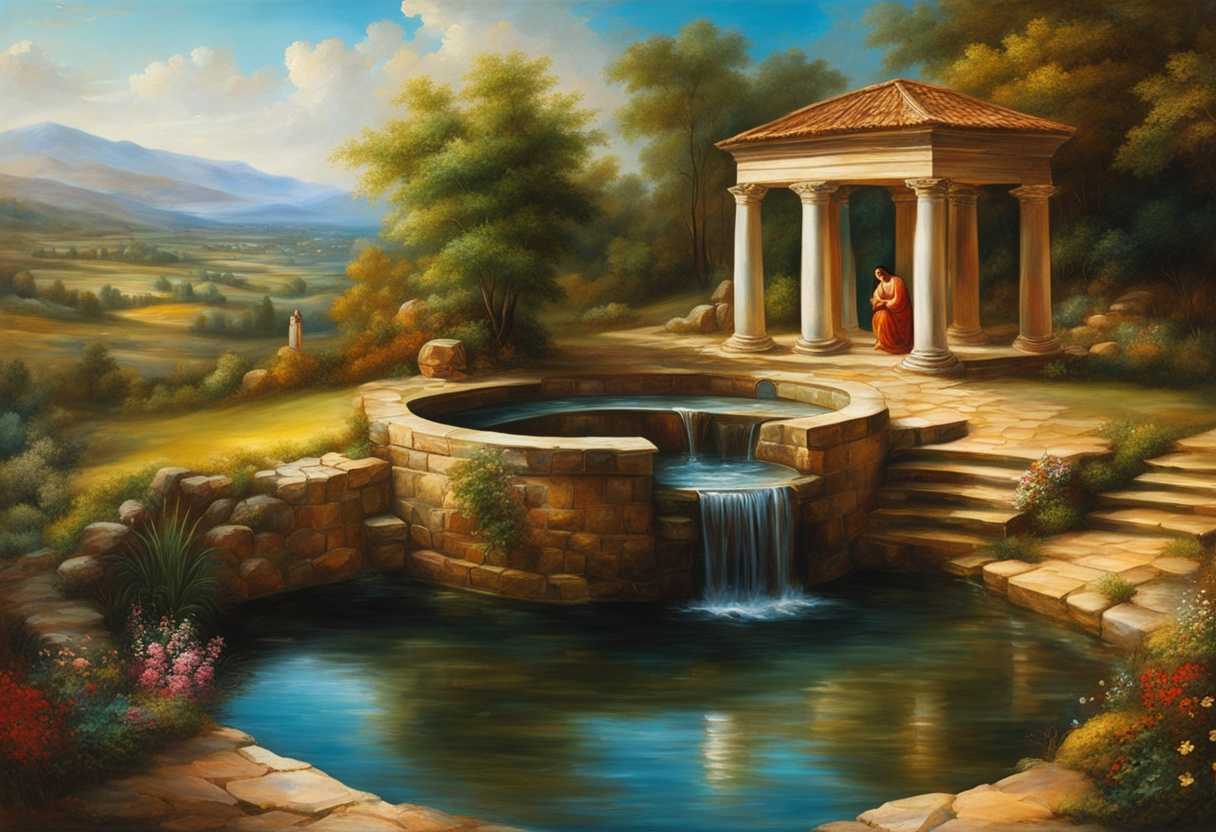
Jacob’s Well is a historic site mentioned in the New Testament, specifically in John 4:6, where Jesus speaks to a Samaritan woman. It symbolizes both physical thirst and spiritual fulfillment, as Jesus uses it to illustrate the living water he offers.
Scripture
18 And Jacob came safely to the city of Shechem, which is in the land of Canaan, on his way from Paddan-aram, and he camped before the city.
19 And from the sons of Hamor, Shechem’s father, he bought for a hundred pieces of money the piece of land on which he had pitched his tent.
20 There he erected an altar and called it El-Elohe-Israel.
Meaning of Jacob’s Well in the Bible
Jacob’s Well, as depicted in John 4:6, carries profound theological and symbolic significance, serving as the backdrop for one of Jesus’ most pivotal encounters. Located near Sychar in Samaria, the well represents not only a physical source of life-sustaining water but also embodies a deeper longing for spiritual nourishment. When Jesus engages with the Samaritan woman, He transcends social and ethnic boundaries—being a Jew speaking to a Samaritan—illustrating His mission to break down barriers and offer salvation to all. The well thus becomes a metaphor for the thirst that exists in every person’s soul regardless of background, emphasizing our innate need for God’s truth and love.
As the conversation unfolds, Jesus reveals the deeper meaning of the water He offers—“but whoever drinks the water I give them will never thirst” (John 4:14, NIV). This living water symbolizes eternal life, grace, and the satisfaction that comes from a relationship with Christ. The notion of Jacob’s Well encourages believers to seek spiritual fulfillment in Christ rather than in earthly substances or achievements. The encounter highlights the transformative power of faith, where Jesus acknowledges the woman’s past and offers her redemption. This interaction at Jacob’s Well serves as a reminder of the holistic nature of human need—both the physical and spiritual are intertwined, and it is in Christ alone that we find complete fulfillment.
Jacob’s Well also features prominently in the history of the patriarch Jacob, providing insights into its enduring significance. According to Genesis, Jacob dug the well after a long journey, signifying both his labor and his connection to the land that would become part of the inheritance for his descendants. The well represents continuity and legacy, illustrating the blessings that God bestows upon His chosen people. Furthermore, Jacob’s commitment to establishing a home in this region reflects the early stages of Israel’s journey, connecting the location to the broader narrative of God’s covenant with Abraham, Isaac, and Jacob—reinforcing themes of promise and provision that resonate throughout biblical texts.
Moreover, the well serves as a symbol of deeper spiritual truths in other biblical traditions. It represents the search for truth and identity, as illustrated through the Samaritan woman’s transformative encounter. The physical act of drawing water becomes an allegory for the spiritual seeking that individuals undertake to find purpose and belonging. Ecclesiastes, with its reflections on the meaning of life, parallels this motif by suggesting that earthly pursuits ultimately leave one thirsty for something deeper. In this light, Jacob’s Well transcends its geographical positioning—it stands as a universal reminder that true satisfaction can only be found through divine communion and spiritual awakening, echoing the quest for meaning that spans scriptures and human experience alike.
Symbol of Spiritual Thirst
Jacob’s Well represents the deep spiritual thirst that exists within humanity. Just as physical water is essential for survival, the well symbolizes the need for spiritual nourishment and fulfillment. The encounter at the well illustrates the idea that true satisfaction comes not from earthly sources but from a deeper relationship with the divine. This thirst for spiritual connection is a recurring theme throughout the Bible, emphasizing the importance of seeking God to quench one’s soul.
Intersection of Cultures and Faiths
Jacob’s Well serves as a significant meeting point between different cultures and faiths, particularly between Jews and Samaritans. This location highlights the broader theme of inclusivity and the breaking down of barriers. The interaction that takes place at the well signifies that God’s message and grace are available to all, regardless of their background or beliefs. This aspect of the well underscores the biblical principle that faith transcends cultural divisions and invites all people into a relationship with God.
Legacy of Ancestral Heritage
The well is also a symbol of Jacob’s legacy and the heritage of the Israelites. It connects the past with the present, reminding believers of their spiritual ancestry and the promises made to the patriarchs. This connection to heritage emphasizes the importance of remembering one’s roots and the faith journey that has been passed down through generations. Jacob’s Well thus serves as a reminder of the continuity of God’s covenant and the enduring significance of faith in the lives of believers.
How to Deepen Your Faith Through Spiritual Revelation
Deepening your faith through spiritual revelation is a beautiful journey that invites you to cultivate a more intimate relationship with God. Start by creating a quiet space in your life—whether through prayer, meditation, or simply sitting in silence—where you can listen for His voice. Engage with Scripture not just as a text, but as a living conversation with God; allow the words to resonate in your heart and mind, seeking understanding and personal application. Journaling your thoughts and prayers can also help you track your spiritual growth and recognize moments of revelation. Remember, faith is not a destination but a continuous process of discovery, so be open to the unexpected ways God may reveal Himself to you, whether through nature, relationships, or even challenges. Embrace these moments with gratitude, and let them guide you deeper into the love and grace that define your walk as a Christian.
Bible References to Jacob’s Well Meaning:
John 4:5-14: 5 So he came to a town of Samaria called Sychar, near the field that Jacob had given to his son Joseph.
6 Jacob’s well was there; so Jesus, wearied as he was from his journey, was sitting beside the well. It was about the sixth hour.
7 A woman from Samaria came to draw water. Jesus said to her, “Give me a drink.”
8 For his disciples had gone away into the city to buy food.
9 The Samaritan woman said to him, “How is it that you, a Jew, ask for a drink from me, a woman of Samaria?” (For Jews have no dealings with Samaritans.)
10 Jesus answered her, “If you knew the gift of God, and who it is that is saying to you, ‘Give me a drink,’ you would have asked him, and he would have given you living water.”
11 The woman said to him, “Sir, you have nothing to draw water with, and the well is deep. Where do you get that living water?
12 Are you greater than our father Jacob? He gave us the well and drank from it himself, as did his sons and his livestock.
13 Jesus said to her, “Everyone who drinks of this water will be thirsty again,
14 but whoever drinks of the water that I will give him will never be thirsty again. The water that I will give him will become in him a spring of water welling up to eternal life.”
John 4:15-26: 15 The woman said to him, “Sir, give me this water, so that I will not be thirsty or have to come here to draw water.”
16 So Jesus said to her, “Go, call your husband, and come here.”
17 The woman answered him, “I have no husband.” Jesus said to her, “You are right in saying, ‘I have no husband’;
18 There is no fear in love, but perfect love casts out fear. For fear has to do with punishment, and whoever fears has not been perfected in love.
19 The woman said to him, “Sir, I perceive that you are a prophet.
20 Our fathers worshiped on this mountain, but you say that in Jerusalem is the place where people ought to worship.”
21 Jesus said to her, “Woman, believe me, the hour is coming when neither on this mountain nor in Jerusalem will you worship the Father.”
22 You worship what you do not know; we worship what we know, for salvation is from the Jews.
23 But the hour is coming, and is now here, when the true worshipers will worship the Father in spirit and truth, for the Father is seeking such people to worship him.
24 God is spirit, and those who worship him must worship in spirit and truth.
25 The woman said to him, “I know that Messiah is coming (he who is called Christ). When he comes, he will tell us all things.”
26 Jesus said to her, “I who speak to you am he.”
John 4:27-30: 27 Just then his disciples came back. They marveled that he was talking with a woman, but no one said, “What do you seek?” or, “Why are you talking with her?”
28 So the woman left her water jar and went away into town and said to the people,
29 “Come, see a man who told me all that I ever did. Can this be the Christ?”
30 They went out of the town and were coming to him.
John 4:31-38: 31 Meanwhile the disciples were urging him, saying, “Rabbi, eat.”
32 But he said to them, “I have food to eat that you do not know about.”
33 So the disciples said to one another, “Has anyone brought him something to eat?”
34 Jesus said to them, “My food is to do the will of him who sent me and to accomplish his work.”
35 Do you not say, ‘There are yet four months, then comes the harvest’? Look, I tell you, lift up your eyes, and see that the fields are white for harvest.
36 Already the one who reaps is receiving wages and gathering fruit for eternal life, so that sower and reaper may rejoice together.
37 For here the saying holds true, ‘One sows and another reaps.’
38 I sent you to reap that for which you did not labor. Others have labored, and you have entered into their labor.
John 4:39-42: 39 Many Samaritans from that town believed in him because of the woman’s testimony, “He told me all that I ever did.”
40 So when the Samaritans came to him, they asked him to stay with them, and he stayed there two days.
41 And many more believed because of his word.
42 They said to the woman, “It is no longer because of what you said that we believe, for we have heard for ourselves, and we know that this is indeed the Savior of the world.”

Reverend Michael Johnson is an experienced Church Minister with a profound expertise in spirituality and guidance. With a serene presence and a compassionate heart, he has faithfully served his congregation for over 20 years, leading them on a spiritual journey towards inner peace and enlightenment. Reverend Johnson’s extensive knowledge of religious philosophies and profound understanding of human nature have made him a trusted confidant and mentor to many, as he seamlessly weaves his profound wisdom into life teachings. Reverend Johnson’s calming demeanor and empathetic nature continue to uplift and heal souls, nurturing a sense of unity and tranquility within his community.