
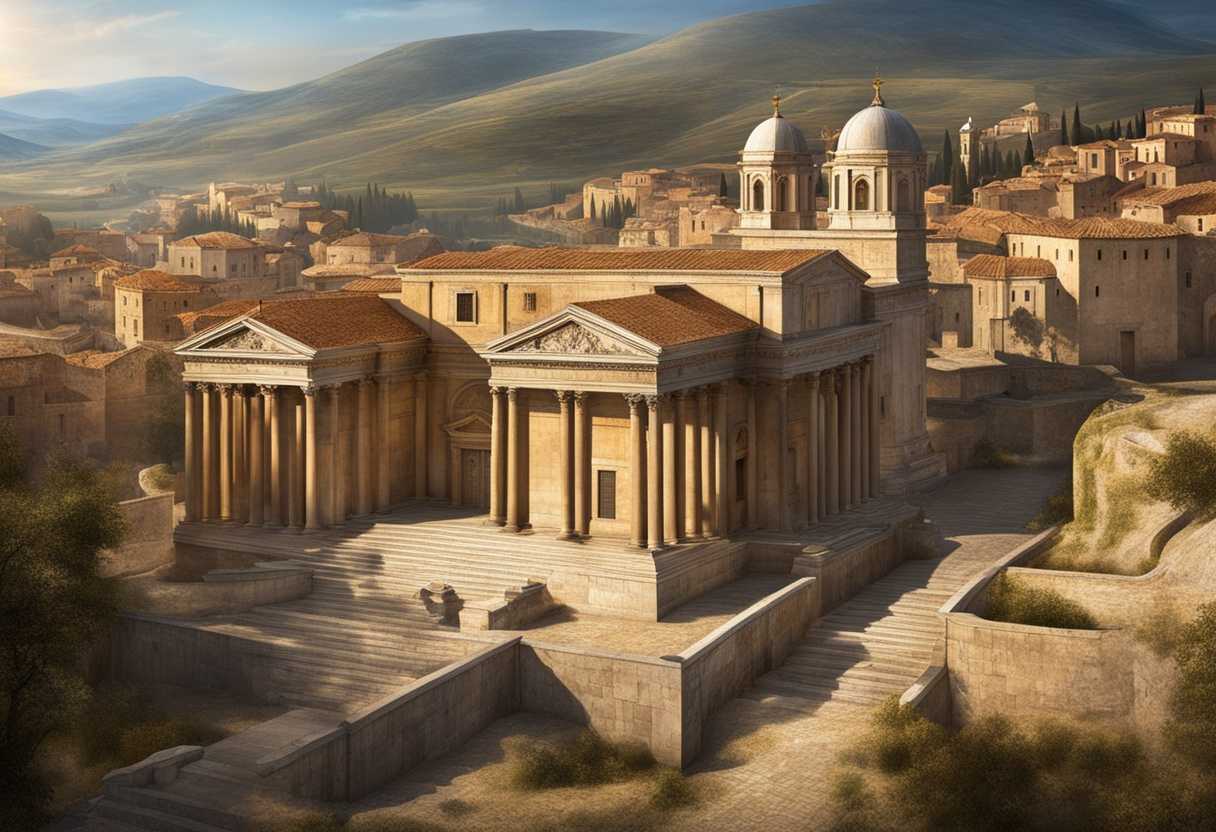
In the Bible, Gibeon refers to a city of the Hivites, known for its strategic location and as a center of worship. It is significant for its inhabitants’ deception of the Israelites leading to a treaty, and it later became a refuge for the Ark of the Covenant (Joshua 9; 2 Samuel 6:4).
Scripture
3 But when the inhabitants of Gibeon heard what Joshua had done to Jericho and to Ai,
4 They on their part acted with cunning and went and made ready provisions and took worn-out sacks for their donkeys, and wineskins, worn-out and torn and mended,
5 And they went to Joshua in the camp at Gilgal and said to him and to the men of Israel, “We have come from a distant country, so now make a covenant with us.”
6 And they went to Joshua in the camp at Gilgal and said to him and to the men of Israel, “We have come from a distant country, so now make a covenant with us.”
7 But the men of Israel said to the Hivites, “Perhaps you live among us; then how can we make a covenant with you?”
8 But they said to Joshua, “We are your servants.” And Joshua said to them, “Who are you? And where do you come from?”
9 They said to him, “From a very distant country your servants have come, because of the name of the Lord your God. For we have heard a report of him, and all that he did in Egypt,
10 and all that he did to the two kings of the Amorites who were beyond the Jordan, to Sihon the king of Heshbon, and to Og king of Bashan, who lived in Ashtaroth.
11 So our elders and all the inhabitants of our country said to us, ‘Take provisions in your hand for the journey and go to meet them and say to them, “We are your servants. Come now, make a covenant with us.”‘
12 This our bread we took hot for our provision out of our houses on the day we set out to come to you, but now, behold, it is dry and crumbly.
13 these wineskins were new when we filled them, and behold, they have burst. And these garments and sandals of ours are worn out from the very long journey.”
14 So the men took some of their provisions, but did not ask counsel from the Lord.
15 And Joshua made peace with them and made a covenant with them, to let them live, and the leaders of the congregation swore to them.
16 This is what we will do to them: we will let them live, lest wrath be upon us, because of the oath that we swore to them.”
17 And the people of Israel set out and reached their cities on the third day. Now their cities were Gibeon, Chephirah, Beeroth, and Kiriath-jearim.
18 But the people of Israel did not attack them, because the leaders of the congregation had sworn to them by the Lord, the God of Israel. Then all the congregation murmured against the leaders.
19 But all the leaders said to all the congregation, “We have sworn to them by the Lord, the God of Israel, and now we may not touch them.
20 This we will do to them: let them live, lest wrath be upon us, because of the oath that we swore to them.”
21 And the leaders said to them, “Let them live.” So they became cutters of wood and drawers of water for all the congregation, just as the leaders had said of them.
22 Joshua summoned them, and he said to them, “Why did you deceive us, saying, ‘We are very far from you,’ when you dwell among us?
23 Now therefore you are cursed, and some of you shall never be anything but servants, cutters of wood and drawers of water for the house of my God.”
24 They answered Joshua, “Because it was told to your servants for a certainty that the Lord your God had commanded his servant Moses to give you all the land and to destroy all the inhabitants of the land from before you—so we feared greatly for our lives because of you and did this thing.
25 And now, behold, we are in your hand. Whatever seems good and right in your sight to do to us, do it.”
26 So he did this to them and delivered them out of the hand of the people of Israel, and they did not kill them.
27 But Joshua made them that day cutters of wood and drawers of water for the congregation and for the altar of the Lord, to this day, in the place that he should choose.
Meaning of Gibeon in the Bible
Gibeon holds profound significance within the biblical narrative, particularly as it illustrates complex themes of covenant, deception, and divine sovereignty. Located strategically near Jerusalem, Gibeon was home to the Gibeonites, who, fearing the power of the Israelites, resorted to subterfuge by claiming to be travelers from a distant land in order to secure a treaty with Joshua (Joshua 9:3-15). This act of deception raises questions about the interplay of faith, ethics, and the consequences of human actions while simultaneously revealing God’s sovereignty. Despite their cunning, the Gibeonites became servants of the Israelites, indicating that the Lord can work through human deception to fulfill His divine plans (Joshua 9:21). This narrative underscores the themes of grace, as they were spared destruction and integrated into the larger community of Israel.
Moreover, Gibeon is significant in the biblical account as a sanctuary for worship and a place where pivotal events unfolded post-conquest. It served as the site where the Ark of the Covenant was placed for a time (2 Samuel 6:4), emphasizing its importance in Israel’s spiritual life. The presence of the Ark, symbolizing God’s covenant with Israel, signifies that even amidst human failings and deception, God remains steadfast in His promises. The city’s later prominence in ceremonial worship highlights the idea that God can redeem situations and people, turning them from deception to a means of covenantal fulfillment. This complex legacy of Gibeon exemplifies the overarching biblical theme that God’s plans surpass human efforts and failures, illuminating a path towards redemption and community.
Additionally, the significance of Gibeon extends into the narrative of Israel’s monarchy, particularly during the reign of King Solomon. It was at Gibeon that Solomon conducted a noteworthy sacrifice, offering one thousand burnt offerings, which illustrates the city’s role as a key religious center (1 Kings 3:4). This act not only represents Solomon’s devotion to God but also the importance of Gibeon as a legitimate place of worship prior to the establishment of the Temple in Jerusalem. Solomon’s subsequent encounter with God at Gibeon, where he sought wisdom, further underscores the idea that divine wisdom is often sought in sacred spaces, enhancing Gibeon’s reputation as a site of divine revelation and guidance.
Furthermore, the legacy of Gibeon can be traced in its later association with the priestly line. The Gibeonites were appointed as water carriers and woodcutters for the congregation, a role that not only highlights their integration into Israelite society but also their continued relevance in the worship practices of the nation (1 Chronicles 9:16). This role emphasizes their transformation from deceptive outsiders to integral members of the Israelite community, reinforcing the notion that redemption and purpose can emerge from unexpected beginnings. The ongoing narrative of Gibeon invites readers to reflect on the multifaceted nature of God’s covenantal relationships, illustrating that His grace can permeate various aspects of life, bringing about a deeper understanding of community, service, and divine Providence in the history of Israel.
A Place of Deception and Covenant
Gibeon serves as a significant example of how deception can lead to unexpected alliances. The Gibeonites, fearing the Israelites, resorted to trickery to secure their safety. This narrative illustrates the complexities of human relationships and the consequences of deceit, ultimately leading to a covenant that would shape the future interactions between the Israelites and the Gibeonites.
A Symbol of Divine Mercy
Despite the Gibeonites’ deceptive actions, their story also highlights themes of divine mercy and grace. The Israelites, upon discovering the truth, chose to honor their covenant rather than destroy the Gibeonites. This decision reflects God’s overarching plan for mercy, showing that even those who may seem outside of His favor can find a place within His grace.
A Center of Worship and Service
Gibeon later became a significant religious center, particularly for the worship of Yahweh. The Gibeonites were integrated into the Israelite community, serving in roles that contributed to the worship practices of the Israelites. This transformation underscores the idea that places and people can evolve in their purpose, becoming integral to the spiritual life of a community.
How to Embrace Divine Grace in Your Christian Journey
Embracing divine grace in your Christian journey is a transformative experience that invites you to let go of the burdens of perfectionism and self-reliance. It begins with acknowledging that grace is a gift from God, freely given and not earned through our deeds. As you cultivate a deeper relationship with Christ, allow His love to wash over you, reminding you that your worth is not defined by your mistakes but by His unending mercy. Spend time in prayer and reflection, asking the Holy Spirit to open your heart to receive this grace fully. Surround yourself with a community of believers who can encourage you and share their own experiences of grace, fostering an environment where you can grow together in faith. Remember, embracing divine grace means accepting that you are a work in progress, and it’s in your vulnerability that God’s strength shines the brightest. So, take a deep breath, let go of your fears, and step boldly into the abundant life that grace offers.
Bible References to the Meaning of Gibeon:
Joshua 10:1-14: 5 So the five kings of the Amorites, the king of Jerusalem, the king of Hebron, the king of Jarmuth, the king of Lachish, and the king of Eglon, gathered their forces and went up with all their armies and encamped against Gibeon and made war against it.
2 he feared greatly, because Gibeon was a great city, like one of the royal cities, and because it was greater than Ai, and all its men were warriors.
3 So Adoni-zedek king of Jerusalem sent to Hoham king of Hebron, to Piram king of Jarmuth, to Japhia king of Lachish, and to Debir king of Eglon, saying,
4 “Come up to me and help me, and let us strike Gibeon, for it has made peace with Joshua and with the people of Israel.”
5 So the five kings of the Amorites, the king of Jerusalem, the king of Hebron, the king of Jarmuth, the king of Lachish, and the king of Eglon, gathered their forces and went up with all their armies and encamped against Gibeon and made war against it.
6 And the men of Gibeon sent to Joshua at the camp in Gilgal, saying, “Do not relax your hand from your servants. Come up to us quickly and save us and help us, for all the kings of the Amorites who dwell in the hill country are gathered against us.”
7 So Joshua went up from Gilgal, he and all the people of war with him, and all the mighty men of valor.
8 And the Lord said to Joshua, “Do not fear them, for I have given them into your hands. Not a man of them shall stand before you.”
5 So Joshua and all the people of war with him came against them suddenly by the waters of Merom and fell upon them.
10 And the Lord threw them into a panic before Israel, who struck them with a great blow at Gibeon and chased them by the way of the ascent of Beth-horon and struck them as far as Azekah and Makkedah.
11 And as they fled before Israel, while they were going down the ascent of Beth-horon, the Lord threw down large stones from heaven on them as far as Azekah, and they died. There were more who died because of the hailstones than the sons of Israel killed with the sword.
12 At that time Joshua spoke to the Lord in the day when the Lord gave the Amorites over to the sons of Israel, and he said in the sight of Israel, “Sun, stand still at Gibeon, and moon, in the Valley of Aijalon.”
10 And the sun stood still, and the moon stopped, until the nation took vengeance on their enemies. Is this not written in the Book of Jashar? The sun stopped in the midst of heaven and did not hurry to set for about a whole day.
14 There has been no day like it before or since, when the Lord heeded the voice of a man, for the Lord fought for Israel.
Joshua 10:15-21: 15 Then Joshua returned, and all Israel with him, to the camp at Gilgal.
16 These five kings fled and hid themselves in the cave at Makkedah.
17 And it was told to Joshua, “The five kings have been found, hidden in the cave at Makkedah.”
18 Joshua said, “Roll large stones against the mouth of the cave and set men by it to guard them,”
19 But do not stay there yourselves, pursue your enemies and attack their rear guard. Do not let them enter their cities, for the Lord your God has given them into your hand.”
20 So Joshua and the people of Israel defeated them with a great blow at Gibeon, chased them along the way that goes up to Beth-horon, and struck them down as far as Azekah and Makkedah.
21 And all the people returned safe to Joshua in the camp at Makkedah.
Joshua 10:22-27: 22 Then Joshua said, “Open the mouth of the cave and bring those five kings out to me from the cave.”
23 And they did so, and brought those five kings out to him from the cave, the king of Jerusalem, the king of Hebron, the king of Jarmuth, the king of Lachish, and the king of Eglon.
24 And when they brought those kings out to Joshua, Joshua summoned all the men of Israel and said to the chiefs of the men of war who had gone with him, “Come near; put your feet on the necks of these kings.” Then they came near and put their feet on their necks.
25 And Joshua said to them, “Do not be afraid or dismayed; be strong and courageous. For thus the Lord will do to all your enemies against whom you fight.”
26 And afterward Joshua struck them and put them to death, and he hanged them on five trees. And they hung on the trees until evening.
27 But at the time of the going down of the sun, Joshua commanded, and they took them down from the trees and threw them into the cave where they had hidden themselves, and they set large stones against the mouth of the cave, which remain to this very day.
Joshua 10:28-43: 28 As for Makkedah, Joshua captured it on that day and struck it, and its king, with the edge of the sword. He devoted to destruction every person in it; he left none remaining. And he did to the king of Makkedah just as he had done to the king of Jericho.
29 Then Joshua and all Israel with him passed on from Makkedah to Libnah and fought against Libnah.
30 The Lord gave it also and its king into the hand of Israel. And he struck it with the edge of the sword, and every person in it; he left none remaining in it. And he did to its king as he had done to the king of Jericho.
31 And Joshua and all Israel passed on from Libnah to Lachish and laid siege to it and fought against it.
32 And the Lord gave Lachish into the hand of Israel, and he captured it on the second day and struck it with the edge of the sword, and every person in it, as he had done to Libnah.
33 Then Horam king of Gezer came up to help Lachish. And Joshua struck him and his people, until he left none remaining.
34 And Joshua and all Israel passed on from Lachish to Eglon, and they camped against it and fought against it.
35 And they captured it on that day, and struck it with the edge of the sword. And he devoted every person in it to destruction that day, as he had done to Lachish.
36 Then Joshua and all Israel with him went up from Eglon to Hebron. And they fought against it
37 And they took it and struck it with the edge of the sword, and its king and its towns they devoted to destruction.
38 Then Joshua and all Israel with him turned back to Debir and fought against it.
39 and he captured it with its king and all its towns. And they struck them with the edge of the sword and devoted to destruction every person in it; he left none remaining. Just as he had done to Hebron and to Libnah and its king, so he did to Debir and to its king.
40 So Joshua struck the whole land, the hill country and the Negeb and the lowland and the slopes, and all their kings. He left none remaining, but devoted to destruction all that breathed, just as the Lord God of Israel commanded.
41 And Joshua struck them from Kadesh-barnea as far as Gaza, and all the country of Goshen, as far as Gibeon.
42 And Joshua captured all these kings and their land at one time, because the Lord God of Israel fought for Israel.
43 Thus Joshua struck the whole land, the hill country and the Negeb and the lowland and the slopes, and all their kings. He left none remaining, but devoted to destruction all that breathed, just as the Lord God of Israel commanded.
Joshua 11:16-23: 16 So Joshua took all that land, the hill country and all the Negeb and all the land of Goshen and the lowland and the Arabah and the hill country of Israel and its lowland,
17 from Mount Halak, which rises toward Seir, as far as Baal-gad in the Valley of Lebanon below Mount Hermon. And he captured all their kings and struck them and put them to death.
18 Joshua made war a long time with all those kings.
19 There was not a city that made peace with the people of Israel except the Hivites, the inhabitants of Gibeon.
20 For it was the Lord’s doing to harden their hearts that they should come against Israel in battle, in order that they should be devoted to destruction and should receive no mercy but be destroyed, just as the Lord commanded Moses.
21 And Joshua came at that time and cut off the Anakim from the hill country, from Hebron, from Debir, from Anab, and from all the hill country of Judah, and from all the hill country of Israel. Joshua devoted them to destruction with their cities.
22 There was none of the Anakim left in the land of the people of Israel. Only in Gaza, in Gath, and in Ashdod did some remain.
23 So Joshua took the whole land, according to all that the Lord had spoken to Moses. And Joshua gave it for an inheritance to Israel according to their tribal allotments. And the land had rest from war.
Joshua 21:17-19: 17 Then out of the tribe of Benjamin, Gibeon with its pasturelands, Geba with its pasturelands,
18 Anathoth with its pasturelands, and Almon with its pasturelands—four cities.
19 All the cities of the Levites within the possession of the people of Israel were forty-eight in all, with their pasturelands.
2 Samuel 2:12-17: 12 Abner the son of Ner, and the servants of Ish-bosheth the son of Saul, went out from Mahanaim to Gibeon.
13 And Joab the son of Zeruiah and the servants of David went out and met them at the pool of Gibeon. And they sat down, the one on the one side of the pool, and the other on the other side of the pool.
14 And Abner said to Joab, “Let the young men arise and compete before us.” And Joab said, “Let them arise.”
15 So they arose and passed over by number, twelve for Benjamin and Ish-bosheth the son of Saul, and twelve of the servants of David.
16 And each caught his opponent by the head and thrust his sword in his opponent’s side, so they fell down together. Therefore that place was called Helkath-hazzurim, which is at Gibeon.
17 And there was a very fierce battle that day, and Abner and the men of Israel were beaten before the servants of David.
2 Samuel 21:1-6: 1 Now there was a famine in the days of David for three years, year after year. And David sought the face of the Lord. And the Lord said, “There is bloodguilt on Saul and on his house, because he put the Gibeonites to death.”
2 So the king called the Gibeonites and spoke to them. (Now the Gibeonites were not of the people of Israel, but of the remnant of the Amorites. Although the people of Israel had sworn to spare them, Saul had sought to strike them down in his zeal for the people of Israel and Judah.)
3 And David said to the Gibeonites, “What shall I do for you? And how shall I make atonement, that you may bless the heritage of the Lord?”
4 Then the Gibeonites said to him, “We have no concern of silver or gold with Saul or his house, nor is it for us to put any man to death in Israel.” And he said, “What do you say that I shall do for you?”
5 They said to the king, “The man who consumed us and planned to destroy us, so that we should have no place in all the territory of Israel,
6 let seven of his sons be given to us, so that we may hang them before the Lord at Gibeah of Saul, the chosen of the Lord.” And the king said, “I will give them.”
2 Samuel 21:7-9: 7 But the king spared Mephibosheth, the son of Saul’s son Jonathan, because of the oath of the Lord that was between them, between David and Jonathan the son of Saul.
8 But the king took the two sons of Rizpah the daughter of Aiah, whom she bore to Saul, Armoni and Mephibosheth; and the five sons of Merab the daughter of Saul, whom she bore to Adriel the son of Barzillai the Meholathite.
9 and he gave them into the hands of the Gibeonites, and they hanged them on the mountain before the Lord, and the seven of them perished together. And they were put to death in the first days of harvest, at the beginning of barley harvest.
1 Kings 3:4-15: 4 And the king went to Gibeon to sacrifice there, for that was the great high place. Solomon used to offer a thousand burnt offerings on that altar.
5 At Gibeon the Lord appeared to Solomon in a dream by night, and God said, “Ask what I shall give you.”
6 And Solomon said, “You have shown great and steadfast love to your servant David my father, because he walked before you in faithfulness, in righteousness, and in uprightness of heart toward you. And you have kept for him this great and steadfast love and have given him a son to sit on his throne this day.
7 And now, O Lord my God, you have made your servant king in place of David my father, although I am but a little child. I do not know how to go out or come in.
8 And your servant is in the midst of your people whom you have chosen, a great people, too many to be numbered or counted for multitude.
9 Give your servant therefore an understanding mind to govern your people, that I may discern between good and evil, for who is able to govern this your great people?”
10 It pleased the Lord that Solomon had asked this.
11 And God said to him, “Because you have asked this, and have not asked for yourself long life or riches or the life of your enemies, but have asked for yourself understanding to discern what is right,
12 behold, I give you a wise and discerning mind, so that none like you has been before you and none like you shall arise after you.
13 I give you also what you have not asked, both riches and honor, so that no other king shall compare with you, all your days.
14 And if you will walk in my ways, keeping my statutes and my commandments, as your father David walked, then I will lengthen your days.
15 And Solomon awoke, and behold, it was a dream. Then he came to Jerusalem and stood before the ark of the covenant of the Lord, and offered up burnt offerings and peace offerings, and made a feast for all his servants.
1 Kings 9:1-3: 4 And as for you, if you will walk before me, as David your father walked, with integrity of heart and uprightness, doing according to all that I have commanded you, and keeping my statutes and my rules,
2 that the Lord appeared to Solomon a second time, as he had appeared to him at Gibeon.
3 And the Lord said to him, “I have heard your prayer and your plea, which you have made before me. I have consecrated this house that you have built, by putting my name there forever. My eyes and my heart will be there for all time.
1 Chronicles 8:29-32: 29 Jeiel the father of Gibeon lived in Gibeon, and the name of his wife was Maacah.
30 His firstborn son was Abdon, then Zur, Kish, Baal, Nadab,
31 Gedor, Ahio, Zecher
32 Mikloth fathered Shimeah. Now these also lived opposite their kinsmen in Jerusalem, with their kinsmen.
1 Chronicles 9:35-39: 35 In Gibeon lived the father of Gibeon, Jeiel, and the name of his wife was Maacah,
36 and his firstborn son Abijah, then Zichri, the son of Izhar.
37 Gedor, Ahio, Zechariah and Mikloth
38 And Mikloth was the father of Shimeam. They also lived opposite their kinsmen in Jerusalem, with their kinsmen.
39 Ner fathered Kish, Kish fathered Saul, Saul fathered Jonathan, Malchi-shua, Abinadab, and Eshbaal.
1 Chronicles 12:1-7: 12:1 Now these are the men who came to David at Ziklag, while he could not move about freely because of Saul the son of Kish. And they were among the mighty men who helped him in war.
2 They were bowmen and could shoot arrows and sling stones with either the right or the left hand; they were Benjaminites, Saul’s kinsmen.
3 The chief was Ahiezer, then Joash, both sons of Shemaah of Gibeah; also Jeziel and Pelet, the sons of Azmaveth;
4 and Ishmaiah the Gibeonite, a mighty man among the thirty and a leader over them, offered his help to David.
5 From the Gadites there went over to David at the stronghold in the wilderness mighty and experienced warriors, expert with shield and spear, whose faces were like the faces of lions and who were swift as gazelles upon the mountains.
6 Elkanah, Isshiah, Azarel, Joezer, Jashobeam, the Korahites,
7 Joel the brother of Nathan, Mibhar the son of Hagri,
1 Chronicles 14:16-17: 16 And David did as God commanded him, and they struck down the Philistine army from Gibeon to Gezer.
17 And the fame of David went out into all lands, and the Lord brought the fear of him upon all nations.
1 Chronicles 16:39-40: 39 And Zadok the priest and his brothers the priests before the tabernacle of the Lord in the high place that was at Gibeon
40 to offer burnt offerings to the Lord on the altar of burnt offering regularly morning and evening, to do all that is written in the Law of the Lord that he commanded Israel.
1 Chronicles 21:29-30: 29 For the tabernacle of the Lord, which Moses had made in the wilderness, and the altar of burnt offering were at that time in the high place at Gibeon,
30 But David could not go before it to inquire of God, for he was afraid of the sword of the angel of the Lord.
2 Chronicles 1:1-13: 2 Solomon the son of David established himself in his kingdom, and the Lord his God was with him and made him exceedingly great.
2 Solomon spoke to all Israel, to the commanders of thousands and of hundreds, to the judges, and to all the leaders in all Israel, the heads of fathers’ houses.
3 So Solomon, and all the assembly with him, went to the high place that was at Gibeon, for the tent of meeting of God, which Moses the servant of the Lord had made in the wilderness, was there.
4 (Solomon) brought up the ark of God from the city of David, which is Zion.
5 Moreover, the bronze altar that Bezalel the son of Uri, son of Hur, had made, was there before the tabernacle of the Lord. And Solomon and the assembly sought it out.
6 And Solomon went up there to the bronze altar before the Lord, which was at the tent of meeting, and offered a thousand burnt offerings on it.
7 In that night God appeared to Solomon, and said to him, “Ask what I shall give you.”
8 And Solomon said to God, “You have shown great and steadfast love to David my father, and have made me king in his place.
9 Now, O Lord God, let your promise to David my father be established, for you have made me king over a people as numerous as the dust of the earth.
10 Give me now wisdom and knowledge to go out and come in before this people, for who can govern this people of yours, which is so great?”
11 God answered Solomon, “Because this was in your heart, and you have not asked possessions, wealth, honor, or the life of those who hate you, and have not even asked long life, but have asked wisdom and knowledge for yourself that you may govern my people over whom I have made you king,
12 wisdom and knowledge are granted to you. I will also give you riches, possessions, and honor, such as none of the kings had who were before you, and none after you shall have.
13 So Solomon came from the high place at Gibeon, from before the tent of meeting, to Jerusalem. And he reigned over Israel.
Nehemiah 3:7-8: 7 And next to them repaired Melatiah the Gibeonite and Jadon the Meronothite, the men of Gibeon and of Mizpah, the seat of the governor of the province Beyond the River.
8 Next to him Uzziel the son of Harhaiah, goldsmiths, repaired. Next to him Hananiah, one of the perfumers, repaired, and they restored Jerusalem as far as the Broad Wall.
Nehemiah 7:25-26: 25 The sons of Gibeon, 95.
26 the men of Bethlehem and Netophah, 125
Isaiah 28:21-22: 21 For the Lord will rise up as on Mount Perazim;
as in the Valley of Gibeon he will be roused;
to do his deed—strange is his deed!
and to work his work—alien is his work!
22 Now therefore be not mockers, lest your bonds be made strong; for I have heard a decree of destruction from the Lord God of hosts upon the whole land.
Jeremiah 28:1-4: 1 In that same year, at the beginning of the reign of Zedekiah king of Judah, in the fifth month of the fourth year, Hananiah the son of Azzur, the prophet from Gibeon, spoke to me in the house of the Lord, in the presence of the priests and all the people, saying,
2 “Thus says the Lord of hosts, the God of Israel: I have broken the yoke of the king of Babylon.”
3 Within two years I will bring back to this place all the vessels of the Lord’s house, which Nebuchadnezzar king of Babylon took away from this place and carried to Babylon.
4 I will also bring back to this place Jeconiah the son of Jehoiakim, king of Judah, and all the exiles from Judah who went to Babylon, declares the Lord, for I will break the yoke of the king of Babylon.”

Reverend Ogunlade is a seasoned Church Minister with over three decades of experience in guiding and nurturing congregations. With profound wisdom and a serene approach, Reverend Ogunlade has carried out various pastoral duties, including delivering uplifting sermons, conducting religious ceremonies, and offering sage counsel to individuals seeking spiritual guidance. Their commitment to fostering harmony and righteousness within their community is exemplified through their compassionate nature, making them a beloved and trusted figure among the congregation.