
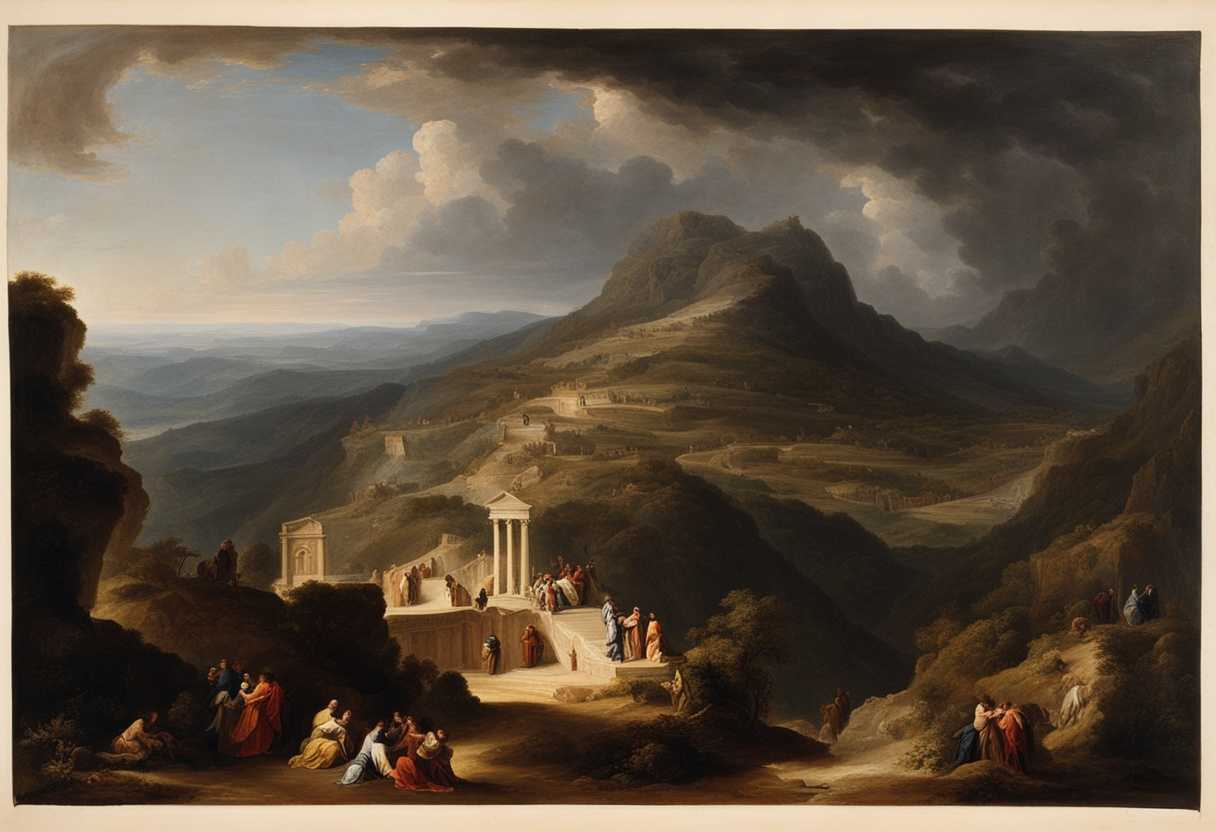
In the Bible, Mount Ebal is associated with cursing and the proclamation of God’s commandments. It is located in the vicinity of Shechem, and in Deuteronomy 27, the Israelites were instructed to build an altar there and pronounce curses on those who violate God’s laws.
Scripture
29 And when the Lord your God brings you into the land that you are entering to take possession of it, you shall set the blessing on Mount Gerizim and the curse on Mount Ebal.
30 Are they not beyond the Jordan, west of the road, toward the going down of the sun, in the land of the Canaanites who live in the Arabah, opposite Gilgal, beside the oak of Moreh?
31 For you are to cross over the Jordan to go in to take possession of the land that the Lord your God is giving you. And when you possess it and live in it,
32 And you shall be careful to do all the statutes and the rules that I am setting before you today.
Meaning of Ebal in the Bible
Mount Ebal holds a significant place in biblical tradition as a symbol of judgment and the seriousness of God’s commandments. In Deuteronomy 27:11-13, the Israelite community is instructed to divide themselves into two groups, with half standing on Mount Gerizim to proclaim blessings, while the other half stands on Mount Ebal to declare curses. The curses pronounced from Mount Ebal were specifically aimed at those who turned away from God’s statutes, highlighting the consequences of disobedience (Deuteronomy 27:15-26). This stark division between blessings and curses underscores the covenant relationship between God and Israel, where adherence to God’s laws brings blessings, while violation leads to dire consequences.
The broader meaning of Mount Ebal extends beyond its physical location; it serves as a moral and spiritual reminder of the choices that individuals and communities must make concerning their obedience to God’s will. In Joshua 8:30-35, we see the fulfillment of Moses’ commands when the Israelites erected an altar on Mount Ebal, affirming their commitment to God’s covenant. This act signifies the importance of reminding oneself of the ethical and moral framework established by God’s commands. Thus, Mount Ebal emphasizes the duality of divine justice—blessing for obedience and cursing for transgression—and invites believers to reflect on their path in light of these eternal principles, ultimately reinforcing the biblical theme of covenant faithfulness and the nature of God’s righteousness.
Beyond the immediate context of blessing and cursing, Mount Ebal represents a deeper theological theme within the biblical narrative: the balance between justice and mercy. While the mountain’s associations with curses highlight the gravity of disobedience, it also implies an opportunity for repentance and return to right relationship with God. The presence of curses signifies not only a warning but also an invitation to adhere to God’s commandments, illustrating the continual hope offered through repentance and alignment with divine will. This duality encourages a reflective consideration of how choices impact one’s relationship with God and the community.
Furthermore, Ebal’s significance can also be gleaned from its connection to the broader narrative of the Israelites’ journey and their establishment in the Promised Land. As they engage in communal rituals on Ebal, the mountains serve as a geographical marker of their identity as a covenant people. The act of standing on these two mountains represents a tangible reminder of their commitment to God’s laws and serves as a symbol of their collective responsibility to uphold the covenant. This reinforces the idea of communal accountability in spiritual matters, emphasizing that faith and obedience are not merely personal endeavors, but communal commitments that shape the identity and destiny of the people as a whole. Thus, Mount Ebal intertwines the concepts of justice, community, and the enduring nature of God’s covenant in the life of Israel, firmly rooting the significance of choices within the framework of relationship and consequence.
Symbol of Blessing and Cursing
Mount Ebal is often associated with the themes of blessing and cursing in the biblical narrative. It serves as a physical representation of the covenant between God and the Israelites, where blessings are pronounced on one mountain (Gerizim) and curses on Ebal. This duality emphasizes the choices that individuals and communities must make in their relationship with God, highlighting the consequences of obedience versus disobedience.
Representation of Obedience to God
Ebal also signifies the importance of obedience to God’s commandments. The rituals and declarations made on this mountain underscore the necessity of adhering to divine laws as a means of maintaining a covenant relationship with God. This aspect of Ebal serves as a reminder that faith is not merely a matter of belief but is also demonstrated through actions and adherence to God’s will.
A Call to Remembrance
Mount Ebal functions as a memorial site, calling the Israelites to remember their history and the covenant established with God. The acts performed there serve as a reminder of their identity as God’s chosen people and the importance of their commitment to His laws. This aspect of Ebal encourages believers to reflect on their spiritual journey and the significance of their commitments in the context of their faith.
How to Embrace Blessings Through Faith and Obedience
Embracing blessings through faith and obedience is a beautiful journey that transforms our relationship with God and deepens our understanding of His grace. It starts with cultivating a heart that trusts in His promises, even when circumstances seem daunting. Remember, faith is not just a feeling; it’s an active choice to believe in God’s goodness and sovereignty. As you immerse yourself in Scripture, you’ll find countless examples of how obedience to God’s word leads to abundant blessings—think of Abraham, who stepped out in faith, or the Israelites who followed God’s commands into the Promised Land. Each act of obedience, no matter how small, is a step closer to experiencing the fullness of His blessings. So, take time to pray, seek His guidance, and be willing to act on what He reveals to you. In doing so, you’ll not only witness His faithfulness but also grow in your own faith, creating a beautiful cycle of trust and divine favor in your life.
Bible References to the Meaning of Ebal:
Deuteronomy 27:1-26: 1 Now Moses and the elders of Israel commanded the people, saying, “Keep the whole commandment that I command you today.
2 And on the day you cross over the Jordan to the land that the Lord your God is giving you, you shall set up large stones and plaster them with plaster.
3 And you shall write on them all the words of this law, when you cross over to enter the land that the Lord your God is giving you, a land flowing with milk and honey, as the Lord, the God of your fathers, has promised you.
4 So when you have crossed over the Jordan, you shall set up these stones, concerning which I command you today, on Mount Ebal, and you shall plaster them with plaster.
5 And there you shall build an altar to the Lord your God, an altar of stones. You shall wield no iron tool on them;
6 You shall build the altar of the Lord your God of uncut stones, and you shall offer burnt offerings on it to the Lord your God.
7 And you shall sacrifice peace offerings and shall eat there, and you shall rejoice before the Lord your God.
8 And you shall write on the stones all the words of this law very plainly.”
9 Then Moses and the Levitical priests said to all Israel, “Keep silence and hear, O Israel: this day you have become the people of the Lord your God.
10 “You shall therefore obey the voice of the Lord your God, keeping his commandments and his statutes, which I command you today.”
11 That day Moses charged the people, saying,
12 “When you have crossed over the Jordan, these shall stand on Mount Gerizim to bless the people: Simeon, Levi, Judah, Issachar, Joseph, and Benjamin.
13 And these shall stand on Mount Ebal for the curse: Reuben, Gad, Asher, Zebulun, Dan, and Naphtali.
14 And the Levites shall declare to all the men of Israel in a loud voice:
15 “‘Cursed be the man who makes a carved or cast metal image, an abomination to the Lord, a thing made by the hands of a craftsman, and sets it up in secret.’ And all the people shall answer and say, ‘Amen.’
16 “‘Cursed be anyone who dishonors his father or his mother.’ And all the people shall say, ‘Amen.’
17 “‘Cursed be anyone who moves his neighbor’s landmark.’ And all the people shall say, ‘Amen.’
18 “‘Cursed be anyone who misleads a blind man on the road.’ And all the people shall say, ‘Amen.’
19 “‘Cursed be anyone who perverts the justice due to the sojourner, the fatherless, and the widow.’ And all the people shall say, ‘Amen.’
20 “‘Cursed be anyone who lies with his father’s wife, because he has uncovered his father’s nakedness.’ And all the people shall say, ‘Amen.’
21 “‘Cursed be anyone who lies with any kind of animal.’ And all the people shall say, ‘Amen.’
22 “‘Cursed be anyone who lies with his sister, whether the daughter of his father or the daughter of his mother.’ And all the people shall say, ‘Amen.’
23 “‘Cursed be anyone who lies with his mother-in-law.’ And all the people shall say, ‘Amen.’
24 “‘Cursed be anyone who strikes down his neighbor in secret.’ And all the people shall say, ‘Amen.’
25 “‘Cursed be anyone who takes a bribe to shed innocent blood.’ And all the people shall say, ‘Amen.’
26 “‘Cursed be anyone who does not confirm the words of this law by doing them.’ And all the people shall say, ‘Amen.’
Deuteronomy 28:1-14: 1 “And if you faithfully obey the voice of the Lord your God, being careful to do all his commandments that I command you today, the Lord your God will set you high above all the nations of the earth.”
2 And all these blessings shall come upon you and overtake you, if you obey the voice of the Lord your God.
3 Blessed shall you be in the city, and blessed shall you be in the field.
4 Blessed shall be the fruit of your womb and the fruit of your ground and the fruit of your cattle, the increase of your herds and the young of your flock.
5 Blessed shall be your basket and your kneading bowl.
6 Blessed shall you be when you come in, and blessed shall you be when you go out.
7 “The Lord will cause your enemies who rise against you to be defeated before you. They shall come out against you one way and flee before you seven ways.”
8 The Lord will command the blessing on you in your barns and in all that you undertake.
9 The Lord will establish you as a people holy to himself, as he has sworn to you, if you keep the commandments of the Lord your God and walk in his ways.
10 And all the peoples of the earth shall see that you are called by the name of the Lord, and they shall be afraid of you.
11 And the Lord will make you abound in prosperity, in the fruit of your womb and in the fruit of your livestock and in the fruit of your ground, within the land that the Lord swore to your fathers to give you.
12 The Lord will open to you his good treasury, the heavens, to give the rain to your land in its season and to bless all the work of your hands. And you shall lend to many nations, but you shall not borrow.
13 And the Lord will make you the head and not the tail, and you shall only go up and not down, if you obey the commandments of the Lord your God, which I command you today, being careful to do them,
14 and if you do not turn aside from any of the words that I command you today, to the right hand or to the left, to go after other gods to serve them.
Joshua 8:30-35: 30 At that time Joshua built an altar to the Lord, the God of Israel, on Mount Ebal,
31 just as Moses the servant of the Lord had commanded the people of Israel, as it is written in the Book of the Law of Moses, “an altar of uncut stones, upon which no man has wielded an iron tool.” And they offered on it burnt offerings to the Lord and sacrificed peace offerings.
32 And there in the presence of the people of Israel he wrote on the stones a copy of the law of Moses, which he had written.
33 And all Israel, sojourner as well as native born, with their elders and officers and their judges, stood on opposite sides of the ark before the Levitical priests who carried the ark of the covenant of the Lord, half of them in front of Mount Gerizim and half of them in front of Mount Ebal, just as Moses the servant of the Lord had commanded at the first, to bless the people of Israel.
34 And afterward he read all the words of the law, the blessing and the curse, according to all that is written in the Book of the Law.
35 There was not a word of all that Moses commanded that Joshua did not read before all the assembly of Israel, and the women, and the little ones, and the sojourners who lived among them.
Judges 9:7-21: 7 Now when they told Jotham, he went and stood on top of Mount Gerizim and lifted his voice and cried out.
8 The trees once went out to anoint a king over them, and they said to the olive tree, ‘Reign over us.’
9 But the olive tree said to them, ‘Shall I leave my abundance, by which gods and men are honored, and go hold sway over the trees?’
10 And the trees said to the fig tree, ‘You come and reign over us.’
11 But the fig tree said to them, ‘Shall I leave my sweetness and my good fruit and go hold sway over the trees?’
12 And the trees said to the vine, ‘You come and reign over us.’
13 “But the vine said to them, ‘Shall I leave my wine that cheers God and men and go hold sway over the trees?’”
14 Then all the trees said to the bramble, ‘You come and reign over us.’
15 And the bramble said to the trees, ‘If in good faith you are anointing me king over you, then come and take refuge in my shade, but if not, let fire come out of the bramble and devour the cedars of Lebanon.’
16 “Now therefore, if you have acted in good faith and integrity when you made Abimelech king, and if you have dealt well with Jerubbaal and his house and have done to him as his deeds deserved—”
17 for my father fought for you and risked his life and delivered you from the hand of Midian,
18 And you have risen up against my father’s house this day and have killed his sons, seventy men on one stone, and have made Abimelech, the son of his female servant, king over the leaders of Shechem, because he is your relative—
19 if you then have acted in good faith and integrity with Jerubbaal and with his house this day, then rejoice in Abimelech, and let him also rejoice in you.
20 But if not, let fire come out from Abimelech and devour the leaders of Shechem and Beth-millo; and let fire come out from the leaders of Shechem and from Beth-millo and devour Abimelech.”
21 And Jotham ran away and fled and went to Beer and lived there, because of Abimelech his brother.

Rev. François Dupont is a dedicated church minister with a wealth of experience in serving spiritual communities. With a calm and serene demeanor, he has been devoted to sharing the message of love, compassion, and tolerance for over two decades. Through his thoughtful sermons, compassionate counseling, and unwavering support, Rev. Dupont has touched the lives of countless individuals, allowing them to find solace and strength during difficult times. His serene presence and deep understanding of the human condition make him a trusted guide for those seeking spiritual nourishment and guidance.