
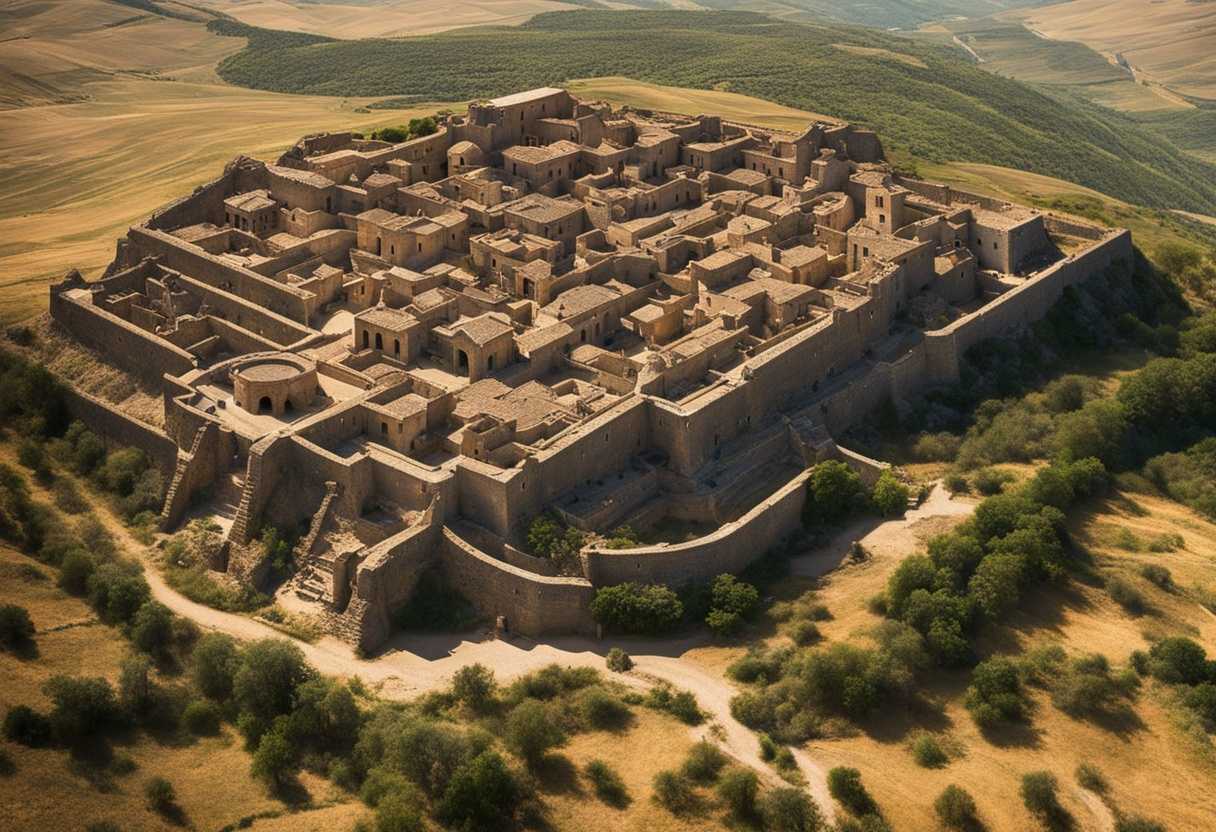
In the Bible, Geba is a city located in the territory of Benjamin, mentioned as a Levitical city and a site of a boundary between the tribes of Benjamin and Ephraim (1 Samuel 13:3; 2 Kings 23:8). It is noted for its strategic location and historical significance during the reigns of various Israelite kings.
Scripture
21 Now the cities of the tribe of the people of Benjamin according to their clans were Jericho, Beth-hoglah, Emek-keziz,
22 Beth-arabah, Zemaraim, Bethel,
23 Avvim, Parah, Ophrah,
24 Chephar-ammoni, Ophni, and Geba: twelve cities with their villages.
25 Gibeon, Ramah, Beeroth,
26 In Mizpeh, Chephar-haammoni, Ophni,
27 Rekem, Irpeel, Taralah,
28 Zela, Haeleph, Jebus (that is, Jerusalem), Gibeah and Kiriath-jearim—fourteen cities with their villages.
Meaning of Geba in the Bible
Geba, situated in the territory of Benjamin, carries deeper theological and historical significance beyond its geographical location in the Bible. As a Levitical city, it represents a place of refuge and worship, embodying the spiritual heritage of the Israelite tribes. The verses in 1 Samuel 13:3 and 2 Kings 23:8 highlight Geba’s strategic importance during critical moments in Israel’s history, serving as a boundary marker that delineates the territories of the tribes of Benjamin and Ephraim. This demarcation not only reflects the physical division of land but symbolizes the ongoing tensions and alliances among the tribes of Israel as they navigated their collective identity and destiny in the Promised Land.
The presence of Geba in biblical narratives invites reflections on themes of unity and division within the larger Israelite community. The city’s role as both a military outpost and a center of worship underscores the blending of sacred and secular life, illustrating how locations in the biblical narrative often functioned as spiritual hubs while also serving practical governmental purposes. When the kings of Israel established authority and territorial sovereignty, places like Geba became focal points of both conflict and cooperation, driving home the message that God was integral to both the spiritual and earthly struggles of His people. In this way, Geba is emblematic of a community grappling with its identity in the divine plan, revealing how God used specific locations to weave the complex tapestry of Israel’s history and faith.
Further exploration of Geba’s role in the biblical narrative reveals its mention in connection with the military ambitions of various Israelite leaders. The city served as a critical location for David and his forces, emphasizing its strategic military value in the defense and consolidation of the kingdom of Israel. The engagement of warriors around Geba, as seen in the accounts of battles throughout the books of Samuel and Chronicles, illustrates the city’s position as a critical point of defense against enemy occupations and internal strife. This military significance not only highlights the tactical importance of geographical locations in Israel’s conflicts but also reinforces the notion of divine protection and guidance that the Israelites sought in their endeavors.
Moreover, Geba is often mentioned in conjunction with other cities that highlight the collective struggle of the Israelites as they aimed for unity and strength as a nation. The cities surrounding Geba, such as Michmash, played significant roles in battles and demonstrate how leaders would rally the tribes around shared geographic landmarks. This synergy of military activity, local governance, and spiritual observance emphasizes the importance of Geba as a nexus for cultural identity, cohesion, and faith in God’s providence. Thus, Geba not only represents a historical and geographical landmark but also stands as a testament to the intricate relationship between the land, the people, and their faith throughout Israel’s journey, serving as a reminder of both the blessings and challenges encountered in their spiritual pilgrimage.
Historical Significance
Geba is often recognized as a significant location in the ancient history of Israel. It served as a strategic city in the territory of Benjamin, playing a crucial role in the defense and administration of the region. Its position allowed it to act as a military outpost and a point of control over the surrounding areas, reflecting the importance of geography in biblical narratives.
Symbol of Division and Unity
In biblical texts, Geba can also symbolize the themes of division and unity among the tribes of Israel. As a border city, it marked the boundary between the northern and southern kingdoms, illustrating the political and social divisions that arose after the reign of Solomon. Conversely, it also served as a point of gathering for the tribes, highlighting the potential for unity in worship and governance despite the divisions.
Spiritual Implications
Geba’s mention in the Bible often carries spiritual implications, representing the need for vigilance and protection in the life of faith. The city’s role as a fortified location can be seen as a metaphor for the spiritual defenses believers must maintain against external threats. This reflects the broader biblical theme of seeking refuge and strength in God amidst challenges, emphasizing the importance of spiritual fortitude.
How to Deepen Your Faith and Impact Others Positively
Deepening your faith is a journey that requires intentionality and openness to God’s guidance. Start by immersing yourself in Scripture; let the Word of God speak to you daily, and consider journaling your thoughts and prayers to track your spiritual growth. Surround yourself with a community of believers who inspire and challenge you—engaging in fellowship can ignite your passion for Christ and provide accountability. Remember, your faith is not just for your own benefit; it’s a light meant to shine in the lives of others. Look for opportunities to serve, whether through volunteering, offering a listening ear, or simply sharing your testimony. As you grow closer to God, you’ll find that your actions and words can profoundly impact those around you, reflecting His love and grace in a world that desperately needs it.
Bible References to the Meaning of Geba:
1 Samuel 13:1-7: 13 Saul lived for one year and then became king, and when he had reigned for two years over Israel,
2 Saul chose three thousand men of Israel. Two thousand were with Saul in Michmash and the hill country of Bethel, and a thousand were with Jonathan in Gibeah of Benjamin. The rest of the people he sent home, every man to his tent.
3 Jonathan defeated the garrison of the Philistines that was at Geba, and the Philistines heard of it. And Saul blew the trumpet throughout all the land, saying, “Let the Hebrews hear.”
4 And all Israel heard it said that Saul had defeated the garrison of the Philistines, and also that Israel had become a stench to the Philistines. And the people were called out to join Saul at Gilgal.
5 And the Philistines mustered to fight with Israel, thirty thousand chariots and six thousand horsemen and troops like the sand on the seashore in multitude. They came up and encamped in Michmash, to the east of Beth-aven.
6 When the men of Israel saw that they were in trouble (for the people were hard pressed), the people hid themselves in caves and in holes and in rocks and in tombs and in cisterns,
7 And some of the Hebrews crossed the fords of the Jordan to the land of Gad and Gilead. But Saul was still at Gilgal, and all the people followed him trembling.
2 Samuel 5:17-25: 17 When the Philistines heard that David had been anointed king over Israel, all the Philistines went up to search for David. But David heard of it and went down to the stronghold.
18 Now the Philistines had come and spread out in the Valley of Rephaim.
19 And David inquired of the Lord, “Shall I go up against the Philistines? Will you give them into my hand?” And the Lord said to David, “Go up, for I will certainly give the Philistines into your hand.”
20 So David came to Baal-perazim, and David defeated them there. And he said, “The Lord has broken through my enemies before me like a breaking flood.” So the name of that place is called Baal-perazim.
21 And the Philistines left their idols there, and David and his men carried them away.
22 And the Philistines came up yet again and spread out in the Valley of Rephaim.
23 And when David inquired of the Lord, he said, “You shall not go up; go around to their rear, and come against them opposite the balsam trees.
24 And when you hear the sound of marching in the tops of the balsam trees, then rouse yourself, for then the Lord has gone out before you to strike down the army of the Philistines.
25 And David did as the Lord commanded him, and struck down the Philistines from Geba to Gezer.
1 Kings 15:16-22: 16 And there was war between Asa and Baasha king of Israel all their days.
17 Now Baasha king of Israel went up against Judah and built Ramah, that he might permit no one to go out or come in to Asa king of Judah.
18 Then Asa took all the silver and the gold that were left in the treasures of the house of the Lord and the treasures of the king’s house and gave them into the hands of his servants. And King Asa sent them to Ben-hadad the son of Tabrimmon, the son of Hezion, king of Syria, who lived in Damascus, saying,
19 “Let there be a covenant between me and you, as there was between my father and your father. Behold, I am sending to you a present of silver and gold. Go, break your covenant with Baasha king of Israel, that he may withdraw from me.”
20 Ben-hadad listened to King Asa and sent the commanders of his armies against the cities of Israel, and conquered Ijon, Dan, Abel-beth-maacah, and all Chinneroth, with all the land of Naphtali.
21 When Baasha heard of it, he stopped building Ramah and he lived in Tirzah.
22 Then King Asa made a proclamation to all Judah, none was exempt, and they carried away the stones of Ramah and its timber, with which Baasha had been building, and with them King Asa built Geba of Benjamin and Mizpah.
2 Kings 23:4-8: 4 And the king commanded Hilkiah the high priest and the priests of the second order and the keepers of the threshold to bring out of the temple of the Lord all the vessels made for Baal, for Asherah, and for all the host of heaven. He burned them outside Jerusalem in the fields of the Kidron and carried their ashes to Bethel.
5 And he deposed the priests whom the kings of Judah had ordained to make offerings in the high places at the cities of Judah and around Jerusalem; those also who burned incense to Baal, to the sun and the moon and the constellations and all the host of the heavens.
6 And he brought out the Asherah from the house of the Lord, outside Jerusalem, to the brook Kidron, and burned it at the brook Kidron and beat it to dust and cast the dust of it upon the graves of the common people.
7 And he broke down the houses of the male cult prostitutes who were in the house of the Lord, where the women wove hangings for the Asherah.
8 And he brought all the priests out of the cities of Judah, and defiled the high places where the priests had made offerings, from Geba to Beersheba. And he broke down the high places of the gates that were at the entrance of the gate of Joshua the governor of the city, which were on one’s left at the gate of the city.
1 Chronicles 6:54-60: 54 These are the dwelling places according to their settlements within their borders for the sons of Aaron of the families of the Kohathites, for theirs was the first lot.
55 till he came to the hill country of Ephraim, and found a place for themselves to live in.
56 but the fields of the city and its villages they gave to Caleb the son of Jephunneh.
57 To the sons of Aaron they gave the cities of refuge: Hebron, Libnah with its pasturelands, Jattir, Eshtemoa with its pasturelands,
58 Hilen with its pasturelands, Debir with its pasturelands,
59 and Ashan with its pasturelands, and Beth-shemesh with its pasturelands;
60 And out of the tribe of Benjamin: Geba with its pasturelands, Alemeth with its pasturelands, and Anathoth with its pasturelands. All their cities throughout their families were thirteen.
1 Chronicles 8:1-7: 1 Benjamin fathered Bela his firstborn, Ashbel the second, Aharah the third,
2 Nohah fathered Ahuzzam, Gera, and Naaman. Naaman fathered Ahuzzam.
3 The sons of Bela: Addar, Gera, Abihud,
4 and Abishur, Gilead’s wife bore him Ahban and Molid.
5 and Gera, and Shephuphan, and Huram.
6 These are the sons of Ehud (they were heads of fathers’ houses of the inhabitants of Geba, and they were carried into exile to Manahath):
7 Naaman, Ahijah, and Gera, that is, Heglam, who fathered Uzza and Ahihud.
1 Chronicles 14:8-17: 8 When the Philistines heard that David had been anointed king over all Israel, all the Philistines went up to search for David. But David heard of it and went out against them.
9 Now the Philistines had come and made a raid in the Valley of Rephaim.
10 And David inquired of God, “Shall I go up against the Philistines? Will you give them into my hand?” And the Lord said to him, “Go up, and I will give them into your hand.”
11 So David did as God commanded him, and they struck down the Philistine army from Gibeon to Gezer.
12 And when they had fled, David sent and took them out of the land of the Philistines, and they lived in Judah and made raids against the inhabitants of the land, the Philistines.
13 And the Philistines yet again made a raid in the valley.
14 And when David inquired of God, God said to him, “You shall not go up after them; go around and come against them opposite the balsam trees.
15 And when you hear the sound of marching in the tops of the balsam trees, then go out to battle, for God has gone out before you to strike down the army of the Philistines.
16 And David did as God commanded him, and they struck down the Philistine army from Gibeon to Gezer.
17 And the fame of David went out into all lands, and the Lord brought the fear of him upon all nations.
2 Chronicles 16:1-6: In the thirty-sixth year of the reign of Asa, Baasha king of Israel went up against Judah and built Ramah, that he might permit no one to go out or come in to Asa king of Judah.
2 Then Asa took silver and gold from the treasures of the house of the Lord and the king’s house and sent them to Ben-hadad king of Syria, who lived in Damascus, saying,
3 There is a covenant between me and you, as there was between my father and your father. Behold, I am sending to you silver and gold. Go, break your covenant with Baasha king of Israel, that he may withdraw from me.
4 And Ben-hadad listened to King Asa and sent the commanders of his armies against the cities of Israel, and they conquered Ijon, Dan, Abel-maim, and all the store cities of Naphtali.
5 When Baasha heard it, he stopped building Ramah and let his work cease.
6 Then King Asa took all Judah, and they carried away the stones of Ramah and its timber, with which Baasha had been building, and with them he built Geba and Mizpah.
Ezra 2:1-26: 1 Now these were the people of the province who came up out of the captivity of those exiles whom Nebuchadnezzar the king of Babylon had carried captive to Babylonia.
2 They came with Zerubbabel, Jeshua, Nehemiah, Seraiah, Reelaiah, Mordecai, Bilshan, Mispar, Bigvai, Rehum, and Baanah.
3 who came with Zerubbabel, Jeshua, Nehemiah, Seraiah, Reelaiah, Mordecai, Bilshan, Mispar, Bigvai, Rehum, and Baanah. The number of the men of the people of Israel:
4 The men of the people of Israel:
5 the sons of Arah, 775
6 the sons of Pahath-moab, namely the sons of Jeshua and Joab, 2,812
7 who came with Zerubbabel, Jeshua, Nehemiah, Seraiah, Reelaiah, Mordecai, Bilshan, Mispar, Bigvai, Rehum, and Baanah. The number of the men of the people of Israel:
8 the sons of Parosh, 2,172.
9 The sons of Zaccai, 760.
10 The sons of Bani: Hashum,
11 the sons of Bebai, 628.
12 the sons of Azgad, 1,222
13 the sons of Adonikam, 666.
14 The sons of Bigvai, two thousand fifty-six.
15 The sons of Adin, 454
16 besides their male and female servants, of whom there were 7,337. And they had 200 male and female singers.
17 the sons of Azgad, 2,322.
18 the sons of Adonikam, 666.
19 The sons of Hashum, 223.
20 The sons of Immer, 1,052.
21 The sons of Bethlehem, one hundred twenty-three.
22 The men of Netophah 56, 56, 56, 56, 56, 56, 56, 56, 56, 56, 56, 56, 56, 56, 56, 56, 56, 56, 56, 56, 56, 56, 56, 56, 56, 56, 56, 56, 56, 56, 56, 56, 56, 56, 56, 56, 56, 56, 56, 56, 56, 56, 56, 56, 56, 56, 56, 56, 56, 56, 56, 56, 56, 56, 56, 56, 56, 56, 56, 56, 56, 56, 56, 56, 56, 56, 56, 56, 56, 56, 56, 56, 56, 56, 56, 56, 56, 56, 56, 56, 56, 56, 56, 56, 56, 56, 56, 56, 56, 56, 56, 56, 56, 56, 56, 56, 56, 56, 56, 56, 56
23 The men of Anathoth, 128.
24 The sons of Azmaveth, forty-two.
25 the sons of Kiriath-arim, Chephirah, and Beeroth, 743
26 the sons of Ramah and Geba, 621
Nehemiah 11:25-36: 25 And as for the villages, with their fields, some of the people of Judah lived in Kiriath-arba and its villages, and in Dibon and its villages, and in Jekabzeel and its villages,
26 in Jeshua, in Moladah, in Beth-pelet,
27 And in Hazor-hadattah, Nobah, Ananiah,
28 in Ziklag, in Meconah and its villages,
29 and at En-rimmon, Zorah, Jarmuth,
30 Zanoah, Adullam, and their villages, Lachish and its fields, Azekah and its villages. So they encamped from Beersheba to the Valley of Hinnom.
31 The people of Benjamin also lived from Geba onward, at Michmash, Aija, Bethel and its villages,
32 And at Anathoth, Nob, Ananiah,
33 Hazor, Ramah, Gittaim,
34 in Anathoth, Nob, Ananiah,
35 in Lodebar, and its villages, and in Jether, and in Eshtemoa, with their pasturelands,
36 in all, 1,760 of the priests’ sons were heads of fathers’ houses. And Zadok, a young man mighty in valor, and twenty-two of his own relatives.
Isaiah 10:24-34: 24 Therefore thus says the Lord God of hosts: “O my people, who dwell in Zion, be not afraid of the Assyrians when they strike with the rod and lift up their staff against you as the Egyptians did.
25 For in a very little while my fury will come to an end, and my anger will be directed to their destruction.
26 And the Lord of hosts will wield against them a whip, as when he struck Midian at the rock of Oreb. And his staff will be over the sea, and he will lift it as he did in Egypt.
27 And in that day his burden will depart from your shoulder, and his yoke from your neck; and the yoke will be broken because of the fat.”
28 He has come to Aiath; he has passed through Migron; at Michmash he stores his baggage;
29 They have crossed over the pass; at Geba they lodge for the night; Ramah trembles; Gibeah of Saul has fled.
30 Cry aloud, O daughter of Gallim! Give attention, O Laishah! O poor Anathoth!
31 Madmenah is in flight;
the inhabitants of Gebim flee for safety.
32 This very day he will halt at Nob; he will shake his fist at the mount of the daughter of Zion, the hill of Jerusalem.
33 Behold, the Lord God of hosts will lop the boughs with terrifying power; the great in height will be hewn down, and the lofty will be brought low.
34 He will cut down the thickets of the forest with an axe, and Lebanon will fall by the Majestic One.
Zechariah 14:10-11: 10 The whole land shall be turned into a plain from Geba to Rimmon south of Jerusalem. But Jerusalem shall remain aloft on its site from the Gate of Benjamin to the place of the former gate, to the Corner Gate, and from the Tower of Hananel to the king’s winepresses.
11 And it shall be inhabited, for there shall never again be a decree of utter destruction. Jerusalem shall dwell in security.

Reverend Ogunlade is a seasoned Church Minister with over three decades of experience in guiding and nurturing congregations. With profound wisdom and a serene approach, Reverend Ogunlade has carried out various pastoral duties, including delivering uplifting sermons, conducting religious ceremonies, and offering sage counsel to individuals seeking spiritual guidance. Their commitment to fostering harmony and righteousness within their community is exemplified through their compassionate nature, making them a beloved and trusted figure among the congregation.