
In the Bible, Ethiopia is often referenced as a region located south of Egypt, known for its ancient civilization and rich resources. It is associated with the descendants of Cush, and appears in various contexts, including the story of the Ethiopian eunuch in Acts 8:26-40, symbolizing the spread of the Gospel beyond Israel.
Scripture
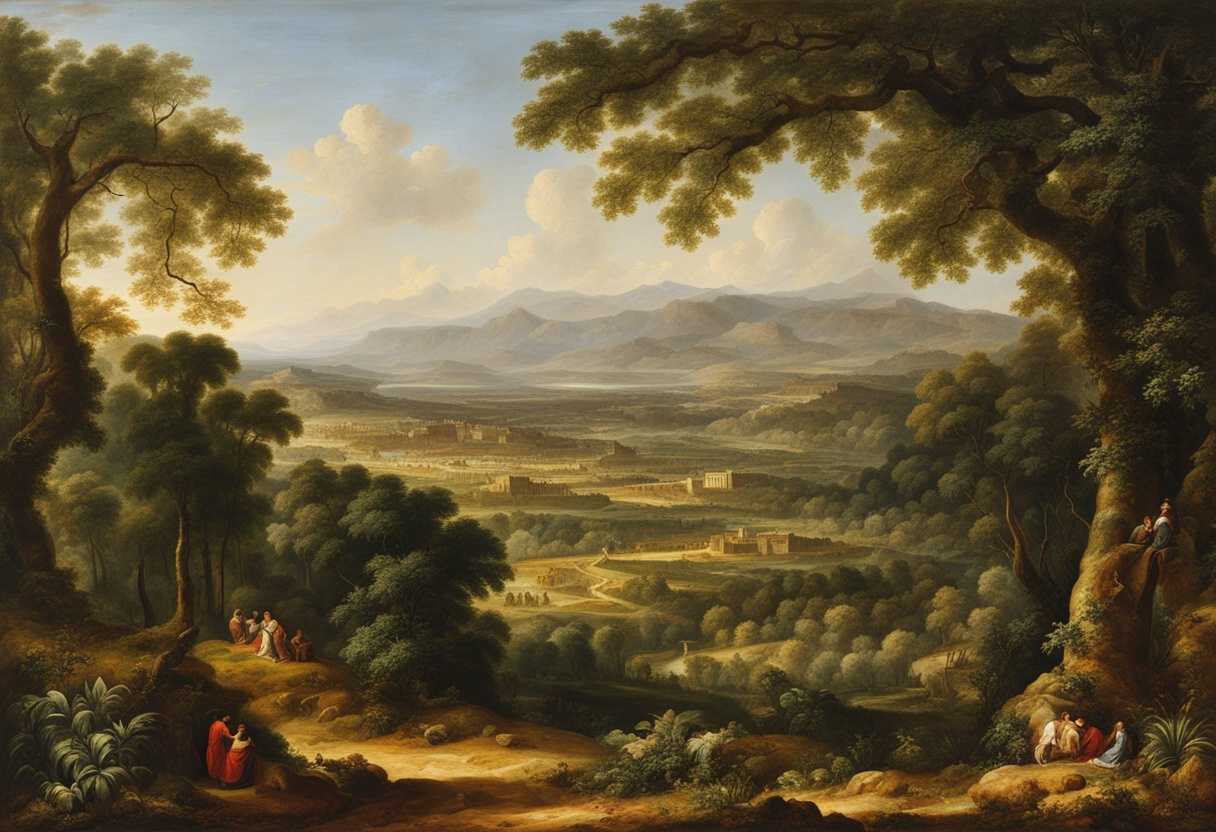
10 A river flowed out of Eden to water the garden, and there it divided and became four rivers.
11 The name of the first is the Pishon. It is the one that flowed around the whole land of Havilah, where there is gold.
12 The gold of that land is good; bdellium and onyx stone are there.
13 The name of the second river is the Gihon. It is the one that flowed around the whole land of Cush.
14 The name of the third river is the Tigris, which flows east of Assyria. And the fourth river is the Euphrates.
Ethiopia’s Significance in the Bible
Ethiopia, known in biblical texts as Cush, is richly woven into the narratives and teachings of the Bible, symbolizing both geographic and spiritual dimensions. This ancient kingdom, located to the south of Egypt, is prominent in several verses, such as Genesis 10:6-7, where Cush is listed among the descendants of Ham, highlighting its significance in the biblical lineage. The reference to Ethiopia also evokes a sense of the broader world and the universality of God’s message, as illustrated in Acts 8:26-40. The story of the Ethiopian eunuch, a high-ranking official who converts to Christianity after an encounter with Philip, emphasizes the inclusivity of the Gospel. This event marks a pivotal moment where the good news of Jesus crosses cultural and geographical boundaries, signifying that salvation is intended for all nations.
Ethiopia’s repeated mention throughout the Scriptures, including prophecies found in Isaiah 18:1-2 and Jeremiah 13:23, signifies not only its historical importance but also its role as a symbol of hope and redemption. These prophetic passages often use Ethiopia to represent extreme ends of the earth, underscoring the idea that God’s reach extends to all people, regardless of their origin. The presence of Ethiopia in sacred texts serves to illustrate God’s plan for redemption, wherein all nations can partake in His grace. Thus, Ethiopia embodies the theme of divine inclusiveness and the promise that the Gospel transcends ethnic and cultural barriers, inviting all to respond to God’s call.
The figure of Ethiopia in the Bible illustrates a multifaceted relationship with themes of power, spirituality, and international relationships. Ethiopia was known for its wealth and influence; it is often depicted in the context of its interactions with Israel and Judah, representing other nations that were both allies and adversaries. For instance, in the book of Zephaniah, Cush is referenced in discussions of God’s judgment against nations, indicating that even powerful kingdoms are subject to divine authority and accountability. Through these passages, Ethiopia emerges not only as a geographical location but as a metaphor for the broader discourse of strength, the fragility of human power, and the inevitability of divine justice.
Moreover, the significance of Ethiopia in the Bible extends to its representation of faith and apostolic zeal. In Ethiopic Christian tradition, the land is often associated with the early spread of Christianity, as exemplified by the testimony of the Ethiopian eunuch. Beyond individual stories, the kingdom of Ethiopia is emblematic of a collective faith journey, showcasing how God’s word was disseminated beyond Jewish communities to encompass a diverse population. This narrative reflects the biblical invitation to embrace a faith that transcends geographical and cultural boundaries, positioning Ethiopia as a vital participant in the unfolding story of salvation history, emblematic of the promise that the light of God’s revelation shines universally.
Symbol of Diversity and Inclusion
Ethiopia in the Bible often represents the diversity of God’s creation and the inclusion of all nations in His plan. The mention of Ethiopia, a land associated with people of different cultures and ethnicities, highlights the idea that God’s message transcends geographical and cultural boundaries. This serves as a reminder that the Gospel is for everyone, regardless of their background, and emphasizes the importance of unity among believers from various nations.
Representation of Strength and Resilience
Ethiopia is frequently depicted as a land of strength and resilience. The people of Ethiopia are often portrayed as formidable and proud, symbolizing endurance in the face of adversity. This representation can be seen as a metaphor for spiritual strength, encouraging believers to remain steadfast in their faith despite challenges. The mention of Ethiopia in various contexts serves to inspire individuals to draw upon their inner strength and resilience in their spiritual journeys.
Connection to Prophecy and Redemption
Ethiopia also holds a significant place in biblical prophecy and the theme of redemption. The references to Ethiopia often point to a future where nations will come together in worship and acknowledgment of God. This prophetic vision underscores the idea that God’s redemptive plan encompasses all peoples, including those from distant lands. The inclusion of Ethiopia in these narratives serves to illustrate the universal scope of God’s love and the promise of salvation for all humanity.
How to Embrace Faith and Diversity in Christ
Embracing faith and diversity in Christ is a beautiful journey that invites us to see the world through the eyes of love and understanding. As we deepen our relationship with Jesus, we are called to recognize that His message transcends cultural, racial, and social boundaries. This means actively seeking out and engaging with those who are different from us, listening to their stories, and appreciating the unique perspectives they bring to our shared faith. Remember, in Galatians 3:28, we are reminded that in Christ, there is neither Jew nor Gentile, neither slave nor free, nor is there male and female, for we are all one in Him. So, let’s celebrate our differences as reflections of God’s creativity, and let’s strive to build a community that mirrors the inclusive love of Christ, where everyone feels valued and welcomed. By doing so, we not only grow in our faith but also become a living testament to the unity that Jesus desires for His followers.
Bible References to Ethiopia in Scripture:
2 Chronicles 14:9-15: 9 And Zerah the Ethiopian came out against them with an army of a million men and 300 chariots, and came as far as Mareshah.
10 So Asa went out to meet him, and they drew up their lines of battle in the Valley of Zephathah at Mareshah.
11 And Asa cried to the Lord his God, “O Lord, there is none like you to help, between the mighty and the weak. Help us, O Lord our God, for we rely on you, and in your name we have come against this multitude. O Lord, you are our God; let not man prevail against you.”
12 So the Lord defeated the Ethiopians before Asa and before Judah, and the Ethiopians fled.
13 and Asa and the people who were with him pursued them as far as Gerar, and the Ethiopians fell until none remained alive, for they were broken before the Lord and his army. And the men of Judah carried away very much spoil.
14 And they struck down all the cities around Gerar, for the fear of the Lord was upon them. They plundered all the cities, for there was much plunder in them.
15 And they struck down the tents of those who had livestock and carried away sheep in abundance and camels. Then they returned to Jerusalem.
Psalm 68:31-32: 31 Nobles shall come from Egypt; Cush shall hasten to stretch out her hands to God.
32 O kingdoms of the earth, sing to God; sing praises to the Lord, Selah.
Isaiah 18:1-7: 1 Ah, land of whirring wings that is beyond the rivers of Cush,
2 which sends ambassadors by the sea, in vessels of papyrus on the waters. Go, you swift messengers, to a nation tall and smooth, to a people feared near and far, a nation mighty and conquering, whose land the rivers divide.
3 All you inhabitants of the world, you who dwell on the earth, when a signal is raised on the mountains, look! When a trumpet is blown, hear!
4 For thus the Lord said to me: “I will quietly look from my dwelling like clear heat in sunshine, like a cloud of dew in the heat of harvest.”
5 For, before the harvest, when the blossom is over, and the flower becomes a ripening grape, he cuts off the shoots with pruning hooks, and the spreading branches he lops off and clears away.
6 They shall all of them be left to the birds of prey of the mountains and to the beasts of the earth. And the birds of prey will summer on them, and all the beasts of the earth will winter on them.
7 At that time tribute will be brought to the Lord of hosts from a people tall and smooth, from a people feared near and far, a nation mighty and conquering, whose land the rivers divide, to Mount Zion, the place of the name of the Lord of hosts.
Isaiah 45:14: 14 Thus says the Lord: “The wealth of Egypt and the merchandise of Cush, and the Sabeans, men of stature, shall come over to you and be yours; they shall follow you; they shall come over in chains and bow down to you. They will plead with you, saying: ‘Surely God is in you, and there is no other, no god besides him.’”
Jeremiah 13:23: 23 Can the Ethiopian change his skin
or the leopard his spots?
Then also you can do good
who are accustomed to do evil.
Ezekiel 29:10-12: 10 therefore, behold, I am against you and against your streams, and I will make the land of Egypt an utter waste and desolation, from Migdol to Syene, as far as the border of Cush.
11 No foot of man shall pass through it, and no foot of beast shall pass through it; it shall be uninhabited for forty years.
12 And I will make the land of Egypt a desolation in the midst of desolated countries, and her cities shall be a desolation forty years among cities that are laid waste. I will scatter the Egyptians among the nations, and disperse them through the countries.
Ezekiel 30:4-9: 4 A sword shall come upon Egypt,
and anguish shall be in Cush,
when the slain fall in Egypt,
and her wealth is carried away,
and her foundations are torn down.
5 Cush, and Put, and Lud, and all Arabia, and Libya, and the people of the land that is in league, shall fall with them by the sword.
6 “Thus says the Lord:
Those who support Egypt shall fall,
and her proud might shall come down;
from Migdol to Syene
they shall fall within her by the sword,
declares the Lord God.
7 And they shall be desolated in the midst of desolated countries, and their cities shall be in the midst of cities that are laid waste.
8 And they will know that I am the Lord, when I have set fire to Egypt, and all her helpers are broken.
9 “On that day messengers shall go out from me in ships to terrify the unsuspecting people of Cush, and anguish shall come upon them on the day of Egypt’s doom; for, behold, it comes!”
Amos 9:7: 7 “Are you not like the Cushites to me, O people of Israel?” declares the Lord. “Did I not bring up Israel from the land of Egypt, and the Philistines from Caphtor and the Syrians from Kir?”
Zephaniah 3:9-10: 9 “For at that time I will change the speech of the peoples to a pure speech, that all of them may call upon the name of the Lord and serve him with one accord.
10 From beyond the rivers of Cush, my worshipers, the daughter of my dispersed people, shall bring me an offering.
Acts 8:26-39: 26 Now an angel of the Lord said to Philip, “Rise and go toward the south to the road that goes down from Jerusalem to Gaza.” This is a desert place.
27 And he rose and went. And there was an Ethiopian, a eunuch, a court official of Candace, queen of the Ethiopians, who was in charge of all her treasure. He had come to Jerusalem to worship
28 And he was returning, seated in his chariot, and he was reading the prophet Isaiah.
And the Spirit said to Philip, “Go over and join this chariot.”
30 So Philip ran to him and heard him reading Isaiah the prophet and asked, “Do you understand what you are reading?”
31 And he said, “How can I, unless someone guides me?” And he invited Philip to come up and sit with him.
32 Now the passage of the Scripture that he was reading was this: “Like a sheep he was led to the slaughter and like a lamb before its shearer is silent, so he opens not his mouth.
33 In his humiliation justice was denied him. Who can describe his generation? For his life is taken away from the earth.
34 And the eunuch said to Philip, “About whom, I ask you, does the prophet say this, about himself or about someone else?”
35 Then Philip opened his mouth, and beginning with this Scripture he told him the good news about Jesus.
36 And as they were going along the road they came to some water, and the eunuch said, “See, here is water! What prevents me from being baptized?”
37 And Philip said, “If you believe with all your heart, you may.” And he replied, “I believe that Jesus Christ is the Son of God.”
38 And he commanded the chariot to stop, and they both went down into the water, Philip and the eunuch, and he baptized him.
39 And when they came up out of the water, the Spirit of the Lord carried Philip away, and the eunuch saw him no more, and went on his way rejoicing.

Reverend Ogunlade is a seasoned Church Minister with over three decades of experience in guiding and nurturing congregations. With profound wisdom and a serene approach, Reverend Ogunlade has carried out various pastoral duties, including delivering uplifting sermons, conducting religious ceremonies, and offering sage counsel to individuals seeking spiritual guidance. Their commitment to fostering harmony and righteousness within their community is exemplified through their compassionate nature, making them a beloved and trusted figure among the congregation.