
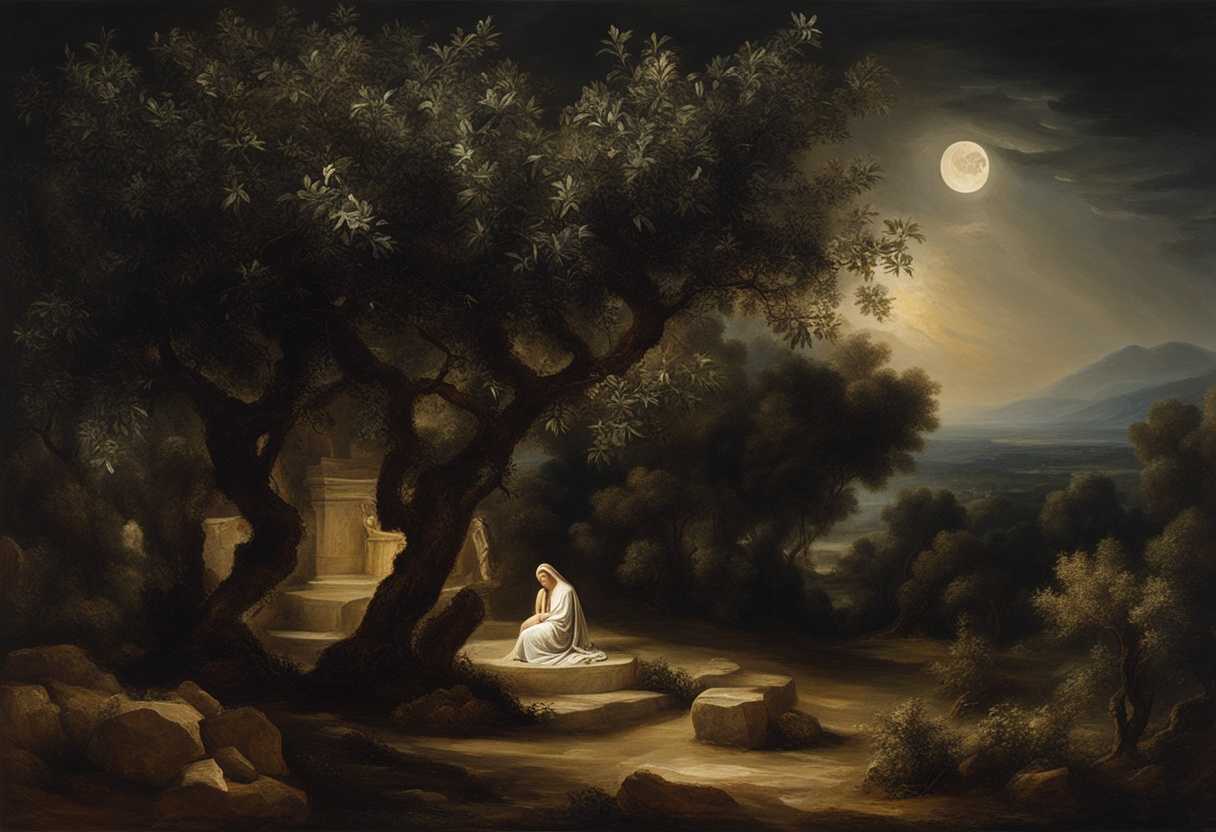
The Garden of Gethsemane, located at the foot of the Mount of Olives in Jerusalem, is where Jesus prayed and experienced deep anguish before his crucifixion, as described in the Gospels (Matthew 26:36-46, Mark 14:32-42, Luke 22:39-46). It symbolizes a place of profound struggle, surrender, and submission to God’s will.
Scripture
36 Then Jesus went with them to a place called Gethsemane, and he said to his disciples, “Sit here, while I go over there and pray.”
37 And taking with him Peter and the two sons of Zebedee, he began to be sorrowful and troubled.
38 Then he said to them, “My soul is very sorrowful, even to death; remain here, and watch with me.”
39 And going a little farther he fell on his face and prayed, saying, “My Father, if it be possible, let this cup pass from me; nevertheless, not as I will, but as you will.”
40 And he came to the disciples and found them sleeping. And he said to Peter, “So, could you not watch with me one hour?
41 Watch and pray that you may not enter into temptation. The spirit indeed is willing, but the flesh is weak.
42 Again, for the second time, he went away and prayed, “My Father, if this cannot pass unless I drink it, your will be done.”
43 And again he came and found them sleeping, for their eyes were heavy.
44 So, leaving them again, he went away and prayed for the third time, saying the same words again.
45 Then he came to the disciples and said to them, “Sleep and take your rest later on. See, the hour is at hand, and the Son of Man is betrayed into the hands of sinners.
46 Rise, let us be going; see, my betrayer is at hand.
Meaning of the Garden of Gethsemane
The Garden of Gethsemane holds profound theological significance within the New Testament narrative, marking a critical juncture in the passion of Christ. In Matthew 26:39, Jesus is depicted as praying, “My Father, if it is possible, let this cup pass from me; yet not what I want, but what you want.” This moment encapsulates the human struggle with divine destiny; Jesus, fully aware of the suffering awaiting him, wrestles with his impending fate. His anguished prayers reveal not only his humanity but also a model of submission to God’s will, emphasizing the importance of surrender even amid overwhelming distress. The anguish felt in Gethsemane can resonate with believers experiencing their own trials, illustrating the biblical call to trust and yield to God’s providential plan.
Moreover, Gethsemane symbolizes the theme of redemption and sacrifice, as it is here that Jesus prepares for his ultimate act of love through the crucifixion. In Luke 22:43, an angel appears to strengthen him, signifying divine support during his emotional turmoil. This interplay of human vulnerability and divine fortitude speaks to the Christian understanding of suffering and glory intertwined. The Garden, therefore, becomes a sanctuary of prayer and submission, inviting followers to witness how one can confront their fears and doubts while remaining anchored in faith. As Christians reflect on this pivotal moment, they are encouraged to embrace their own struggles with the same resolute spirit, trusting in God’s greater purpose amidst personal calamities.
In addition to its portrayal of Jesus’ inner turmoil, the Garden of Gethsemane serves as a significant backdrop for understanding the nature of divine relationship and the power of prayer. This setting, characterized by olive trees symbolizing peace and prosperity, contrasts sharply with the spiritual battle that unfolds within its confines. The act of Jesus praying fervently in this garden underscores the vital role of communion with God, especially when faced with trials that threaten to overwhelm the soul. The intimate conversation between Jesus and the Father illustrates the model of heartfelt dialogue that believers are invited to adopt in their own struggles. This exchange serves as a reminder that prayer is not merely a ritualistic exercise but a profound engagement with the divine that can cultivate strength and clarity in times of uncertainty.
Furthermore, Gethsemane reveals the concept of solidarity in suffering. As Jesus invites his disciples to stay awake and pray with him, there is an implicit call to community engagement in moments of crisis. The disciples’ inability to remain vigilant reflects human frailty, yet it also highlights the shared nature of spiritual journeys. Just as Jesus confronts his impending betrayal and crucifixion, believers are reminded of their collective struggles and the need for mutual support within the body of Christ. The Garden becomes emblematic of both individual and communal experiences of trial, showcasing how moments of deep sorrow can bring communities together in prayer and reflection. Ultimately, Gethsemane transcends being just a place of Jesus’ suffering; it evolves into a symbol of the perpetual struggle between faith and fear that resonates with every generation of believers.
A Place of Suffering and Submission
The Garden of Gethsemane represents a profound moment of human anguish and divine submission. It is where Jesus faced the weight of his impending crucifixion, illustrating the struggle between human desire and divine will. This setting emphasizes the importance of surrendering to God’s plan, even in the face of immense personal suffering. It serves as a reminder that moments of deep distress can lead to spiritual growth and a closer relationship with God.
A Symbol of Prayer and Vigilance
Gethsemane is also a powerful symbol of prayer and the need for vigilance in the face of temptation. Jesus’ time in the garden highlights the significance of prayer as a source of strength and guidance. It teaches believers the importance of remaining spiritually alert and connected to God, especially during challenging times. The garden serves as a call to cultivate a life of prayer, encouraging individuals to seek divine support in their struggles.
A Foreshadowing of Redemption
The Garden of Gethsemane foreshadows the redemptive work of Christ through his suffering and sacrifice. It marks the beginning of the passion narrative, where Jesus willingly embraces his role as the Savior. This moment underscores the theme of redemption that runs throughout the Bible, illustrating that through suffering, hope and salvation can emerge. The garden thus becomes a pivotal point in the narrative of salvation history, emphasizing the transformative power of Christ’s sacrifice for humanity.
How to Embrace Faith Through Prayer and Sacrifice
Embracing faith through prayer and sacrifice is a deeply personal journey that invites us to connect with God on a profound level. Prayer is not just a ritual; it’s a heartfelt conversation with our Creator, where we lay bare our hopes, fears, and gratitude. As you carve out time each day to pray, consider it an opportunity to listen as much as to speak, allowing God’s presence to guide your thoughts and actions. Sacrifice, on the other hand, is about giving up something valuable—be it time, comfort, or resources—for the sake of others and in service to God. This act of selflessness not only strengthens our faith but also mirrors Christ’s ultimate sacrifice for us. As you navigate this path, remember that both prayer and sacrifice are expressions of love and commitment, drawing you closer to God and helping you to live out your faith in tangible ways. Embrace these practices with an open heart, and watch how they transform your relationship with God and those around you.
Bible References to Garden of Gethsemane:
Mark 14:32-42: 32 And they went to a place called Gethsemane. And he said to his disciples, “Sit here while I pray.”
33 And he took with him Peter and James and John, and began to be greatly distressed and troubled.
34 And he said to them, “My soul is very sorrowful, even to death. Remain here and watch.”
35 And going a little farther, he fell on the ground and prayed that, if it were possible, the hour might pass from him.
36 And he said, “Abba, Father, all things are possible for you. Remove this cup from me. Yet not what I will, but what you will.”
37 And he came and found them sleeping, and he said to Peter, “Simon, are you asleep? Could you not watch one hour?
38 Watch and pray that you may not enter into temptation. The spirit indeed is willing, but the flesh is weak.
39 And again he went away and prayed, saying the same words.
40 And again he came and found them sleeping, for their eyes were very heavy, and they did not know what to answer him.
41 And he came the third time and said to them, “Are you still sleeping and taking your rest? It is enough; the hour has come. The Son of Man is betrayed into the hands of sinners.
42 “Rise, let us be going; see, my betrayer is at hand.”
Luke 22:39-46: 39 And he came out and went, as was his custom, to the Mount of Olives, and the disciples followed him.
40 And when he came to the place, he said to them, “Pray that you may not enter into temptation.”
41 And he withdrew from them about a stone’s throw, and knelt down and prayed,
42 saying, “Father, if you are willing, remove this cup from me. Nevertheless, not my will, but yours, be done.”
43 And there appeared to him an angel from heaven, strengthening him.
44 And being in agony he prayed more earnestly; and his sweat became like great drops of blood falling down to the ground.
45 And when he rose from prayer, he came to the disciples and found them sleeping for sorrow.
46 and he said to them, “Why are you sleeping? Rise and pray that you may not enter into temptation.”
John 18:1-11: 1 When Jesus had spoken these words, he went out with his disciples across the Kidron Valley, where there was a garden, which he and his disciples entered.
2 Now Judas, who betrayed him, also knew the place, for Jesus often met there with his disciples.
3 So Judas, having procured a band of soldiers and some officers from the chief priests and the Pharisees, went there with lanterns and torches and weapons.
4 Then Jesus, knowing all that would happen to him, came forward and said to them, “Whom do you seek?”
5 They answered him, “Jesus of Nazareth.” Jesus said to them, “I am he.” Judas, who betrayed him, was standing with them.
6 When Jesus said to them, “I am he,” they drew back and fell to the ground.
7 So he asked them again, “Whom do you seek?” And they said, “Jesus of Nazareth.”
8 Jesus answered, “I told you that I am he. So, if you seek me, let these men go.”
9 This was to fulfill the word that he had spoken: “Of those whom you gave me I have lost not one.”
10 Then Simon Peter, having a sword, drew it and struck the high priest’s servant and cut off his right ear. The servant’s name was Malchus.
11 So Jesus said to Peter, “Put your sword into its sheath; shall I not drink the cup that the Father has given me?”

Reverend Ogunlade is a seasoned Church Minister with over three decades of experience in guiding and nurturing congregations. With profound wisdom and a serene approach, Reverend Ogunlade has carried out various pastoral duties, including delivering uplifting sermons, conducting religious ceremonies, and offering sage counsel to individuals seeking spiritual guidance. Their commitment to fostering harmony and righteousness within their community is exemplified through their compassionate nature, making them a beloved and trusted figure among the congregation.