
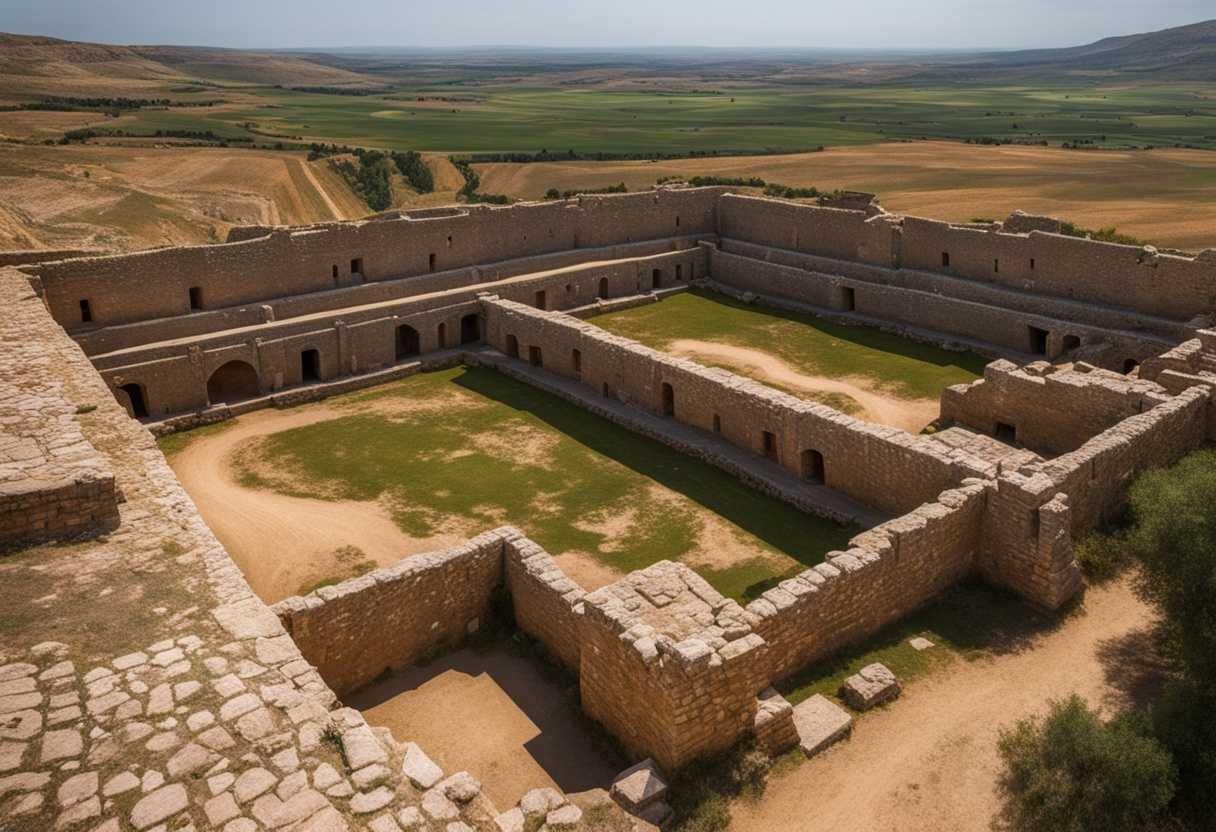
Hazor, in the Bible, is an ancient city mentioned as a significant Canaanite stronghold in the Book of Joshua, particularly known for its destruction by Joshua during the Israelite conquests (Joshua 11:10-11). The name “Hazor” means “enclosure” or “fortress,” highlighting its role as a fortified city in the ancient Near East.
Scripture
1 When Jabin, king of Hazor, heard of this, he sent to Jobab king of Madon, and to the king of Shimron, and to the king of Achshaph,
2 and to the kings who were in the northern hill country, and in the Arabah south of Chinneroth, and in the lowland, and in Naphoth-dor on the west,
3 to the Canaanites in the east and the west, the Amorites, the Hittites, the Perizzites, and the Jebusites in the hill country, and the Hivites under Hermon in the land of Mizpah.
4 And they came out with all their troops, a great horde, in number like the sand that is on the seashore, with very many horses and chariots.
5 And all these kings joined their forces and came and encamped together at the waters of Merom to fight against Israel.
6 And the Lord said to Joshua, “Do not be afraid of them, for tomorrow at this time I will give over all of them, slain, to Israel. You shall hamstring their horses and burn their chariots with fire.”
7 And Joshua and all the people of war with him came against them suddenly by the waters of Merom and fell upon them.
8 And the Lord gave them into the hand of Israel, who struck them and chased them as far as Great Sidon and Misrephoth-maim, and eastward as far as the Valley of Mizpeh. And they struck them until he left none remaining.
9 And Joshua did to them just as the Lord said to him: he hamstrung their horses and burned their chariots with fire.
10 And Joshua turned back at that time and captured Hazor and struck its king with the sword, for Hazor formerly was the head of all those kingdoms.
11 And they struck with the sword all who were in it, devoting them to destruction; there was none left that breathed. And he burned Hazor with fire.
12 And all the cities of those kings, and all their kings, Joshua captured, and struck them with the edge of the sword, devoting them to destruction, just as Moses the servant of the Lord had commanded.
13 But none of the cities that stood on mounds did Israel burn, except Hazor alone; that Joshua burned.
Meaning of Hazor in the Bible
The significance of Hazor in the Bible extends beyond its physical destruction during the Israelite conquests; it serves as a symbol of the struggle between Israel and the Canaanite nations. The city’s name, meaning “enclosure” or “fortress,” underscores its prominent role as a military stronghold, a site of refuge for the Canaanites, and the place where pagan practices flourished (Joshua 11:10-11). Hazor was a critical player in the regional power dynamics, reflecting the opposition that the Israelites faced while attempting to establish their identity and covenantal relationship with God. This backdrop is vividly illustrated in texts like Deuteronomy 7:2, where God commands the Israelites to destroy the Canaanite nations, as they represent not only physical adversaries but also spiritual challenges that could lead the Israelites astray from their worship of Yahweh.
In a broader theological context, Hazor represents the ongoing conflict between divine ordination and human autonomy. The obliteration of such fortified cities highlights God’s sovereignty in fulfilling His promises to Israel (Joshua 21:44-45), while also emphasizing the consequences of disobedience and idolatry among the nations (Judges 4:2). The eventual rebirth of Hazor in later texts, such as in the context of King Solomon’s building projects (1 Kings 9:15), illustrates themes of redemption and reoccupation, prompting reflections on the cyclical nature of sin, judgment, and restoration throughoutScripture, echoing God’s enduring desire for His people to turn to Him amidst the strongholds of their lives.
The narrative of Hazor invites a deeper exploration of themes related to obedience and rebellion within the biblical canon. Beyond its military significance, Hazor functions as a living testament to the consequences of rejecting divine command. The city’s history illustrates a pattern where the Israelites repeatedly struggled against the temptation to adopt Canaanite practices, ultimately highlighting how spiritual proximity to foreign idols can lead to an erosion of covenant faithfulness. The relentlessness of such spiritual struggles can be seen throughout the history of Israel, where Hazor, as a fortified city, embodies the barriers that the Israelites faced in their pursuit of holiness and fidelity to God’s law.
Moreover, the references to Hazor offer insights into the broader prophetic dialogue present in Scripture, where it often serves as a backdrop for prophetic warnings against idolatry and disobedience. The prophetic literature frequently alludes to the plight of nations like Hazor, which could easily symbolize the rebellion of Israel itself—an ominous reminder that divine judgment awaits those who reject the covenant. As the Israelites encountered the remnants of Hazor’s influence, they were continually prompted to remember the weight of their covenant with God, reinforcing the notion that true strength lies not in physical fortifications but in spiritual commitment and fidelity to Yahweh. In this light, Hazor moves beyond a mere geographical marker to embody the perennial struggles faced by God’s people throughout biblical history.
Historical Significance of Hazor
Hazor is often recognized as a significant ancient city in biblical history, serving as a center of Canaanite culture and power. Its strategic location made it a key player in the conflicts between the Israelites and the surrounding nations. The city’s prominence in various battles and its eventual destruction symbolize the broader theme of divine judgment and the fulfillment of God’s promises to the Israelites regarding the land of Canaan.
Symbol of Idolatry and Apostasy
In the biblical narrative, Hazor is also associated with idolatry and the worship of foreign gods. The city’s inhabitants practiced rituals that were contrary to the worship of Yahweh, leading to its representation as a symbol of apostasy. This serves as a cautionary tale within the biblical text, illustrating the dangers of turning away from divine commandments and the consequences that follow such actions.
Reflection of God’s Sovereignty
The fate of Hazor reflects the overarching theme of God’s sovereignty in the biblical narrative. The city’s rise and fall demonstrate that no earthly power can withstand the will of God. Hazor’s destruction is a reminder of the ultimate authority of God over nations and cities, reinforcing the belief that divine plans will prevail despite human opposition. This theme resonates throughout the scriptures, emphasizing the importance of faithfulness to God’s covenant.
How to Embrace Faith in Everyday Conquests
Embracing faith in our everyday conquests is about weaving our beliefs into the fabric of our daily lives, transforming mundane moments into opportunities for spiritual growth. Start by inviting God into your routine—whether it’s through morning prayers, reflecting on scripture during your lunch break, or simply pausing to express gratitude for the little things. Remember, faith isn’t just about grand gestures; it’s in the small acts of kindness, patience, and love we show to others. When faced with challenges, lean on your faith as a source of strength and guidance, trusting that God is with you in every step you take. By consciously choosing to see each day as a chance to live out your faith, you’ll find that even the simplest tasks can become profound acts of worship, helping you grow closer to God and embody the love of Christ in all that you do.
Bible References to the Meaning of Hazor:
Judges 4:1-24: 1 And the people of Israel again did what was evil in the sight of the Lord after Ehud died.
2 And the Lord sold them into the hand of Jabin king of Canaan, who reigned in Hazor.
3 Then the people of Israel cried out to the Lord for help, for he had 900 chariots of iron and he oppressed the people of Israel cruelly for twenty years.
4 Now Deborah, a prophetess, the wife of Lappidoth, was judging Israel at that time.
5 Now she used to sit under the palm of Deborah between Ramah and Bethel in the hill country of Ephraim, and the people of Israel came up to her for judgment.
6 She sent and summoned Barak the son of Abinoam from Kedesh-naphtali and said to him, “Has not the Lord, the God of Israel, commanded you, ‘Go, gather your men at Mount Tabor, taking 10,000 from the people of Naphtali and the people of Zebulun.
7 And I will draw out Sisera, the general of Jabin’s army, to meet you by the river Kishon with his chariots and his troops, and I will give him into your hand.’”
8 Barak said to her, “If you will go with me, I will go, but if you will not go with me, I will not go.”
9 And she said, “I will surely go with you. Nevertheless, the road on which you are going will not lead to your glory, for the Lord will sell Sisera into the hand of a woman.” Then Deborah arose and went with Barak to Kedesh.
10 And Barak called out Zebulun and Naphtali to Kedesh. And 10,000 men went up at his heels, and Deborah went up with him.
11 Now Heber the Kenite had separated from the Kenites, the descendants of Hobab the father-in-law of Moses, and had pitched his tent as far away as the oak in Zaanannim, which is near Kedesh.
12 When Sisera was told that Barak the son of Abinoam had gone up to Mount Tabor.
13 And Sisera called out all his chariots, 900 chariots of iron, and all the men who were with him, from Harosheth-hagoyim to the river Kishon.
14 And Deborah said to Barak, “Up! For this is the day in which the Lord has given Sisera into your hand. Does not the Lord go out before you?” So Barak went down from Mount Tabor with ten thousand men following him.
15 And the Lord routed Sisera and all his chariots and all his army before Barak by the edge of the sword. And Sisera got down from his chariot and fled away on foot.
16 But Barak pursued the chariots and the army to Harosheth-hagoyim, and all the army of Sisera fell by the edge of the sword; not a man was left.
17 But Sisera fled away on foot to the tent of Jael, the wife of Heber the Kenite, for there was peace between Jabin the king of Hazor and the house of Heber the Kenite.
18 And Jael came out to meet Sisera and said to him, “Turn aside, my lord; turn aside to me; do not be afraid.” So he turned aside to her into the tent, and she covered him with a rug.
19 But Sisera fled away on foot to the tent of Jael, the wife of Heber the Kenite, for there was peace between Jabin the king of Hazor and the house of Heber the Kenite.
20 And he said to her, “Stand at the opening of the tent, and if any man comes and asks you, ‘Is anyone here?’ say, ‘No.’”
21 But Jael the wife of Heber took a tent peg, and took a hammer in her hand. Then she went softly to him and drove the peg into his temple until it went down into the ground while he was lying fast asleep from weariness. So he died.
22 And behold, as Barak was pursuing Sisera, Jael went out to meet him and said to him, “Come, and I will show you the man whom you are seeking.” So he went in to her tent, and there lay Sisera dead, with the tent peg in his temple.
23 So on that day God subdued Jabin the king of Canaan before the people of Israel.
24 And the hand of the people of Israel pressed harder and harder against Jabin the king of Canaan, until they destroyed Jabin king of Canaan.
1 Kings 9:15-16: 15 And this is the account of the forced labor that King Solomon drafted to build the house of the Lord and his own house and the Millo and the wall of Jerusalem and Hazor and Megiddo and Gezer.
16 (Pharaoh king of Egypt had gone up and captured Gezer and burned it with fire, and had killed the Canaanites who lived in the city, and had given it as dowry to his daughter, Solomon’s wife.)
Jeremiah 49:28-33: 28 Concerning Kedar and the kingdoms of Hazor that Nebuchadnezzar king of Babylon struck down.
29 Their tents and their flocks shall be taken,
their curtains and all their goods;
their camels shall be led away from them,
and men shall cry to them: ‘Terror on every side!’
30 Flee, wander far away, dwell in the depths, O inhabitants of Hazor! declares the Lord. For Nebuchadnezzar king of Babylon has made a plan against you and formed a purpose against you.
31 Arise, go up against a nation at ease, that dwells securely, declares the Lord, that has no gates or bars, that dwells alone.
32 Their camels shall become plunder, their herds of livestock a spoil.
33 “Hazor shall become a haunt of jackals,
an everlasting waste;
no man shall dwell there;
no man shall sojourn in her.”
Joshua 19:32-39: 32 The sixth lot came out for the people of Naphtali, for the people of Naphtali, according to their clans.
33 Their boundary was from Heleph, from the oak in Zaanannim, and Adami-nekeb, and Jabneel, as far as Lakkum, and it ended at the Jordan.
34 Then the boundary turns westward to Aznoth-tabor and goes from there to Hukkok, touching Zebulun at the south and Asher on the west and Judah on the east at the Jordan.
35 The fortified cities are Ziddim, Zer, Hammath, Rakkath, Chinnereth
36 Adamah, Ramah, Hazor,
37 Kedesh, Edrei, En-hazor,
38 This is the inheritance of the tribe of the people of Dan, according to their clans, these cities with their villages.
39 This is the inheritance of the tribe of the people of Naphtali, according to their clans—the cities with their villages.
2 Kings 15:29: 29 In the days of Pekah king of Israel, Tiglath-pileser king of Assyria came and captured Ijon, Abel-beth-maacah, Janoah, Kedesh, Hazor, Gilead, and Galilee, all the land of Naphtali, and he carried the people captive to Assyria.
Joshua 12:7-24: 7 And these are the kings of the land whom Joshua and the people of Israel defeated on the west side of the Jordan, from Baal-gad in the Valley of Lebanon to Mount Halak, that rises toward Seir (and Joshua gave their land to the tribes of Israel as a possession according to their allotments,
8 in the hill country, in the lowland, in the Arabah, in the slopes, in the wilderness, and in the Negeb, the land of the Hittites, the Amorites, the Canaanites, the Perizzites, the Hivites, and the Jebusites:
9 the king of Jericho, one; the king of Ai, which is beside Bethel, one;
10 the king of Jerusalem, one, the king of Hebron, one,
11 the king of Jarmuth, one; the king of Lachish, one;
12 the king of Eglon, one; the king of Gezer, one;
13 the king of Debir, one; the king of Geder, one;
14 the king of Hormah, one; the king of Arad, one;
15 the king of Libnah, one; the king of Adullam, one;
16 the king of Makkedah one; the king of Bethel one;
17 the king of Tappuah, one; the king of Hepher, one;
18 the king of Aphek, one; the king of Lasharon, one;
19 the king of Madon, one; the king of Hazor, one;
20 the king of Shimron-meron, one; the king of Achshaph, one;
21 the king of Taanach, one; the king of Megiddo, one;
22 the king of Kedesh, one; the king of Jokneam in Carmel, one;
23 the king of Dor in Naphath-dor, one; the king of Goiim in Galilee, one;
24 the king of Tirzah one, in all thirty-one kings.

Rev. François Dupont is a dedicated church minister with a wealth of experience in serving spiritual communities. With a calm and serene demeanor, he has been devoted to sharing the message of love, compassion, and tolerance for over two decades. Through his thoughtful sermons, compassionate counseling, and unwavering support, Rev. Dupont has touched the lives of countless individuals, allowing them to find solace and strength during difficult times. His serene presence and deep understanding of the human condition make him a trusted guide for those seeking spiritual nourishment and guidance.