
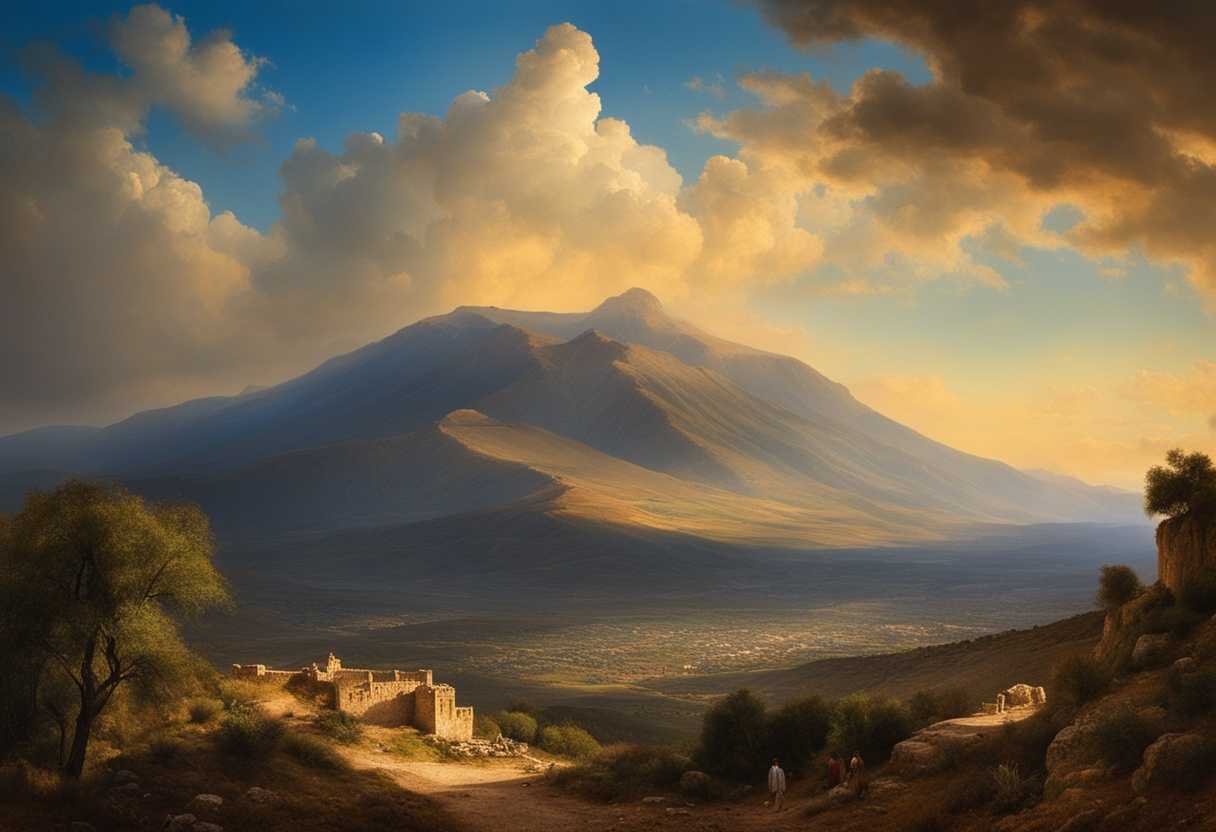
In the Bible, Gerizim refers to one of the mountains near Shechem in Samaria. It is significant as the site where blessings were proclaimed during the Israelites’ entrance into the Promised Land, as detailed in Deuteronomy 11:29 and Joshua 8:33.
Scripture
29 And when the Lord your God brings you into the land that you are entering to take possession of it, you shall set the blessing on Mount Gerizim and the curse on Mount Ebal.
30 Are they not beyond the Jordan, west of the road, toward the going down of the sun, in the land of the Canaanites who live in the Arabah, opposite Gilgal, beside the oak of Moreh?
31 For you are to cross over the Jordan to go in to take possession of the land that the Lord your God is giving you. And when you possess it and live in it,
32 And you shall be careful to do all the statutes and the rules that I am setting before you today.
Meaning of Gerizim in the Bible
The mountain of Gerizim holds a profound significance in the biblical narrative, primarily as the locus of blessings for the Israelites upon their entrance into the Promised Land. According to Deuteronomy 11:29, Moses instructs the people to proclaim blessings from Mount Gerizim and curses from Mount Ebal as they pass through the valley between these two mountains. This dual proclamation not only emphasizes the consequences of obedience versus disobedience to God’s covenant but also establishes Gerizim as a symbol of divine favor and the goodness of living in accordance with God’s laws. In Joshua 8:33, this ritual of blessing and curse is reiterated, signifying the importance of communal acknowledgment of God’s commandments and the blessings that come from fidelity to them.
Moreover, Mount Gerizim is intricately linked to the identity of the Samaritans, who regard it as a sacred site, believing it to be the true location for the worship of Yahweh. This belief is rooted in texts such as John 4:20-21, where the Samaritan woman at the well speaks of Gerizim in contrast to Jerusalem. The divergence in worship practices highlights a broader theological tension between the Jewish and Samaritan communities, underscoring themes of inclusion, purity, and authentic worship within the biblical narrative. Thus, beyond its geographical significance, Gerizim encapsulates themes of covenant loyalty, societal identity, and the ongoing relationship between humanity and the divine, marking it as a pivotal element in understanding the overarching message of the Scriptures.
Further exploration of Mount Gerizim reveals its role in the historical and religious context of the ancient Israelites. Beyond being a site for blessings, Gerizim served as a geographical anchor for the northern tribes of Israel. Its association with the Samaritan community showcases the mountain as a focal point of worship and identity, contrasting with the southern tradition centered on Jerusalem. The Samaritans, who affirmed the Torah’s authority, viewed Mount Gerizim as an essential part of their religious heritage, claiming it to be the location chosen by God for His worship. This perspective depicted Gerizim not merely as a topographical feature but as a narrative battleground for theological discourses, emphasizing the tensions and disputes in ancient Israelite society around worship and divine authorization.
Additionally, the mountain appears in the prophetic literature, where it represents both a reminder of Israel’s past failures and a symbol of hope for restoring true worship. The presence of Gerizim in the context of prophetic visions suggests an eschatological future where the place becomes significant again, hinting at the unity of worship among all nations. This vision points toward a time of reconciliation and return to the core values encapsulated by the covenant, inevitably bringing to the forefront the ideals of justice, mercy, and fidelity to God, which are central to the prophetic traditions. Thus, Mount Gerizim transcends its physical attributes to embody spiritual aspirations and a longing for communal harmony, reinforcing its thematic relevance throughout the biblical text.
Symbol of Blessing and Obedience
Mount Gerizim is often associated with the blessings that come from obedience to God’s commandments. In the biblical narrative, it serves as a physical representation of the rewards that follow a faithful life. The mountain stands in contrast to Mount Ebal, which symbolizes curses and disobedience. This duality highlights the importance of choice in the life of believers, emphasizing that following God’s will leads to spiritual and communal blessings.
Cultural and Religious Significance
Gerizim holds significant cultural and religious importance, particularly for the Samaritans, who regard it as a sacred site. The mountain is seen as the true location of worship, contrasting with the Jerusalem temple. This belief underscores the theme of identity and belonging within the biblical narrative, illustrating how different groups interpret divine instruction and sacred spaces. The reverence for Gerizim reflects broader themes of faith, community, and the quest for a rightful relationship with God.
A Place of Divine Encounter
Mount Gerizim is also viewed as a place where divine encounters occur. It serves as a backdrop for significant moments in the biblical story, where individuals and communities seek God’s presence and guidance. This aspect of Gerizim emphasizes the idea that certain locations can become sacred through the experiences of faith and revelation. It invites believers to consider how their own encounters with the divine shape their understanding of God and their spiritual journey.
How to Embrace Blessings and Overcome Curses as a Christian
Embracing blessings and overcoming curses as a Christian is a journey that requires both faith and intentionality. Start by cultivating a heart of gratitude; regularly reflecting on the blessings in your life—big and small—can shift your perspective and help you recognize God’s hand at work. Scripture reminds us in James 1:17 that every good and perfect gift comes from above, so take time to acknowledge these gifts in prayer. When faced with challenges or perceived curses, lean into your faith community for support and encouragement, as we are called to bear one another’s burdens (Galatians 6:2). Additionally, immerse yourself in God’s Word, which equips you with the truth to counter negativity and doubt. Remember, you have the authority through Christ to break any chains that bind you (Luke 10:19), so speak life and blessings over your circumstances. Ultimately, trust in God’s sovereignty and goodness, knowing that He can turn any situation around for your good and His glory.
Bible References to Gerizim’s Meaning:
Deuteronomy 27:11-14: 11 That day Moses charged the people, saying,
12 “When you have crossed over the Jordan, these shall stand on Mount Gerizim to bless the people: Simeon, Levi, Judah, Issachar, Joseph, and Benjamin.
13 And these shall stand on Mount Ebal for the curse: Reuben, Gad, Asher, Zebulun, Dan, and Naphtali.
14 And the Levites shall declare to all the men of Israel in a loud voice:
Joshua 8:30-35: 30 At that time Joshua built an altar to the Lord, the God of Israel, on Mount Ebal,
31 just as Moses the servant of the Lord had commanded the people of Israel, as it is written in the Book of the Law of Moses, “an altar of uncut stones, upon which no man has wielded an iron tool.” And they offered on it burnt offerings to the Lord and sacrificed peace offerings.
32 And there in the presence of the people of Israel he wrote on the stones a copy of the law of Moses, which he had written.
33 And all Israel, sojourner as well as native born, with their elders and officers and their judges, stood on opposite sides of the ark before the Levitical priests who carried the ark of the covenant of the Lord, half of them in front of Mount Gerizim and half of them in front of Mount Ebal, just as Moses the servant of the Lord had commanded at the first, to bless the people of Israel.
34 And afterward he read all the words of the law, the blessing and the curse, according to all that is written in the Book of the Law.
35 There was not a word of all that Moses commanded that Joshua did not read before all the assembly of Israel, and the women, and the little ones, and the sojourners who lived among them.
Judges 9:6-7: 6 And all the leaders of Shechem came together, and all Beth-millo, and they went and made Abimelech king, by the oak of the pillar at Shechem.
7 Now when they told Jotham, he went and stood on top of Mount Gerizim and lifted his voice and cried out.
John 4:19-24: 19 The woman said to him, “Sir, I perceive that you are a prophet.
20 Our fathers worshiped on this mountain, but you say that in Jerusalem is the place where people ought to worship.”
21 Jesus said to her, “Woman, believe me, the hour is coming when neither on this mountain nor in Jerusalem will you worship the Father.”
22 You worship what you do not know; we worship what we know, for salvation is from the Jews.
23 But the hour is coming, and is now here, when the true worshipers will worship the Father in spirit and truth, for the Father is seeking such people to worship him.
24 God is spirit, and those who worship him must worship in spirit and truth.

Rev. François Dupont is a dedicated church minister with a wealth of experience in serving spiritual communities. With a calm and serene demeanor, he has been devoted to sharing the message of love, compassion, and tolerance for over two decades. Through his thoughtful sermons, compassionate counseling, and unwavering support, Rev. Dupont has touched the lives of countless individuals, allowing them to find solace and strength during difficult times. His serene presence and deep understanding of the human condition make him a trusted guide for those seeking spiritual nourishment and guidance.